
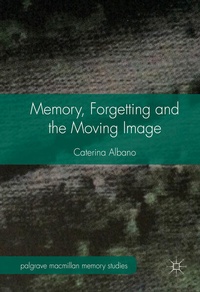
Memory, Forgetting and the Moving Image
Description
Alles über E-Books | Antworten auf Fragen rund um E-Books, Kopierschutz und Dateiformate finden Sie in unserem Info- & Hilfebereich.
Reviews / Votes
"In Memory, Forgetting and the Moving Image, Caterina Albano achieves a brilliant synthesis of memory theory, from Benjamin and Bergson to Deleuze and Derrida. She breaks new ground in theorizing how the technologies of cinema and sound recording, as well as their combination in installation art, have allowed for innovations-both scientific and aesthetic-in the understanding of memory processes and representations. She argues persuasively for an appreciation of the performative role of memory, and offers original insights into the role of forgetting and traumatic amnesia in the shaping of personal and social identities in the emergent culture(s) of globalization. This is an invaluable contribution to memory studies." (Inez Hedges, Professor of Languages, Literatures and Cultures at Northeastern University and author of World Cinema and Cultural Memory)
More details
Other editions
Additional editions


Person
Content
System requirements
File format: PDF
Copy protection: Watermark-DRM (Digital Rights Management)
System requirements:
- Computer (Windows; MacOS X; Linux): Use the free software Adobe Reader, Adobe Digital Editions, or any other PDF viewer of your choice (see eBook Help).
- Tablet/Smartphone (Android; iOS): Install the free app Adobe Digital Editions or another reading app for eBooks, e.g., PocketBook (see eBook Help).
- E-reader: Bookeen, Kobo, Pocketbook, Sony, Tolino and many more (only limited: Kindle).
The file format PDF always displays a book page identically on any hardware. This makes PDF suitable for complex layouts such as those used in textbooks and reference books (images, tables, columns, footnotes). Unfortunately, on the small screens of e-readers or smartphones, PDFs are rather annoying, requiring too much scrolling.
This eBook uses Watermark-DRM, a „soft” copy protection. This means that there are no technical restrictions to prevent illegal distribution. However, there is a personalised watermark embedded in the eBook that can be used to identify the purchaser of the eBook in the event of misuse and to provide evidence for legal purposes.
For more information, see our eBook Help page.