

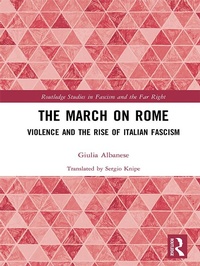
The March on Rome
Violence and the Rise of Italian Fascism
1st Edition
Published on 27. March 2019
210 pages
978-1-351-63075-7 (ISBN)
Description

The aim of this book is to reconstruct the violent nature of the March on Rome and to emphasise its significance in demarcating a real break in the country's history and the beginning of the Fascist dictatorship. This aspect of the March has long been obscured: first by the Fascists' celebratory project, and then by the ironic and reductive interpretation of the event put forward by anti-Fascists.
This volume focuses on the role and purpose of Fascist political violence from its origins. In doing so, it highlights the conflictual nature of the March by illustrating the violent impact it had on Italian institutions as well as the importance of a debate on this political turning point in Italy and beyond. The volume also examines how the event crucially contributed to the construction of a dictatorial political regime in Italy in the weeks following Mussolini's appointment as head of the government.
Originally published in Italian, this book fills a notable gap in current critical discussion surrounding the March in the English language.
This volume focuses on the role and purpose of Fascist political violence from its origins. In doing so, it highlights the conflictual nature of the March by illustrating the violent impact it had on Italian institutions as well as the importance of a debate on this political turning point in Italy and beyond. The volume also examines how the event crucially contributed to the construction of a dictatorial political regime in Italy in the weeks following Mussolini's appointment as head of the government.
Originally published in Italian, this book fills a notable gap in current critical discussion surrounding the March in the English language.
Reviews / Votes
"It is all very well guffawing when Donald Trump is portrayed as Il Douche.But the actual Duce, Benito Mussolini, was the first modern European dictator, the first fascist and the first totalitarian. His career is worth examining at least as seriously as that of his junior and sometime admirer, Adolf Hitler. How excellent, then, that we now have a solid translation of Giulia Albanese's detailed study of Mussolini's accession to power in the so-called March on Rome, part paramilitary coup and part politicians' backstairs deal. What Albanese starkly underlines is how violent Fascists were from start to finish and therefore how likely it was that, once in office, Mussolini would establish a tyranny for a generation."
- R.J.B. Bosworth, Jesus College, Oxford.
"In this timely and important book, Giulia Albanese forces us to rethink the basis of Fascist rule. Mussolini was far from being simply a showman or a wily operator. The March on Rome demonstrates powerfully that Mussolini's regime was a dictatorship, with violence at its core, from the very beginning."
- Roberta Pergher, Indiana University.
More details
Series
Edition
1. Auflage
Language
English
Place of publication
London
United Kingdom
Publishing group
Taylor & Francis Ltd
Target group
College/higher education
File size
6,22 MB
ISBN-13
978-1-351-63075-7 (9781351630757)
Copyright in bibliographic data and cover images is held by Nielsen Book Services Limited or by the publishers or by their respective licensors: all rights reserved.
Schweitzer Classification
Other editions
Additional editions
Book
09/2020
1st Edition
Routledge
€56.94
Shipment within 15-20 days
Book
02/2019
1st Edition
Routledge
€207.40
Shipment within 10-20 days
Person
Giulia Albanese is Associate Professor at the University of Padua. Her research focuses on the origins of Fascism, political violence and authoritarian cultures in the interwar years. Her previous books include Dittature mediterranee. Sovversioni fasciste e colpi di stato in Italia, Spagna, Portogallo (2016). With Roberta Pergher, she edited In the Society of Fascists: Acclamation, Acquiescence and Agency in Mussolini's Italy (2012).
Content
Acknowledgements
Preface
Abbreviations
1. The Coup d'Etat Policy
Seditious plans
The Fiume exploit
From Fiume to Rome?
2. Political violence
The struggle for the local hegemony
The anniversary policy
Strategies for violence and seizing power
The general strike and its aftermath
3. Towards the March
Talk of a coup
Organising the March
Defending the State
4. The March on Rome
"It's pouring": the Fascist mobilisation
The revoking of the state of siege
The fascists in Bologna
The appointing of Mussolini
Demobilisation
5. The March after the March
Paper battles
A 'typically Italian revolution': Diplomacy and the March on Rome
The 'bivouac speech' and the parliamentary debate
Army reports
The first official representation
6. A Year of Fascist Domination
Violence and public order
The transformation of the State
Time to draw a balance
Conclusion
Index
Preface
Abbreviations
1. The Coup d'Etat Policy
Seditious plans
The Fiume exploit
From Fiume to Rome?
2. Political violence
The struggle for the local hegemony
The anniversary policy
Strategies for violence and seizing power
The general strike and its aftermath
3. Towards the March
Talk of a coup
Organising the March
Defending the State
4. The March on Rome
"It's pouring": the Fascist mobilisation
The revoking of the state of siege
The fascists in Bologna
The appointing of Mussolini
Demobilisation
5. The March after the March
Paper battles
A 'typically Italian revolution': Diplomacy and the March on Rome
The 'bivouac speech' and the parliamentary debate
Army reports
The first official representation
6. A Year of Fascist Domination
Violence and public order
The transformation of the State
Time to draw a balance
Conclusion
Index
