

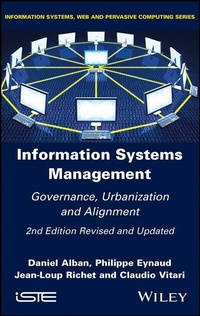
Information Systems Management
Description

This book combines and analyzes three key concepts in IS science: governance, urbanization and alignment. While governance implies the implementation of a certain number of means, bodies and procedures to manage IS more effectively, urbanization involves visualization methods to enable the manager to take into account the different levels of the organization of an IS and their coherence. Finally, alignment assesses the ability of the IS to make a significant contribution to the organization's strategy
More details
Other editions
Additional editions
Persons
Daniel Alban is former Senior Lecturer in Management Sciences and Information Systems at Paris Descartes University (2005-2017), France.
Philippe Eynaud is Professor of Management Sciences at Sorbonne Business School, University of Paris 1 Panthéon-Sorbonne, France.
Jean-Loup Richet is Associate Professor in Information Systems at the IAE Paris-Sorbonne, University of Paris 1 Panthéon-Sorbonne, France.
Claudio Vitari is Professor of Management Sciences at Aix-Marseille University, France.
Content
Foreword to the 2nd Edition xi
Serge AMABILE and Régis MEISSONIER
Foreword to the 1st Edition xv
Laurent BIBARD
Introduction xix
Part 1 Governing the Stakeholders 1
Introduction to Part 1 3
Chapter 1 IS Stakeholders 5
1.1 The technological environment of IS stakeholders, and its development 6
1.2 Impact of the developing technologies on organizational management 8
1.3 Understanding and categorizing the human stakeholders in IS 11
Chapter 2 From Global Governance to IS Governance 21
2.1 From organizational governance to IS governance 22
2.2 Defining IS governance 25
2.3 IS governance in an outsourcing strategy 28
2.4 IS governance in a resource pooling strategy 32
2.5 IS governance in a co-management strategy with stakeholders 37
2.6 Open innovation-type software 42
2.7 Exercise: PingPongApp 42
Chapter 3 IS Governance in Practice 45
3.1 IS governance organizational models 46
3.2 IS governance benchmarks 50
3.3 Implement a best practice benchmark 57
3.4 Exercise: GreenNRJ 59
Part 2 Urbanizing the Territories 63
Introduction to Part 2 65
Chapter 4 The IS Territory 67
4.1 The territory 67
4.2 Organizational and microeconomic territory 69
4.3 Organizational territory and mesoeconomics 77
4.4 The IS territory 80
4.5 The IS territory and the organization's territory 83
4.6 The IS territory and process systems engineering 87
4.7 Alignment between the firm's territory and the IS territory 91
4.8 Representing the IS territory 96
4.9 Unified modeling language (UML) 98
4.10 Exercise: Linky and Enedis' IS territory 103
Chapter 5 Territorial Urbanization 107
5.1 Urbanization 107
5.2 Urbanization of ISs 110
5.3 Urbanization: approaches and objectives 112
5.4 The planner's job 118
5.5 The limits 119
5.6 IS urbanization and the ecological transition 120
5.7 Exercise: urbanization of France's government IS 122
Chapter 6 Urbanizing the Inter-organizational IS 125
6.1 Inter-organizational territory 125
6.2 Inter-organizational territory of the IS 131
6.3 Alignment and representation of the inter-organizational IS territory 139
6.4 Urbanization of an inter-organizational IS 139
6.5 Exercise: AGK 149
Part 3 Project Alignment 153
Introduction to Part 3 155
Chapter 7 IS Project Management 157
7.1 Strategy of IS projects 157
7.2 Roll-out of a traditional IS project 160
7.3 Agile IS projects: a development methodology, a process and a philosophy 163
7.4 DevOps: making the link between IS developments and IS department procedures 168
7.5 Security in IS projects 170
7.6 Exercise: cybersecurity in projects, managing tomorrow's threats 174
Chapter 8 Technology, Alignment and Strategic Transformation 177
8.1 The alignment of stakeholders, territories and projects 178
8.2 Strategic alignment 179
8.3 Competition, technological revolutions and new strategies 181
8.4 Strategic transformation linked to ISs and new technologies 185
8.5 Towards a dynamic perspective of strategic transformation linked to the IS 188
8.6 Exercise: TechOne: Big Data and the Cloud 189
Chapter 9 Auditing ISs 191
9.1 What is an audit? 191
9.2 The IS and auditing 195
9.3 The audit process 198
9.4 Scope of the audit 201
9.5 Audit repositories 203
9.6 Towards an approach via the risks of strategic alignment? 204
9.7 Conclusion 206
9.8 Exercise: an auditor's view 206
Conclusion 209
Glossary 219
References 227
Index 237
Introduction
The purpose of this work is to raise awareness among managers in organizations (businesses, administrative bodies, associations and groups of individuals within a collaborative economy) about the issues raised by information systems (ISs). This book does not set out to try to cover all of the questions raised by ISs, or to offer an exhaustive list of ready-made answers. The authors' intention is rather to provide a framework for analysis and the keys to a coherent understanding, in order to help IS stakeholders deal with questions that are rich in diversity and constantly evolving. Information and Communication Technologies (ICTs) are by nature difficult to pin down. They are paradoxical in nature. On the one hand, they are forward-looking, and indispensable in that they pave the way for innovations full of potential (Big Data, artificial intelligence and connected objects). On the other hand, they are vectors of major vulnerabilities (cybersecurity, loss of privacy), and it is still difficult today to gauge their scope and consequences. This is why the study of ISs is both necessary and fascinating.
Beyond the purely operational issues [ALB 09], we can clearly see that IS management deals with ethical questions and the complexity of the world. To the extent that they structure the processes of business departments and increasingly condition the relationships between the stakeholders in a value chain, decisions taken about ISs have a strategic impact. To the extent that they are no longer confined to the world of work, but increasingly offer a continuum to personal spaces, decisions about ISs also have an impact on everyone. This book is pedagogical in nature, aiming to make a contribution towards ensuring that issues relating to ISs are not left exclusively to the experts in this field.
To approach the topic of IS management, we propose to jointly associate and consider three key concepts of IS science: governance, urbanization and alignment.
IS governance entails the implementation of a certain number of resources, bodies and procedures in order to better manage the IS. Governance aims to handle questions such as: how should decision-making for IS stakeholders be structured? How can value creation be measured? How can stakeholders be involved in value creation? How can all information resources be integrated into a single approach? Lastly, how can internal and external challenges be coordinated?
IS urbanization uses visualization methods to help the manager take stock of the different organization levels of an IS and their coherence. Urbanization detects the constraints, opportunities and contradictions that are acting upon the information architecture and can provide the decision-makers with tools to help them envision the continuous development of the IS construction process. Urbanization thus answers the following questions: how can information flows be organized? How can their fluidity be improved? Lastly, how can they be adapted to current and future changes?
IS alignment evaluates the IS's capacity to make a significant contribution to the organization's strategy. In a context of rapid technological change and highly competitive markets, alignment enables responsiveness and aims for proactivity. It is a vector for creativity and promotes the emergence of comparative advantage. As it requires a concrete response and rejects intangible, standardized answers, strategic alignment recognizes the diversity of organizations and issues to be taken into account: how can we make the IS responsive to strategic agility? Also, how can we facilitate the adaptation of tools and humans in the face of changing objectives?
From a pedagogical perspective, the book sets out to make the link between the theory of ISs and the theory of organizations. Thus, we link the three specific IS concepts mentioned above (IS governance, IS urbanization and IS alignment) with three other, more generic, keys: stakeholder, territory and project.
The stakeholder is the crucial element that makes it possible to envision governance, because they are the source of value creation. However, the human stakeholder engages in collective action via socio-technical interfaces and systems. The interweaving in ISs is so strong that it is sometimes difficult to differentiate, within the organized activity, what is human in scope and what stems from computer applications. It is thus possible - as the sociology of innovation proposes [LAT 07] - to think of technical artifacts and ISs in particular as agents.
The territory is the operative field embraced by a self-regulating IS. Territory is a key concept of the urbanization process and is characterized by a multiplicity of levels: geographic, functional, represented, etc. This means that thought must be given to maintaining coherence between the various territorial levels of the IS, in the face of the disruptive influence of the context.
The project is an important element in the IS strategy. Management of the project portfolios allows an implementation of strategic alignment. Once the management direction has been set, the projects will define the path towards the target IS. These projects feed into each step of the IS upgrade: acquisition, processing, storage and distribution of information.
Using these three concepts, we propose to define the IS as: "A set of actors (human and/or non-human) that are interdependent, interacting via socio-material systems on a plurality of territories in the framework of an information management project (acquisition, processing, storage, distribution)."
The great challenge of our three-dimensional proposal (stakeholders, territories and projects) is how this can be turned into a system. To do so, we must, behind this didactic breakdown, open an analysis of the overlaps, intersections and cross-influences. In doing this, the danger is then that the manager will feel overwhelmed by the challenges. Taking these three perspectives into account simultaneously can indeed seem tricky, if not impossible. How should it be addressed? What methodology should be used? Is it reasonable to try to bring these three aspects together in sync? To meet these challenges, we propose the adoption of an operational approach based on complexity thinking [LEM 90; MOR 90].
For the sake of clarity, this book introduces each of the three aspects in turn before seeking to combine them in the final part. The book thus has a four-part construction:
- Part 1: Governing the Stakeholders. We offer strategic managers our insights on how their profession has developed by sketching the portrait of the stakeholders involved. Nowadays, these stakeholders are in great demand to drive change in organizational, decision-making and regulatory mechanisms. It is especially important to take stock of these issues in order for them to be given priority status on organizations' strategic agenda. We show that the issue of governance makes reference to assessments in terms of transaction costs, cost-sharing and hidden costs.
- Part 2: Urbanizing the Territories. Beyond the urban metaphor, in this part, we consider the modalities of conducting a breakdown of the IS and the vision induced by the IS planner. The issue of the territory is a complex concept. Territory is often referred to in terms of its macroeconomic aspects. Our proposal is to open up a consideration of IS management at the meso level, which seems to be the appropriate observational level of the extended organizational framework.
- Part 3: Project Alignment. In this part, we approach the issue of aligning the IS project to the general strategy of the organization. In a competitive environment, there are many changes in strategy and organizations are obliged to adapt to technological developments that quickly render the solutions that have already been implemented obsolete. The management of IT project portfolios enables strategic agility and innovation.
- Conclusion: Management of Information Systems in its Complexity. To conclude, we focus on the areas of confluence between the three aspects identified for an analysis of IS management. We show how the coming together of stakeholders and territories raises the need to take into account increased stakeholder mobility in an organizational context, where the organizational boundaries are pushed back significantly, or even broken down. We analyze the coming together of territories and projects and the development of the agility made necessary by new customer expectations. We also look at the assembling of stakeholders and projects around the quest for organizational maturity widely supported by the development of norms and international standards for IS management. At the intersection of the issues of governance, urbanization and IS alignment, there lies complexity management. The use of this term is not an indication of a problem, but rather a solution. In line with the etymological origin of the word (complexus: something that is woven together), it entails focusing on the complementarities and continuations between the various points of view.
Finally, this book is a follow-up to a book published in French by Hermès-Lavoisier in 2009: Le Management opérationnel du système d'information (operational management of the IS). Its purpose is to address a wide audience: students (business schools and their masters of science in business and masters of business administration) and professionals working in IS management.
The target of the book is to describe...
