

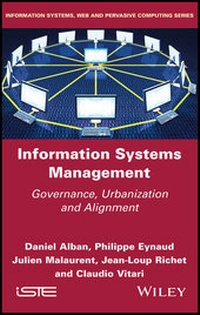
Information Systems Management
Governance, Urbanization and Alignment
1st Edition
Published on 9. April 2019
288 pages
978-1-119-60811-0 (ISBN)
Description

Information Systems Management is intended to sensitize the heads of organizations to the issues raised by information systems (IS). Through its pedagogical presentation, the book ensures that issues related to IS are not left solely to the experts in the field.
The book combines and analyzes three key concepts of IS: governance, urbanization and alignment. While governance requires the implementation of a number of means, bodies and procedures to manage IS more effectively, urbanization involves visualization methods to enable the manager to take into account the different levels of the organization of an IS and their coherence. Finally, alignment assesses the ability of the IS to make a significant contribution to the organization's strategy.
More details
Other editions
New editions
Daniel Alban | Philippe Eynaud | Jean-Loup Richet
Information Systems Management
Governance, Urbanization and Alignment
E-Book
05/2024
2nd Edition
Wiley
€130.99
Available for download
Additional editions
Philippe Eynaud | Daniel Alban | Julien Malaurent
Information Systems Management
Governance, Urbanization and Alignment
Book
04/2019
1st Edition
Wiley-ISTE
€206.42
Shipment within 15-20 days
Content
- Cover
- Half-Title Page
- Title Page
- Copyright Page
- Contents
- Foreword
- Introduction
- PART 1. Governing the Stakeholders
- Introduction to Part 1
- 1. Information Systems Stakeholders
- 1.1. The technological environment of IS stakeholders, and its development
- 1.2. Impact of the developing technologies on organizational management
- 1.3. Understanding and categorizing the human stakeholders in IS
- 1.3.1. The days of the pioneers
- 1.3.2. The birth of the information systems manager, a change in status
- 1.3.3. Organizing functions around IS governance
- 1.3.4. Extending IS from internal stakeholders to external stakeholders
- 2. From Global Governance to IS Governance
- 2.1. From organizational governance to IS governance
- 2.1.1. COSO standards
- 2.1.2. The Sarbanes-Oxley Act
- 2.2. Defining IS governance
- 2.3. IS governance in an outsourcing strategy
- 2.3.1. The scope of outsourcing and the stakeholders involved
- 2.3.2. A dual strategy
- 2.3.3. Transactional governance
- 2.4. IS governance in a resource pooling strategy
- 2.4.1. Hybrid forms between hierarchy and market
- 2.4.2. Self-organized forms
- 2.5. IS governance in a co-management strategy with stakeholders
- 2.5.1. The forgotten stakeholders
- 2.5.2. Recognizing stakeholder contributions
- 2.5.3. A multifaceted approach with a strong HR emphasis
- 2.6. Open innovation type software
- 2.7. Exercise: Bacchus
- 3. IS Governance in Practice
- 3.1. IS governance organizational models
- 3.1.1. Centralized governance
- 3.1.2. Decentralized governance
- 3.1.3. Federal governance
- 3.1.4. Internal software and computing services-type governance
- 3.2. IS governance benchmarks
- 3.2.1. Control Objectives for Information and related Technology (COBIT)
- 3.2.2. Enterprise Value, Governance of IT Investments (ValIT)
- 3.2.3. IT Framework for Management of IT-Related Business Risks (RiskIT)
- 3.2.4. Global Technology Audit Guide (GTAG)
- 3.2.5. Information Technology Infrastructure Library (ITIL)
- 3.2.6. International Organization for Standardization/International Electrotechnical
- 3.2.7. Specific benchmarks
- 3.3. Implement a best practice benchmark
- 3.4. Exercise: GreenNRJ
- PART 2. Urbanizing the Territories
- Introduction to Part 2
- 4. The Information Systems Territory
- 4.1. The territory
- 4.2. Organizational and microeconomic territory
- 4.2.1. The hierarchical-functional territory
- 4.2.2. Business process territory
- 4.2.3. Organizational structures
- 4.3. Organizational territory and mesoeconomics
- 4.4. The information systems territory
- 4.5. The information systems territory and the organization's territory
- 4.5.1. The information systems territory and the hierarchical pyramid
- 4.5.2. Information systems territory and functional silos
- 4.5.3. Information systems territory and the hierarchical-functional pyramid
- 4.6. Information systems territory and systems engineering
- 4.7. Alignment between the firm's territory and the information systems territory
- 4.8. Mapping the information systems territory
- 4.8.1. Process modeling
- 4.8.2. Function modeling
- 4.8.3. Modeling the software
- 4.8.4. Modeling the hardware
- 4.8.5. Modeling the informational content
- 4.8.6. Integrative modeling
- 4.9. Exercise: Linky and Enedis' information systems territory
- 5. Territorial Urbanization
- 5.1. Urbanization
- 5.2. Urbanization of information systems
- 5.3. Urbanization: approaches and objectives
- 5.3.1. Understanding the existing information system
- 5.3.2. Defining the target information system and the associated trajectory
- 5.3.3. Providing the tools to steer development
- 5.4. The planner's job
- 5.5. The limits
- 5.6. Exercise: the urbanization of France's government information systems
- 6. Urbanizing the Inter-organizational Information System
- 6.1. Inter-organizational territory
- 6.1.1. Inter-organizational territories and the value chain: the sectorial chain
- 6.1.2. Inter-organizational territories and the value chain: the ecosystem
- 6.2. Inter-organizational territory of the information system
- 6.2.1. The extended information system
- 6.2.2. The cooperative information system
- 6.3. Alignment and representation of the inter-organizational information systems territory
- 6.4. Urbanization of an inter-organizational information system
- 6.4.1. Cloud computing
- 6.4.2. Computing standards
- 6.4.3. Free software
- 6.4.4. Open data5
- 6.5. The job of the inter-organizational information systems planner
- 6.6. Exercise: AGK
- PART 3. Project Alignment
- Introduction to Part 3
- 7. Information Systems Project Management
- 7.1. Strategy of information systems projects
- 7.1.1. The strategic plan
- 7.1.2. Business department's strategy
- 7.1.3. Operational project governance
- 7.1.4. Budget management
- 7.1.5. Quality system
- 7.2. Roll-out of a traditional information systems project the project
- 7.2.1. Defining, researching and initializing the project
- 7.2.2. Developing and building the information systems solution
- 7.2.3. Management and roll-out of the IS solution
- 7.2.4. Project assessment
- 7.3. Agile information systems projects: a development methodology, a process and a philosophy
- 7.3.1. An empirical, iterative, incremental approach
- 7.3.2. Can all projects become agile?
- 7.4. DevOps: making the link between information systems developments and IS management committee procedures
- 7.5. Security in information systems projects
- 7.5.1. Risk parameter assessment
- 7.5.2. Risk analysis
- 7.5.3. Security in development
- 7.5.4. Security for putting into production and deployment: towards a permanent watch
- 7.6. Exercise: cybersecurity in projects, managing tomorrow's threats
- 8. Technology, Alignment and Strategic Transformation
- 8.1. The alignment of stakeholders, territories and projects
- 8.2. Strategic alignment
- 8.3. Competition, technological revolutions and new strategies
- 8.4. Strategic transformation linked to information systems and new technologies
- 8.5. Towards a dynamic perspective of strategic transformation linked to the information system
- 8.6. Exercise: TechOne: Big Data and the Cloud
- 9. Auditing Information Systems
- 9.1. What is an audit?
- 9.1.1. A need for measurement: alignment by audit
- 9.1.2. The place of the audit
- 9.2. Information systems and auditing
- 9.2.1. Information system internal audits
- 9.2.2. Information system external audits
- 9.3. The audit process
- 9.3.1. Structuring an information system audit project
- 9.4. Scope of the audit
- 9.4.1. Domains and processes audited
- 9.5. Audit repositories
- 9.6. Towards an approach via the risks of strategic alignment?
- 9.7. Conclusion
- 9.8. Exercise: an auditor's view
- Conclusion: Management of Information Systems in its Complexity
- C.1. What does "complexity" mean?
- C.2. Complexity and information systems management
- C.3. Action principles on information system
- Glossary
- References
- Index
- Other titles from iSTE in Information Systems, Web and Pervasive Computing
- EULA
