

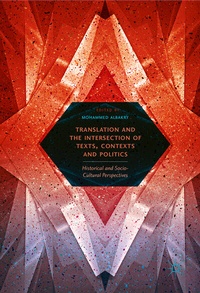
Translation and the Intersection of Texts, Contexts and Politics
Description

This book analyzes the impact of historical, political and sociocultural contexts on the reading, rewriting and translating of texts. The authors base their arguments on their experiences of translating or researching different text types, taking in fiction, short stories, memoirs, religious texts, scientific treatises, and news reports from a variety of different languages and cultural traditions. In doing so they cover a wide range of contexts and time periods, including Early Modern Europe, post-1848 Switzerland, nineteenth-century Portugal, Egypt in the early twentieth century under British colonial rule, Spain under Franco's dictatorship, and contemporary Peru and China. They also consider the theoretical and pedagogical implications of their conclusions for translation students and practitioners. This edited collection will be of great interest to scholars working in translation studies, applied linguistics, and on issues of cultural difference.
More details
Other editions
Additional editions
Person
Mohammed Albakry is Professor of English and Applied Linguistics and Affiliate Faculty in the Literacy Studies Ph.D. Program at Middle Tennessee State University, USA. He has authored numerous refereed articles and co-edited the drama anthology Tahir Tales: Plays from the Egyptian Revolution (2016). He is also a practicing translator and was awarded a 2014 National Endowment for the Arts Translation Fellowship.
Content
- Chapter 1. Interrogating Translation as a Doubly Political and Contextual Act (Mohammed Albakry).- Chapter 2. Montesquieu's Geometer & the Tyrannical Spirits of Translation (Joseph McAlhany).- Chapter 3. Mediating Science in Early Modern England and France (Lindsay Wilson).- Chapter 4. Translating the Forging and Forgery of Mid-nineteenth Century Swiss(-German)Identity in Gottfried Keller's People of Seldwyla (Hans Gabriel).- Chapter 5. No Blind Admirer of Byron: Imperialist Rivalries and Activist Translation in Júlio Dinis's Uma Família Inglesa (Suzanne Black).- Chapter 6. Between Huda Sha'rawi's Memoirs and Harem Years (Nada Ayad).- Chapter 7. Nothing but Sex from Beginning to End: Censorship in Translating Vladimir Nabokov's Novels in Spain during the Francoist Dictatorship (1939-1975) (Juan Ignacio Guijarro González).- Chapter 8. The Politics of Relay Translation and Language Hierarchies: The Case of Stanislaw Lem's Solaris (Justine Pas).- Chapter 9. Navigating Knots: Negotiating the "Original" and its Embedded Layers of Translations across Cultural Boundaries (Karen Rauch).- Chapter 10. Representing the Tibet Conflict in the Chinese Translation of Western News Reports (Li Pan).
