

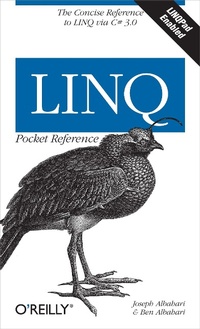
LINQ Pocket Reference
Learn and Implement LINQ for .NET Applications
Published on 26. February 2008
174 pages
978-1-4493-7041-1 (ISBN)
Description

Ready to take advantage of LINQ with C# 3.0? This guide has the detail you need to grasp Microsoft's new querying technology, and concise explanations to help you learn it quickly. And once you begin to apply LINQ, the book serves as an on-the-job reference when you need immediate reminders.All the examples in the LINQ Pocket Reference are preloaded into LINQPad, the highly praised utility that lets you work with LINQ interactively. Created by the authors and free to download, LINQPad will not only help you learn LINQ, it will have you thinking in LINQ.This reference explains:LINQ's key concepts, such as deferred execution, iterator chaining, and type inference in lambda expressionsThe differences between local and interpreted queriesC# 3.0's query syntax in detail-including multiple generators, joining, grouping, query continuations, and moreQuery syntax versus lambda syntax, and mixed syntax queries Composition and projection strategies for complex queriesAll of LINQ's 40-plus query operatorsHow to write efficient LINQ to SQL queriesHow to build expression trees from scratchAll of LINQ to XML's types and their advanced useLINQ promises to be the locus of a thriving ecosystem for many years to come. This small book gives you a huge head start."e;The authors built a tool (LINQPad) that lets you experiment with LINQ interactively in a way that the designers of LINQ themselves don't support, and the tool has all kinds of wonderful features that LINQ, SQL and Regular Expression programmers alike will want to use regularly long after they've read the book."e;-Chris Sells, Connected Systems Program Manager, Microsoft
More details
Other editions
Additional editions
Book
04/2008
1st Edition
O'Reilly
€19.50
Shipment within 10-20 days
Content
- Intro
- Contents
- LINQ Pocket Reference
- Getting Started
- Lambda Queries
- Chaining Query Operators
- Composing Lambda Expressions
- Lambda expressions and Func signatures
- Lambda expressions and element typing
- Natural Ordering
- Other Operators
- Comprehension Queries
- Iteration Variables
- Query Syntax Versus SQL Syntax
- Query Syntax Versus Lambda Syntax
- Mixed Syntax Queries
- Deferred Execution
- Reevaluation
- Outer Variables
- How Deferred Execution Works
- Chaining Decorators
- How Queries Are Executed
- Subqueries
- Subqueries and Deferred Execution
- Composition Strategies
- Progressive Query Building
- The into Keyword
- Scoping rules
- Wrapping Queries
- Projection Strategies
- Object Initializers
- Anonymous Types
- The let Keyword
- Interpreted Queries
- How Interpreted Queries Work
- Execution
- AsEnumerable
- LINQ to SQL
- LINQ to SQL Entity Classes
- DataContext
- Automatic Entity Generation
- Associations
- Deferred Execution with LINQ to SQL
- DataLoadOptions
- Specifying a filter in advance
- Eager loading
- Updates
- Building Query Expressions
- Delegates Versus Expression Trees
- Compiling expression trees
- AsQueryable
- Expression Trees
- The Expression DOM
- Query Operator Overview
- Filtering
- Where
- Comprehension syntax
- Overview
- Indexed filtering
- Where in LINQ to SQL
- Take and Skip
- TakeWhile and SkipWhile
- Distinct
- Projecting
- Select
- *Comprehension syntax
- Overview
- Indexed projection
- Select subqueries and object hierarchies
- Subqueries and joins in LINQ to SQL
- Projecting into concrete types
- SelectMany
- Comprehension syntax
- Overview
- Outer iteration variables
- Thinking in comprehension syntax
- Joining with SelectMany
- SelectMany in LINQ to SQL
- Outer joins with SelectMany
- Joining
- Join and GroupJoin
- Join arguments
- GroupJoin arguments
- Comprehension syntax
- Overview
- Join
- Joining on multiple keys
- Joining in lambda syntax
- GroupJoin
- Flat outer joins
- Joining with lookups
- Ordering
- OrderBy, OrderByDescending, ThenBy, ThenByDescending
- OrderBy, OrderByDescending arguments
- ThenBy, ThenByDescending arguments
- Comprehension syntax
- Overview
- Comparers and collations
- IOrderedEnumerable and IOrderedQueryable
- Grouping
- GroupBy
- Comprehension syntax
- Overview
- GroupBy in LINQ to SQL
- Grouping by multiple keys
- Custom equality comparers
- Set Operators
- Concat and Union
- Intersect and Except
- Conversion Methods
- OfType and Cast
- ToArray, ToList, ToDictionary, ToLookup
- AsEnumerable and AsQueryable
- Element Operators
- First, Last, Single
- ElementAt
- DefaultIfEmpty
- Aggregation Methods
- Count and LongCount
- Min and Max
- Sum and Average
- Aggregate
- Quantifiers
- Contains and Any
- All and SequenceEqual
- Generation Methods
- Empty
- Range and Repeat
- LINQ to XML
- Architectural Overview
- X-DOM Overview
- Loading and Parsing
- Saving and Serializing
- Instantiating an X-DOM
- Functional Construction
- Specifying Content
- Automatic Deep Cloning
- Navigating/Querying an X-DOM
- Child Node Navigation
- FirstNode, LastNode, and Nodes
- Retrieving elements
- Retrieving a single element
- Recursive functions
- Parent Navigation
- Peer Node Navigation
- Attribute Navigation
- Updating an X-DOM
- Simple Value Updates
- Updating Child Nodes and Attributes
- Updating Through the Parent
- Removing a sequence of nodes or attributes
- Working with Values
- Setting Values
- Getting Values
- Values and Mixed Content Nodes
- Automatic XText Concatenation
- Documents and Declarations
- XDocument
- XML Declarations
- Names and Namespaces
- Specifying Namespaces in the X-DOM
- The X-DOM and Default Namespaces
- Prefixes
- Projecting into an X-DOM
- Eliminating Empty Elements
- Streaming a Projection
- Transforming an X-DOM
- Index
