

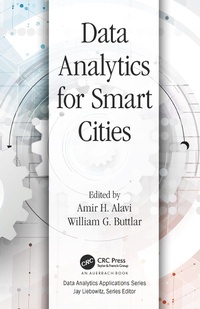
Data Analytics for Smart Cities
1st Edition
Published on 26. October 2018
254 pages
978-0-429-78663-1 (ISBN)
Description

The development of smart cities is one of the most important challenges over the next few decades. Governments and companies are leveraging billions of dollars in public and private funds for smart cities. Next generation smart cities are heavily dependent on distributed smart sensing systems and devices to monitor the urban infrastructure. The smart sensor networks serve as autonomous intelligent nodes to measure a variety of physical or environmental parameters. They should react in time, establish automated control, and collect information for intelligent decision-making. In this context, one of the major tasks is to develop advanced frameworks for the interpretation of the huge amount of information provided by the emerging testing and monitoring systems.
Data Analytics for Smart Cities brings together some of the most exciting new developments in the area of integrating advanced data analytics systems into smart cities along with complementary technological paradigms such as cloud computing and Internet of Things (IoT). The book serves as a reference for researchers and engineers in domains of advanced computation, optimization, and data mining for smart civil infrastructure condition assessment, dynamic visualization, intelligent transportation systems (ITS), cyber-physical systems, and smart construction technologies. The chapters are presented in a hands-on manner to facilitate researchers in tackling applications.
Arguably, data analytics technologies play a key role in tackling the challenge of creating smart cities. Data analytics applications involve collecting, integrating, and preparing time- and space-dependent data produced by sensors, complex engineered systems, and physical assets, followed by developing and testing analytical models to verify the accuracy of results. This book covers this multidisciplinary field and examines multiple paradigms such as machine learning, pattern recognition, statistics, intelligent databases, knowledge acquisition, data visualization, high performance computing, and expert systems. The book explores new territory by discussing the cutting-edge concept of Big Data analytics for interpreting massive amounts of data in smart city applications.
Data Analytics for Smart Cities brings together some of the most exciting new developments in the area of integrating advanced data analytics systems into smart cities along with complementary technological paradigms such as cloud computing and Internet of Things (IoT). The book serves as a reference for researchers and engineers in domains of advanced computation, optimization, and data mining for smart civil infrastructure condition assessment, dynamic visualization, intelligent transportation systems (ITS), cyber-physical systems, and smart construction technologies. The chapters are presented in a hands-on manner to facilitate researchers in tackling applications.
Arguably, data analytics technologies play a key role in tackling the challenge of creating smart cities. Data analytics applications involve collecting, integrating, and preparing time- and space-dependent data produced by sensors, complex engineered systems, and physical assets, followed by developing and testing analytical models to verify the accuracy of results. This book covers this multidisciplinary field and examines multiple paradigms such as machine learning, pattern recognition, statistics, intelligent databases, knowledge acquisition, data visualization, high performance computing, and expert systems. The book explores new territory by discussing the cutting-edge concept of Big Data analytics for interpreting massive amounts of data in smart city applications.
More details
Series
Edition
1. Auflage
Language
English
Place of publication
London
United Kingdom
Publishing group
Taylor & Francis Ltd
Target group
College/higher education
Illustrations
36 Tables, black and white; 93 Illustrations, black and white
File size
43,10 MB
ISBN-13
978-0-429-78663-1 (9780429786631)
Copyright in bibliographic data and cover images is held by Nielsen Book Services Limited or by the publishers or by their respective licensors: all rights reserved.
Schweitzer Classification
Other editions
Additional editions
Amir Alavi | William G. Buttlar
Data Analytics for Smart Cities
Book
01/2023
1st Edition
Auerbach
€75.70
Shipment within 10-20 days
Amir Alavi | William G. Buttlar
Data Analytics for Smart Cities
Book
10/2018
1st Edition
CRC Press
€170.84
Shipment within 10-20 days
Persons
Dr. Amir H. Alavi is an Assistant Professor with a joint appointment in the Civil and Environmental Engineering Department at the University of Missouri-Columbia and the University of Missouri Extension Business Development Program, and holds a courtesy appointment in the Department of Bioengineering. His multidisciplinary research integrates sensing, computation, control, networking, and information systems into the civil infrastructure to create cyber-physical infrastructure systems. Dr. Alavi's research interests include smart cities, structural health monitoring, deployment of advanced sensors, energy harvesting, and civil engineering system informatics. He has worked on research projects supported by Federal Highway Administration (FHWA), National Science Foundation (NSF), Missouri DOT, and Michigan DOT. Dr. Alavi has authored 5 books and over 170 publications in archival journals, book chapters, and conference proceedings. He has received a number of award certificates for his journal articles. Recently, he has been selected among the Google Scholar 300 Most Cited Authors in Civil Engineering, as well as Web of Science ESI's World Top 1% Scientific Minds. He has served as the editor/guest editor of several journals such as Case Studies in Construction Material, Automation in Construction, Geoscience Frontiers, ASCE-ASME Journal of Risk and Uncertainty in Engineering Systems, and Advances in Mechanical Engineering. Dr. Alavi received his PhD degree in Civil Engineering from Michigan State University (MSU). He also holds a MSc and BSc in Civil Engineering from Iran University of Science & Technology.
Dr. William G. Buttlar is the Glen Barton Chair in Flexible Pavements at the University of Missouri (MU). He has over 100 peer-reviewed journal articles and nearly 300 total publications in the areas of pavements, materials, and smart infrastructure. Prior to joining the faculty at MU in 2016, he was a faculty member at the University of Illinois at Urbana-Champaign (UIUC) for 20 years, with 5 years of administrative experience serving as the Associate Dean of the UIUC Graduate College for Science and Engineering Programs, and Associate Dean of Graduate Programs for the College of Engineering. He was also the lead faculty member behind the establishment of City Digital at UILabs in Chicago.
Dr. William G. Buttlar is the Glen Barton Chair in Flexible Pavements at the University of Missouri (MU). He has over 100 peer-reviewed journal articles and nearly 300 total publications in the areas of pavements, materials, and smart infrastructure. Prior to joining the faculty at MU in 2016, he was a faculty member at the University of Illinois at Urbana-Champaign (UIUC) for 20 years, with 5 years of administrative experience serving as the Associate Dean of the UIUC Graduate College for Science and Engineering Programs, and Associate Dean of Graduate Programs for the College of Engineering. He was also the lead faculty member behind the establishment of City Digital at UILabs in Chicago.
Content
Preface
Editors
Contributors
1 Smartphone Technology Integrated with Machine Learning for Airport Pavement Condition Assessment
Amir H. Alavi and William G. Buttlar
2 Global Satellite Observations for Smart Cities
Zhong Liu, Menglin S. Jin, Jacqueline Liu, Angela Li, William Teng, Bruce Vollmer, and David Meyer
3 Advancing Smart and Resilient Cities with Big Spatial Disaster Data: Challenges, Progress, and Opportunities
Xuan Hu and Jie Gong
4 Smart City Portrayal: Dynamic Visualization Applied to the Analysis of Underground Metro
Evgheni Polisciuc and Penousal Machado
5 Smart Bike-Sharing Systems for Smart Cities
Hesham A. Rakha, Mohammed Elhenawy, Huthaifa I. Ashqar, Mohammed H. Almannaa, and Ahmed Ghanem
6 Indirect Monitoring of Critical Transport Infrastructure: Data Analytics and Signal Processing
Abdollah Malekjafarian, Eugene J. OBrien, and Fatemeh Golpayegani
7 Big Data Exploration to Examine Aggressive Driving Behavior in the Era of Smart Cities
Arash Jahangiri, Sahar Ghanipoor Machiani, and Vahid Balali
8 Exploratory Analysis of Run-Off-Road Crash Patterns
Mohammad Jalayer, Huaguo Zhou, and Subasish Das
9 Predicting Traffic Safety Risk Factors Using an Ensemble Classifier
Nasim Arbabzadeh, Mohammad Jalayer, and Mohsen Jafari
10 Architecture Design of Internet of Things-Enabled Cloud Platform for Managing the Production of Prefabricated Public Houses
Clyde Zhengdao Li, Bo Yu, Cheng Fan, and Jingke Hong
Index.
Editors
Contributors
1 Smartphone Technology Integrated with Machine Learning for Airport Pavement Condition Assessment
Amir H. Alavi and William G. Buttlar
2 Global Satellite Observations for Smart Cities
Zhong Liu, Menglin S. Jin, Jacqueline Liu, Angela Li, William Teng, Bruce Vollmer, and David Meyer
3 Advancing Smart and Resilient Cities with Big Spatial Disaster Data: Challenges, Progress, and Opportunities
Xuan Hu and Jie Gong
4 Smart City Portrayal: Dynamic Visualization Applied to the Analysis of Underground Metro
Evgheni Polisciuc and Penousal Machado
5 Smart Bike-Sharing Systems for Smart Cities
Hesham A. Rakha, Mohammed Elhenawy, Huthaifa I. Ashqar, Mohammed H. Almannaa, and Ahmed Ghanem
6 Indirect Monitoring of Critical Transport Infrastructure: Data Analytics and Signal Processing
Abdollah Malekjafarian, Eugene J. OBrien, and Fatemeh Golpayegani
7 Big Data Exploration to Examine Aggressive Driving Behavior in the Era of Smart Cities
Arash Jahangiri, Sahar Ghanipoor Machiani, and Vahid Balali
8 Exploratory Analysis of Run-Off-Road Crash Patterns
Mohammad Jalayer, Huaguo Zhou, and Subasish Das
9 Predicting Traffic Safety Risk Factors Using an Ensemble Classifier
Nasim Arbabzadeh, Mohammad Jalayer, and Mohsen Jafari
10 Architecture Design of Internet of Things-Enabled Cloud Platform for Managing the Production of Prefabricated Public Houses
Clyde Zhengdao Li, Bo Yu, Cheng Fan, and Jingke Hong
Index.
