

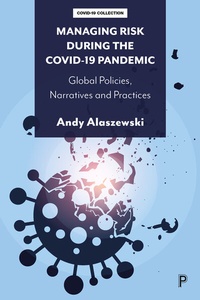
Managing Risk during the COVID-19 Pandemic
Global Policies, Narratives and Practices
1st Edition
Published on 9. May 2023
226 pages
978-1-4473-6527-3 (ISBN)
Description

The past 30 years have seen risk become a major field of study, most recently with the COVID-19 pandemic positioning it at the centre of public awareness, yet there is limited understanding of how risk can and should be used in policy making.
This book provides an accessible guide to the key elements of risk in policy making, including its role in rhetoric to legitimise decisions and choices.
Using risk as a framework, it examines how policy makers in a range of countries responded to the COVID-19 pandemic and explains why some were more successful than others.
This book provides an accessible guide to the key elements of risk in policy making, including its role in rhetoric to legitimise decisions and choices.
Using risk as a framework, it examines how policy makers in a range of countries responded to the COVID-19 pandemic and explains why some were more successful than others.
Reviews / Votes
"The COVID-19 pandemic forced us to reassess how we understand concepts like risk, uncertainty, trust and hope. This book draws on both classic and contemporary texts to theorise how these and related themes played out." Trish Greenhalgh, University of Oxford "As the COVID crisis continues to cast a shadow over politics and society, understanding how its risks were framed, evaluated and managed by politicians and policy makers is critical to ensuring future resilience. Andy Alaszewski's new book provides the most astute and sophisticated analysis available. This is a book that deserves to be read within and far beyond academe." Matthew Flinders, University of Sheffield and Political Studies Association "Responding contemporaneously to the seismic social and political impacts of risk governance during COVID 19 lockdowns, Andy Alaszewski is an attenuated observer and careful historian, turning a practiced anthropologist's eye to the edicts of governments, the symbols and narratives evoked to change behaviour, and the anxious debates that emerged through the fray. The book follows the events from the emergence of the SARS-CoV-2 into global consciousness in early 2020 and provides an accessible, compelling and well-paced account of events that are both familiar and strange." Kirstie Coxon, University of Central Lancashire"This is an incredibly useful resource for those seeking to understand the central policy logics, risk framings and political dynamics of the pandemic; rich in examples, key concepts and theories." Patrick Brown, University of Amsterdam
More details
Edition
First Edition
Language
English
Place of publication
Bristol
United Kingdom
Publishing group
Bristol University Press
Target group
Professional and scholarly
Illustrations
9 s/w Tabellen
9 Tables, black and white
ISBN-13
978-1-4473-6527-3 (9781447365273)
DOI
https://doi.org/10.51952/9781447365273
Copyright in bibliographic data and cover images is held by Nielsen Book Services Limited or by the publishers or by their respective licensors: all rights reserved.
Schweitzer Classification
Other editions
Additional editions
Book
04/2024
1st Edition
Policy Press
€38.50
Shipment within 15-20 days
E-Book
05/2023
1st Edition
Policy Press
€48.99
Available for download
Book
05/2023
1st Edition
Policy Press
€137.50
Shipment within 15-20 days
Person
Andy Alaszewski is Emeritus Professor at the Centre for Health Services Studies, University of Kent. He is a social scientist who has specialised in the study of health risk and society, and is the Founding Editor of the international journal 'Health, Risk and Society'.
Content
Foreword: Jens Zinn
Preface
1. Introduction: Risk as a Key Feature of Late Modern Societies
Part 1: Responding to the Challenges of the Pandemic
2. Managing Uncertainty: Framing COVID-19
3. The Risks of COVID-19: Probability, Categorisation and Outcomes
4. Communicating Risk: Public Health Messaging
Part 2: Mitigating Risk Through Science and Technology
5. 'Following the Science': Expertise and Risk
6. Risk Work To Maintain Services During the Pandemic
Part 3: Risk Narratives
7. Pandemic Narratives: Telling Stories About COVID-19 and Its Risks
8. Contesting Risk: Conspiracy Theories
9. Hindsight: Inquiries and the Blame Game
Part 4: Reflections on the Pandemic and Risk
10. Conclusion: Risk and the Pandemic
Preface
1. Introduction: Risk as a Key Feature of Late Modern Societies
Part 1: Responding to the Challenges of the Pandemic
2. Managing Uncertainty: Framing COVID-19
3. The Risks of COVID-19: Probability, Categorisation and Outcomes
4. Communicating Risk: Public Health Messaging
Part 2: Mitigating Risk Through Science and Technology
5. 'Following the Science': Expertise and Risk
6. Risk Work To Maintain Services During the Pandemic
Part 3: Risk Narratives
7. Pandemic Narratives: Telling Stories About COVID-19 and Its Risks
8. Contesting Risk: Conspiracy Theories
9. Hindsight: Inquiries and the Blame Game
Part 4: Reflections on the Pandemic and Risk
10. Conclusion: Risk and the Pandemic
