

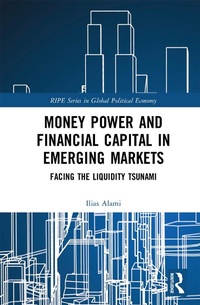
Money Power and Financial Capital in Emerging Markets
Facing the Liquidity Tsunami
1st Edition
Published on 9. December 2019
254 pages
978-1-000-76900-5 (ISBN)
Description

This book provides a comprehensive investigation of the messy and crisis-ridden relationship between the operations of capitalist finance, global capital flows, and state power in emerging markets.
The politics, drivers of emergence, and diversity of these myriad forms of state power are explored in light of the positionality of emerging markets within the network of space and power relations that characterises contemporary global finance. The book develops a multi-disciplinary perspective and combines insights from Marxist political economy, post-Keynesian economics, economic geography, and postcolonial and feminist International Political Economy. Alami comprehensively reviews the theories, histories, and geographies of cross-border finance management, and develops a conceptual framework which allows unpacking the complex entanglement of constraint and opportunities, of growing integration and tight discipline, that cross-border finance represents for emerging markets. Extensive fieldwork research provides an in-depth comparative critical interrogation of the policies and regulations deployed in Brazil and South Africa.
This volume will be especially useful to those researching and working in the areas of international political economy, contemporary geographies of money and finance, and critical development studies. It should also prove of interest to policy makers, practitioners, and activists concerned with the relation between finance and development in emerging markets and beyond.
The politics, drivers of emergence, and diversity of these myriad forms of state power are explored in light of the positionality of emerging markets within the network of space and power relations that characterises contemporary global finance. The book develops a multi-disciplinary perspective and combines insights from Marxist political economy, post-Keynesian economics, economic geography, and postcolonial and feminist International Political Economy. Alami comprehensively reviews the theories, histories, and geographies of cross-border finance management, and develops a conceptual framework which allows unpacking the complex entanglement of constraint and opportunities, of growing integration and tight discipline, that cross-border finance represents for emerging markets. Extensive fieldwork research provides an in-depth comparative critical interrogation of the policies and regulations deployed in Brazil and South Africa.
This volume will be especially useful to those researching and working in the areas of international political economy, contemporary geographies of money and finance, and critical development studies. It should also prove of interest to policy makers, practitioners, and activists concerned with the relation between finance and development in emerging markets and beyond.
Reviews / Votes
"An engaging book that makes a distinctive contribution to understanding the dynamics and contradictions of financial capital in emerging markets. Drawing upon research from the cases of South Africa and Brazil, the author asks important questions about the impact of the expansion of financial capital flows to states in the Global South. Alami challenges the assumption that state financial management practices are shaped by top-down processes of policy diffusion - rather, they are multidirectional circuits of policy design and practice that nonetheless serve to reinscribe the racialized, gendered and class based relations of subordination and domination that are embedded in contemporary global financial markets. An accomplished piece of work that will no doubt make an important theoretical and empirical contribution to the study of the politics of global finance." - Juanita Elias, Professor in International Political Economy, Warwick University, UK."This is a highly innovative, theoretically astute and timely intervention in debates concerning the place of emerging markets within the changing global financial order. By drawing on a range of literatures in a geographical political economy tradition, Alami clearly shows how and why geography matters in the production of cross border finance for emerging markets and the important implications of this for state policy making. By combining theoretical work from a range of disciplines with in-depth case studies of Brazil and South Africa, it is a must read analysis for researchers and practitioners concerned with understanding the changing political economy of global finance as it relates to emerging markets." - Sarah Hall, Professor of Economic Geography, University of Nottingham, UK.
"Drawing upon extensive fieldwork, this book offers a rich and original approach to cross-border financial management in 'emerging markets'. It focuses on the politics of money and its power to influence governments and the balance of social forces in favour of capital: this is the terrorism of money. The study examines in detail the financial development and cross-border financial policies and outcomes in Brazil and South Africa, especially after the Global Financial Crisis. This book is essential reading for students and scholars working in the field." - Alfredo Saad-Filho, Professor of International Development, King's College London, UK.
"Theoretically sophisticated, historically grounded and politically alive, Alami's study of the ongoing struggles of Brazil, South Africa and other Global South states to manage volatile cross-border flows of financial capital in the face of fractured local class relations is a razor-sharp contribution to the burgeoning critical literature on relations of money, power and space." - Brett Christophers, Professor of Social and Economic Geography, Uppsala University, Sweden.
More details
Series
Edition
1. Auflage
Language
English
Place of publication
London
United Kingdom
Publishing group
Taylor & Francis Ltd
Target group
College/higher education
Product notice
Reflowable
Illustrations
5 Tables, black and white; 14 Line drawings, black and white; 14 Illustrations, black and white
ISBN-13
978-1-000-76900-5 (9781000769005)
Copyright in bibliographic data and cover images is held by Nielsen Book Services Limited or by the publishers or by their respective licensors: all rights reserved.
Schweitzer Classification
Other editions
Additional editions
Book
08/2021
1st Edition
Routledge
€65.40
Shipment within 10-20 days
Book
12/2019
1st Edition
Routledge
€206.50
Shipment within 15-20 days
Person
Ilias Alami is a postdoctoral researcher at Maastricht University, the Netherlands. His research and teaching interests are in the areas of the political economy of money and finance, development and international capital flows, the geographies of global finance and financialisation, state capitalism, and race/class/coloniality. He has published peer-reviewed research articles in Geoforum, New Political Economy, Review of Radical Political Economics, Review of African Political Economy, and Development and Change. Prior to joining Maastricht University, he was a Lecturer in International Politics at the University of Manchester. He also held visiting positions at the Getulio Vargas Foundation in Sao Paulo and the University of Johannesburg.
Content
Introduction: Emerging markets in a world awash with liquidity Part one: Theory, History, and Geography Chapter 1: Managing cross-border finance: key theoretical debates and policy prescriptions Chapter 2: The politics of managing cross-border finance in emerging markets Chapter 3: Conceptualising cross-border finance management Chapter 4: The specificity of cross-border finance management in emerging markets Part Two: Case Studies Chapter 5: Capitalist development and cross-border finance in Brazil Chapter 6: Capitalist development and cross-border finance in South Africa Chapter 7: Class relations and post-crisis financial vulnerability in Brazil and South Africa Chapter 8: The uneven formulation of cross-border financial policies in Brazil and South Africa Part Three: Towards a Unified Theory Chapter 9: Continuity, change, and diversity in cross-border finance management Chapter 10: Postcolonial landscapes of cross-border finance management in emerging markets Conclusion: Money-power in 'Third World countries with First World financial systems'
