

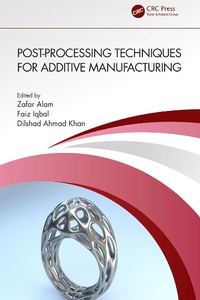
Post-processing Techniques for Additive Manufacturing
1st Edition
Published on 21. July 2023
292 pages
978-1-000-90785-8 (ISBN)
Description

This text defines and covers different themes of post-processing techniques based on mechanical, chemical/electrochemical, and thermal energy. It will serve as an ideal reference text for senior undergraduate and graduate students in diverse engineering fields including manufacturing, industrial, aerospace, and mechanical.
This book:
covers the fundamentals and advancements in the post-processing techniques for additive manufacturing;
explores methods/techniques for post-processing different types of materials used in additive manufacturing processes;
gives insight into the process selection criteria for post-processing of additive manufactured products made from different types of materials;
discusses hybrid processes used for post-processing of additive manufacturing parts; and
highlights post-processing techniques for properties enhancement.
The primary aim of the book is to give the readers a well-informed layout of the different post-processing techniques that range from employing mechanical energy to chemical, electrochemical, and thermal energy to perform the intended task.
This book:
covers the fundamentals and advancements in the post-processing techniques for additive manufacturing;
explores methods/techniques for post-processing different types of materials used in additive manufacturing processes;
gives insight into the process selection criteria for post-processing of additive manufactured products made from different types of materials;
discusses hybrid processes used for post-processing of additive manufacturing parts; and
highlights post-processing techniques for properties enhancement.
The primary aim of the book is to give the readers a well-informed layout of the different post-processing techniques that range from employing mechanical energy to chemical, electrochemical, and thermal energy to perform the intended task.
More details
Edition
1. Auflage
Language
English
Place of publication
London
United Kingdom
Publishing group
Taylor & Francis Ltd
Target group
College/higher education
Product notice
Reflowable
Illustrations
22 Tables, black and white; 56 Line drawings, black and white; 67 Halftones, black and white; 50 Illustrations, color; 73 Illustrations, black and white
ISBN-13
978-1-000-90785-8 (9781000907858)
Copyright in bibliographic data and cover images is held by Nielsen Book Services Limited or by the publishers or by their respective licensors: all rights reserved.
Schweitzer Classification
Other editions
Additional editions
Zafar Alam | Faiz Iqbal | Dilshad Ahmad Khan
Post-processing Techniques for Additive Manufacturing
Book
11/2024
1st Edition
CRC Press
€74.80
Shipment within 10-20 days
Zafar Alam | Faiz Iqbal | Dilshad Ahmad Khan
Post-processing Techniques for Additive Manufacturing
Book
07/2023
1st Edition
CRC Press
€206.70
Shipment within 10-20 days
Persons
Dr Zafar Alam is an Assistant Professor at the Department of Mechanical Engineering, Indian Institute of Technology (Indian School of Mines) Dhanbad, India. Prior to joining IIT (ISM) Dhanbad, he served as an Assistant Professor of Mechanical Engineering at Zakir Husain College of Engineering and Technology, Aligarh Muslim University, India for two years. He received his B. Tech in Mechanical Engineering from Jamia Millia Islamia, India in 2012. He has received his M. Tech and PhD in Production Engineering from Indian Institute of Technology Delhi, India in 2014 and 2019 respectively. As an academician and researcher, he has published an authored book, several book chapters and more than two dozens of research papers in peer reviewed international journals and conferences. He also has to his credit six Indian patents and has received two international and three national awards including the critically acclaimed GYTI (Gandhian Young Technological Innovation) award for his contribution in the field of research and innovation. His research interests include but are not limited to advanced finishing/polishing processes, non-conventional machining, additive manufacturing, industrial automation and motion control.
Dr Faiz Iqbal received his B. Tech in Mechanical and Automation Engineering from Maharshi Dayanand University, India in 2011. He received his M. Tech in Mechatronics Engineering from Amity University, India in 2013 and PhD in Manufacturing Automation from Indian Institute of Technology Delhi, India in 2019. He is currently working as a Lecturer in the School of Engineering, University of Lincoln, Lincoln, United Kingdom. As an academician and researcher, he has to his credit several research papers in peer reviewed international journals and conferences. He also has to his credit four Indian patents and has received two international and three national awards for his contribution in the field of research and innovation. He secured funding for COVID-19 project which he successfully delivered and was nominated for Scottish Knowledge Exchange award in COVID-19 collaborative response category and was awarded the COVID-19 Engineering medal by the School of Engineering, University of Edinburgh. His research interests include but are not limited to Mechatronics; Industrial Automation; Smart Manufacturing; Fluidic logic/Soft Robotics; Advanced Machining Processes; Non-Conventional Machining; Industry 4.0 - Cyber Physical Systems; Advanced Metrology.
Dr Dilshad Ahmad Khan is an Assistant Professor at the Department of Mechanical Engineering,
NIT Hamirpur, India. He is a prominent academician and researcher. He is a Chartered Engineer (CEng) from Institution of Mechanical Engineers, London. He has received his PhD in Manufacturing from IIT Delhi, India in 2018 and Master of Technology (M.Tech) from Aligarh Muslim University, India, in 2010. He received his Bachelor of Engineering (B.E) in Mechanical Engineering from Dr. B.R. Ambedkar University (formerly Agra University), India in 2006. He has published a good number of research articles in international journals and conferences. He got published an authored book entitled as Magnetic Field Assisted Finishing: Methods, Applications and Process Automation. He is the author of several book chapters on various topics of Engineering. He has filed several Indian patents for his innovations. He has received various National and International Awards for his research and innovations including Gandhian Young Technological Innovation Award (GYTI) hosted by President House (Rashtrapati Bhawan), New Delhi. His research interests include advanced finishing/polishing processes, non-conventional machining, additive manufacturing, mechatronic systems and industrial automation.
Dr Faiz Iqbal received his B. Tech in Mechanical and Automation Engineering from Maharshi Dayanand University, India in 2011. He received his M. Tech in Mechatronics Engineering from Amity University, India in 2013 and PhD in Manufacturing Automation from Indian Institute of Technology Delhi, India in 2019. He is currently working as a Lecturer in the School of Engineering, University of Lincoln, Lincoln, United Kingdom. As an academician and researcher, he has to his credit several research papers in peer reviewed international journals and conferences. He also has to his credit four Indian patents and has received two international and three national awards for his contribution in the field of research and innovation. He secured funding for COVID-19 project which he successfully delivered and was nominated for Scottish Knowledge Exchange award in COVID-19 collaborative response category and was awarded the COVID-19 Engineering medal by the School of Engineering, University of Edinburgh. His research interests include but are not limited to Mechatronics; Industrial Automation; Smart Manufacturing; Fluidic logic/Soft Robotics; Advanced Machining Processes; Non-Conventional Machining; Industry 4.0 - Cyber Physical Systems; Advanced Metrology.
Dr Dilshad Ahmad Khan is an Assistant Professor at the Department of Mechanical Engineering,
NIT Hamirpur, India. He is a prominent academician and researcher. He is a Chartered Engineer (CEng) from Institution of Mechanical Engineers, London. He has received his PhD in Manufacturing from IIT Delhi, India in 2018 and Master of Technology (M.Tech) from Aligarh Muslim University, India, in 2010. He received his Bachelor of Engineering (B.E) in Mechanical Engineering from Dr. B.R. Ambedkar University (formerly Agra University), India in 2006. He has published a good number of research articles in international journals and conferences. He got published an authored book entitled as Magnetic Field Assisted Finishing: Methods, Applications and Process Automation. He is the author of several book chapters on various topics of Engineering. He has filed several Indian patents for his innovations. He has received various National and International Awards for his research and innovations including Gandhian Young Technological Innovation Award (GYTI) hosted by President House (Rashtrapati Bhawan), New Delhi. His research interests include advanced finishing/polishing processes, non-conventional machining, additive manufacturing, mechatronic systems and industrial automation.
Content
Chapter 1
Additive Manufacturing and Post-processing: An Introduction
Faiz Iqbal, Zafar Alam and Dilshad Ahmad Khan
Chapter 2
Mechanical Post-Processing Techniques For Metal Additive Manufacturing
Beyza Gavcar and Binnur Sagbas
Chapter 3
Vibratory Surface Finishing of Additive Components Prepared from the Laser Powder Bed Fusion Process
Hamaid Mahmood Khan and Ebubekir Koc
Chapter 4
Ball Burnishing of Additively-Manufactured Parts
Aref Azami, Ramon Jerez-Mesa, Jordi Lluma-Fuentes and Jose Antonito Travieso-Rodriguez
Chapter 5
A Critical Review of Mechanical-based Post-processing Techniques for Additively Manufactured Parts
Abdul Wahab Hashmi, Harlal Singh Mali, Anoj Meena, Shadab Ahmad, Ana Pilar Valerga Puerta and Maria Elizete Kunkele
Chapter 6
Chemical Post-processing for Fused Deposition Modelling
Ana Pilar Valerga, Mir Irfan Ul Haq and Severo R. Fernandez-Vidal
Chapter 7
Post Welding Cold Forging and Effect on Mechanical Properties of Low-Carbon Mild Steel Wire Arc Additive Manufacturing
Arvind Ganesh-a/l Vasuthaven, Zarirah Karrim Wani, Ahmad Baharuddin Abdullah and Zuhailawati Hussain
Chapter 8
Severe Plastic Deformation for Fatigue Strength of Additively Manufactured Components
Abeer Mithal, Niroj Maharjan and Sridhar Idapalapati
Chapter 9
Comparison of Effects of Ultrasonic and Shot Peening Treatments on Surface Properties of L-PBF-Manufactured Superalloy Subjected to HIP Combined with Heat Treatments
D.A. Lesyk, S. Martinez, B.N. Mordyuk, O.O. Pedash, V.V. Dzhemelinskyi and ?. Lamikiz
Chapter 10
Post-processing Techniques of Additively Manufactured Ti-6Al-4V Alloy: A Complete Review on Property Enhancement
Pankaj Kumar Singh, Santosh Kumar, Govind Kumar Verma and Pramod Kumar Jain
Additive Manufacturing and Post-processing: An Introduction
Faiz Iqbal, Zafar Alam and Dilshad Ahmad Khan
Chapter 2
Mechanical Post-Processing Techniques For Metal Additive Manufacturing
Beyza Gavcar and Binnur Sagbas
Chapter 3
Vibratory Surface Finishing of Additive Components Prepared from the Laser Powder Bed Fusion Process
Hamaid Mahmood Khan and Ebubekir Koc
Chapter 4
Ball Burnishing of Additively-Manufactured Parts
Aref Azami, Ramon Jerez-Mesa, Jordi Lluma-Fuentes and Jose Antonito Travieso-Rodriguez
Chapter 5
A Critical Review of Mechanical-based Post-processing Techniques for Additively Manufactured Parts
Abdul Wahab Hashmi, Harlal Singh Mali, Anoj Meena, Shadab Ahmad, Ana Pilar Valerga Puerta and Maria Elizete Kunkele
Chapter 6
Chemical Post-processing for Fused Deposition Modelling
Ana Pilar Valerga, Mir Irfan Ul Haq and Severo R. Fernandez-Vidal
Chapter 7
Post Welding Cold Forging and Effect on Mechanical Properties of Low-Carbon Mild Steel Wire Arc Additive Manufacturing
Arvind Ganesh-a/l Vasuthaven, Zarirah Karrim Wani, Ahmad Baharuddin Abdullah and Zuhailawati Hussain
Chapter 8
Severe Plastic Deformation for Fatigue Strength of Additively Manufactured Components
Abeer Mithal, Niroj Maharjan and Sridhar Idapalapati
Chapter 9
Comparison of Effects of Ultrasonic and Shot Peening Treatments on Surface Properties of L-PBF-Manufactured Superalloy Subjected to HIP Combined with Heat Treatments
D.A. Lesyk, S. Martinez, B.N. Mordyuk, O.O. Pedash, V.V. Dzhemelinskyi and ?. Lamikiz
Chapter 10
Post-processing Techniques of Additively Manufactured Ti-6Al-4V Alloy: A Complete Review on Property Enhancement
Pankaj Kumar Singh, Santosh Kumar, Govind Kumar Verma and Pramod Kumar Jain
