

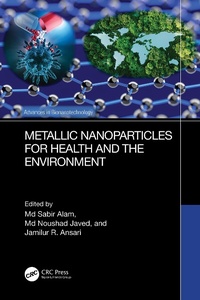
Metallic Nanoparticles for Health and the Environment
1st Edition
Published on 16. October 2023
370 pages
978-1-000-96694-7 (ISBN)
Description

Metallic Nanoparticles for Health and the Environment covers different routes of synthesis for metallic nanoparticles and their process variables. Both the functions and roles of these particles as a drug delivery system and diagnostic agent and other potential theranostic purposes against metabolic disorders, photocatalysis applications, as well as wastewater treatments, are discussed. The book compares the different properties of bulk metallic forms and their nanoparticulated forms. It discusses the mechanisms and impacts of different process variables in different synthesis routes, as well as emerging trends in clinics and so forth.
Features:
Covers different routes of synthesis to create metallic nanoparticles (MNPs) of different characteristics with reference to bulk forms of metals
Describes formulation parameters that have a significant effect on these MNPs including dimensions, morphology, mechanism, surface properties, and other characteristics
Discusses different roles and performances of MNPs in photothermal therapy, metabolic disorders, mechanisms in bacterial, fungal, and viral infections, and inflammatory pathways
Reviews the potential and emerging roles of different MNPs with site target delivery applications and genetic manipulation purposes
Examines the advantages and challenges of these MNPs against remediation of pollutants and toxicants, owing to their superior surface catalytic activities
This book is aimed at researchers and professionals in nanomaterials, pharmaceuticals, and drug delivery.
Features:
Covers different routes of synthesis to create metallic nanoparticles (MNPs) of different characteristics with reference to bulk forms of metals
Describes formulation parameters that have a significant effect on these MNPs including dimensions, morphology, mechanism, surface properties, and other characteristics
Discusses different roles and performances of MNPs in photothermal therapy, metabolic disorders, mechanisms in bacterial, fungal, and viral infections, and inflammatory pathways
Reviews the potential and emerging roles of different MNPs with site target delivery applications and genetic manipulation purposes
Examines the advantages and challenges of these MNPs against remediation of pollutants and toxicants, owing to their superior surface catalytic activities
This book is aimed at researchers and professionals in nanomaterials, pharmaceuticals, and drug delivery.
More details
Series
Edition
1. Auflage
Language
English
Place of publication
London
United Kingdom
Publishing group
Taylor & Francis Ltd
Target group
College/higher education
Illustrations
15 Tables, black and white; 37 Line drawings, black and white; 9 Halftones, black and white; 46 Illustrations, black and white
ISBN-13
978-1-000-96694-7 (9781000966947)
Copyright in bibliographic data and cover images is held by Nielsen Book Services Limited or by the publishers or by their respective licensors: all rights reserved.
Schweitzer Classification
Other editions
Additional editions
Md Sabir Alam | Md Noushad Javed | Jamilur R. Ansari
Metallic Nanoparticles for Health and the Environment
Book
01/2025
1st Edition
CRC Press
€80.40
Shipment within 10-20 days
Md Sabir Alam | Md Noushad Javed | Jamilur R. Ansari
Metallic Nanoparticles for Health and the Environment
Book
10/2023
1st Edition
CRC Press
€242.70
Shipment within 10-20 days
Persons
Md Sabir Alam, His main area of research is Pharmaceutical Nanotechnology and its Biomedical application with specialization in Drug delivery for various targeted diseases, including Psoriasis, Neurological disorders, Cancer targeting, Antimicrobial, and Antimalarial Activity. He obtained M. Pharm in Pharmaceutics from RGUHS Bangalore and held a Ph.D. degree in Nano-pharmaceutics. Currently working as an Associate Professor at the Department of Pharmaceutics, SGT College of Pharmacy, SGT University Gurgaon, Haryana, India. He is having eight years of teaching and research experience. He has authored more than 20 research and reviews articles in international peer-review journals, 1 Book, 20 Book chapters, and 4 Patents. His area of interest includes Synthesis, Characterization Application of Various Nanocarriers for drug delivery/delivery for treating Neurological disease, Cancer and Malarial disease. Dr. Sabir Alam also focuses on revealing the role and impact of process variables in synthesizing various nanoparticles via process, optimization approaches using QbD, DoE. In Bentham Science Journal recently appointed as Executive Guest Editors for Pharmaceutical Nanotechnology (PNT), Recently Submitted Book "Emerging Role of Metallic Nanocarriers for Health and Environment" (2022) Book proposal accepted in CRC Press (Taylor and Francis Group), and Current Pharmaceutical Design (Impact Factoe-3.2) and appoint as Reviewer in IET Nanotechnology journal (Impact Factor-1.84), Join as Advisory Board member of Heliyon Pharmaceutical Sciences, Pharmacology and Toxicology (Cell Press) and Join as editorial board member of ILIVER Journal (Elsevier publisher), Recently ranked among world 10.000 scientist as per AD Scientific index 2023 version 1 in Third consecutive time.
Md Noushad Javed is associated with Department of Mechanical Engineering, University of Texas Rio-Grande Valley, Edinburg, Texas TX 78539, USA. He is a senior researcher in the field of nanomaterials and alumni of the prestigious SPER of Jamia Hamdard (India). He has authored many patents, publications and chapters on the role of different nanomaterials for pharmacological interventions in neurodegenerative disorders, epilepsy, cancer, and hypoxic disorders. His research also focuses on revealing the role and impact of process variables in the process of synthesizing various types of nanoparticles via process, optimization approaches using QbD, DoE, and Artificial intelligence. Apart from his profession, he has served as an editor of many reputed scientific journals, published many high-impact papers, book chapters, and currently associated with many book projects.
Jamilur R. Ansari is currently working as an Associate Professor of Physics at Dronacharya College of Engineering, Khentawas, Gurugram, India. He obtained his Ph.D. degree in the field of Physics/Nanotechnology from Guru Gobind Singh Indraprastha University, Delhi, India, M.Phil. in Nanotechnology, M.Sc. (Physics) from Jamia Millia Islamia, New Delhi, and MBA from Rajasthan Technical University, Rajasthan. He is having 17 years of teaching and research experience with 30 publications in SCI journals. Dr. J. R. Ansari has been acknowledged as the outstanding contributor for reviewing in 2020 by IOP Journal. Three students are pursuing their Ph.D. under his supervision; beside he has guided 11 students in their M.Sc. Project and published papers in SCI Journals. His research focuses on MXenes, perovskites, metal-semiconductor, 2D materials, QDs, self-assembly which involves photo-catalysis, solar cells, sensing and biomedical applications. He is a reviewer in many SCI index journals.
Md Noushad Javed is associated with Department of Mechanical Engineering, University of Texas Rio-Grande Valley, Edinburg, Texas TX 78539, USA. He is a senior researcher in the field of nanomaterials and alumni of the prestigious SPER of Jamia Hamdard (India). He has authored many patents, publications and chapters on the role of different nanomaterials for pharmacological interventions in neurodegenerative disorders, epilepsy, cancer, and hypoxic disorders. His research also focuses on revealing the role and impact of process variables in the process of synthesizing various types of nanoparticles via process, optimization approaches using QbD, DoE, and Artificial intelligence. Apart from his profession, he has served as an editor of many reputed scientific journals, published many high-impact papers, book chapters, and currently associated with many book projects.
Jamilur R. Ansari is currently working as an Associate Professor of Physics at Dronacharya College of Engineering, Khentawas, Gurugram, India. He obtained his Ph.D. degree in the field of Physics/Nanotechnology from Guru Gobind Singh Indraprastha University, Delhi, India, M.Phil. in Nanotechnology, M.Sc. (Physics) from Jamia Millia Islamia, New Delhi, and MBA from Rajasthan Technical University, Rajasthan. He is having 17 years of teaching and research experience with 30 publications in SCI journals. Dr. J. R. Ansari has been acknowledged as the outstanding contributor for reviewing in 2020 by IOP Journal. Three students are pursuing their Ph.D. under his supervision; beside he has guided 11 students in their M.Sc. Project and published papers in SCI Journals. His research focuses on MXenes, perovskites, metal-semiconductor, 2D materials, QDs, self-assembly which involves photo-catalysis, solar cells, sensing and biomedical applications. He is a reviewer in many SCI index journals.
Content
1. Metallic (Inorganic) Nanoparticles: Classification, Synthesis, Mechanism and Scope. 2. Recent Trends in the Biomedical Application of Metallic Nanoparticles. 3. Application of metallic nanoparticles in targeted delivery and genetic manipulations. 4. Emerging Trends in Anti-infectious Metallic Nanoparticles. 5. Anti-inflammatory metallic NPs: Type, Role and Mechanisms. 6. Trends in theranostic applications of metallic nanoparticles. 7. In Vivo & In Vitro toxicity study of metallic nanoparticles. 8. Metallic Nanoparticles for Skins and Photo-Thermal Therapy. 9. Advancement towards the Brain Targeted Metallic Nanoparticles in Neurological Disorders. 10. Catalyst Metallic Nanoparticles: Types, Mechanism and Trends. 11. Metallic nanoparticles for remediation of toxicants and wastewater treatment. 12. Toxicology and Regulatory Challenges of Metallic Nanoparticles. 13. Toxicity of Metallic Nanoparticles: Assessment & Impacts.
