

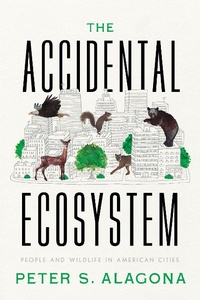
The Accidental Ecosystem
People and Wildlife in American Cities
1st Edition
Published on 19. April 2022
296 pages
978-0-520-38632-7 (ISBN)
Description

One of Smithsonian Magazine's Favorite Books of 2022
With wildlife thriving in cities, we have the opportunity to create vibrant urban ecosystems that serve both people and animals.
The Accidental Ecosystem tells the story of how cities across the United States went from having little wildlife to filling, dramatically and unexpectedly, with wild creatures. Today, many of these cities have more large and charismatic wild animals living in them than at any time in at least the past 150 years. Why have so many cities-the most artificial and human-dominated of all Earth's ecosystems-grown rich with wildlife, even as wildlife has declined in most of the rest of the world? And what does this paradox mean for people, wildlife, and nature on our increasingly urban planet?
The Accidental Ecosystem is the first book to explain this phenomenon from a deep historical perspective, and its focus includes a broad range of species and cities. Cities covered include New York City, Los Angeles, San Francisco, Pittsburgh, Austin, Miami, Chicago, Seattle, San Diego, Atlanta, Philadelphia, and Baltimore. Digging into the natural history of cities and unpacking our conception of what it means to be wild, this book provides fascinating context for why animals are thriving more in cities than outside of them. Author Peter S. Alagona argues that the proliferation of animals in cities is largely the unintended result of human decisions that were made for reasons having little to do with the wild creatures themselves. Considering what it means to live in diverse, multispecies communities and exploring how human and nonhuman members of communities might thrive together, Alagona goes beyond the tension between those who embrace the surge in urban wildlife and those who think of animals as invasive or as public safety hazards. The Accidental Ecosystem calls on readers to reimagine interspecies coexistence in shared habitats, as well as policies that are based on just, humane, and sustainable approaches.
With wildlife thriving in cities, we have the opportunity to create vibrant urban ecosystems that serve both people and animals.
The Accidental Ecosystem tells the story of how cities across the United States went from having little wildlife to filling, dramatically and unexpectedly, with wild creatures. Today, many of these cities have more large and charismatic wild animals living in them than at any time in at least the past 150 years. Why have so many cities-the most artificial and human-dominated of all Earth's ecosystems-grown rich with wildlife, even as wildlife has declined in most of the rest of the world? And what does this paradox mean for people, wildlife, and nature on our increasingly urban planet?
The Accidental Ecosystem is the first book to explain this phenomenon from a deep historical perspective, and its focus includes a broad range of species and cities. Cities covered include New York City, Los Angeles, San Francisco, Pittsburgh, Austin, Miami, Chicago, Seattle, San Diego, Atlanta, Philadelphia, and Baltimore. Digging into the natural history of cities and unpacking our conception of what it means to be wild, this book provides fascinating context for why animals are thriving more in cities than outside of them. Author Peter S. Alagona argues that the proliferation of animals in cities is largely the unintended result of human decisions that were made for reasons having little to do with the wild creatures themselves. Considering what it means to live in diverse, multispecies communities and exploring how human and nonhuman members of communities might thrive together, Alagona goes beyond the tension between those who embrace the surge in urban wildlife and those who think of animals as invasive or as public safety hazards. The Accidental Ecosystem calls on readers to reimagine interspecies coexistence in shared habitats, as well as policies that are based on just, humane, and sustainable approaches.
More details
Other editions
Additional editions
Book
01/2024
1st Edition
University of California Press
€24.00
Shipment within 10-20 days
Book
04/2022
1st Edition
University of California Press
€25.50
Shipment within 10-20 days
Person
Peter S. Alagona is an environmental historian, conservation scientist, and nature-culture geographer. He is Professor of Environmental Studies at the University of California, Santa Barbara.
Content
Preface
Acknowledgments
Introduction: Where the Wild Things Are, Now
1: Hot Spots
2: The Urban Barnyard
3: Nurturing Nature
4: Bambi Boom
5: Room to Roam
6: Out of the Shadows
7: Close Encounters
8: Home to Roost
9: Hide and Seek
10: Creature Discomforts
11: Catch and Release
12: Damage Control
13: Fast-Forward
14: Embracing the Urban Wild
Coda: Lost and Found
Notes
Selected Bibliography
Index
Acknowledgments
Introduction: Where the Wild Things Are, Now
1: Hot Spots
2: The Urban Barnyard
3: Nurturing Nature
4: Bambi Boom
5: Room to Roam
6: Out of the Shadows
7: Close Encounters
8: Home to Roost
9: Hide and Seek
10: Creature Discomforts
11: Catch and Release
12: Damage Control
13: Fast-Forward
14: Embracing the Urban Wild
Coda: Lost and Found
Notes
Selected Bibliography
Index
