

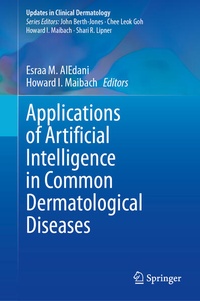
Applications of Artificial Intelligence in Common Dermatological Diseases
Description

This book is first authoritative and comprehensive volume that dedicated to the role of artificial intelligence in common dermatological diseases. This book provides up to date and highly illustrated synopsis of the machine learning and convolutional neural network.
Chapters address the effective usage of artificial intelligence in common dermatological diseases, and the role of learning machine in each disease, and how it helps in diagnosis and fasten the healing process. For example, It describes the usage of AI in early skin cancer detection, in acne vulgarism grading etc.
This book is a valuable resource for dermatologists, medical students, and residents in dermatological specialty.
More details
Other editions
Additional editions
Persons
Dr. Howard Maibach is a dermatologist with expertise in treating contact dermatitis (a rash caused by touching an irritating substance) and occupational dermatitis (a rash resulting from workplace exposure to an irritating substance). His specialties include allergic skin disorders and skin conditions caused by exposure to toxic substances. He also has an interest in dermatopharmacology, the study of medications for skin disorders. Dr. Maibach earned his medical degree from Tulane University School of Medicine. He completed a residency as well as a fellowship in dermatology at the Hospital of the University of Pennsylvania. Dr. Maibach has served on the editorial boards of more than 30 scientific journals. He is a member of 19 professional societies, including the American Academy of Dermatology, San Francisco Dermatological Society and International Commission on Occupational Health.
Dr. Esraa Mohammed AlEdani is an Iraqi physician, writer, and researcher with over 30 publications in prestigious American and British medical journals. Born in Basra, in the Basra Governorate of southern Iraq, she completed her secondary education in her hometown, ranking among the top ten students nationwide. She pursued her medical education at the College of Medicine, University of Basra, where she graduated in 2022-2023 with a Bachelor's degree in Medicine and General Surgery. A year later, she joined the Iraqi Doctors Union.
During her university years, Dr. AlEdani was actively involved in various voluntary organizations, including the International Federation of Medical Students' Associations (IFMSA). Through IFMSA, she participated in awareness campaigns and delivered lectures on critical public health topics. She also attended both local and international conferences, where she engaged in discussions on reproductive health, HIV/AIDS, maternal health, sexually transmitted diseases, gender issues-including gender-based violence-and topics related to sexuality and gender identity.
In August 2023, Dr. AlEdani joined an attachment observation program at Leicester Royal Infirmary Hospital in the Emergency Department, gaining valuable international exposure. Currently, she works at Al-Shifaa Hospital while simultaneously pursuing several research projects, writing books, and preparing for the USMLE exam.
In addition to her medical career, Dr. AlEdani has a strong interest in finance, particularly in forex trading. In her free time, she enjoys reading financial literature, writing, drawing, and playing table games. She also values spending time with her family and friends in Iraq during holidays and vacations.
Content
Chapter One: The role of Artificial intelligence in dermatology.- Chapter Two: The role of Artificial intelligence in acne vulgaris.- Chapter Three: The role of Artificial intelligence in psoriasis.- Chapter Four: The role of Artificial intelligence in skin cancer.- Chapter Five: The role of Artificial intelligence in atopic dermatitis.- Chapter Six: The role of Artificial intelligence in predicting of skin sensitization substances.- Chapter Seven: The challenges and limitations of AI in dermatology.
