

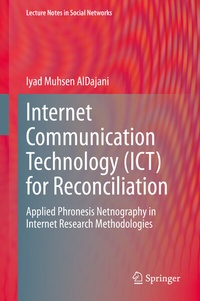
Internet Communication Technology (ICT) for Reconciliation
Description

The book explores Applied Phronesis in internet communication technology and Netnography application, introducing it on Facebook and YouTube usages. It defines two pillars for the research dynamics, "Episteme" and "Techne." - the know-how, how-to, and the power dynamics. The "Episteme" explores the dynamics of reconciliation in the middle of conflict, Internet communication technologies for transformation, Moderation in Islam, online Deliberative Democracy.
The second pillar, " Techne ," is explored through Internet communication technology for the advancement of reconciliation in the middle of a conflict.
The book describes the Phronetic Approach in internet research in academic discourse adopting
Phronesis
"
an Aristotelian concept and method defined by Bent Flyvbjerg,"
and exploring Netnography for
Kozinets,
in Mixed-Method research design and applying methodological triangulation in research and testing the hypothesis using qualitative content analysis for
Krippendorff, developing a methodological discourse for interdisciplinary research using internet communication technologies as part of understanding big-date, introducing Applied Digital Humanities.
More details
Other editions
Additional editions
Person
Content
Chapter 1. The Phenomenology of Internet Communication Technology (ICT) in Phronetic Social Science (Methodology and Research Design).- Chapter 2. Reconciliation in The Middle of Conflict Exposed in Internet Communication Technology (ICT).- Chapter 3. Internet Communication Technology (ICT) for Social Change.- Chapter 4. Internet Communication Technology (ICT) for Moderation " Wasatia " As Concept and a Movement in Palestine.- Chapter 5. Internet Communication Technology (ICT) for Deliberative Democracy.- Chapter 6. Phronetic Netnography Research Design.- Chapter 7. Internet Research Analytics (Theories and Methods).- Chapter 8. Applied Internet Research Analytics, From Theory to Practice.- Chapter 9. Phronetic Social Science Evaluation.- Chapter 10. Research findings and future presectives.
