

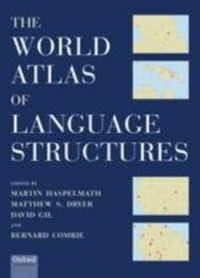
World Atlas of Language Structures
1st Edition
Published on 21. July 2005
712 pages
978-0-19-153124-8 (ISBN)
Description

The World Atlas of Language Structures is a book and CD combination displaying the structural properties of the world's languages. 142 world maps and numerous regional maps - all in colour - display the geographical distribution of features of pronunciation and grammar, such as number of vowels, tone systems, gender, plurals, tense, word order, and body part terminology. Each world map shows an average of 400 languages and is accompanied by a fully referenced description of the structural feature in question. The CD provides an interactive electronic version of the database which allows the reader to zoom in on or customize the maps, to display bibliographical sources, and to establish correlations between features. The book and the CD together provide an indispensable source of information for linguists and others seeking to understand human languages. The Atlas will be especially valuable for linguistic typologists, grammatical theorists, historical and comparative linguists, and for those studying a region such as Africa, Southeast Asia, North America, Australia, and Europe. It will also interest anthropologists and geographers. More than fifty authors from many different countries have collaborated to produce a work that sets new standards in comparative linguistics. No institution involved in language research can afford to be without it.
More details
Other editions
Additional editions
Martin Haspelmath | Matthew S. Dryer | David Gil
The World Atlas of Language Structures
Book
07/2005
Oxford University Press
€909.92
Article exhausted; check different version
Content
- Intro
- Contents
- Abbreviations
- Acknowledgements
- List of Contributors
- INTRODUCTION
- TEXTS AND MAPS
- A. Phonology
- 1 Consonant Inventories
- 2 Vowel Quality Inventories
- 3 Consonant-Vowel Ratio
- 4 Voicing in Plosives and Fricatives
- 5 Voicing and Gaps in Plosive Systems
- 6 Uvular Consonants
- 7 Glottalized Consonants
- 8 Lateral Consonants
- 9 The Velar Nasal (?)
- 10 Vowel Nasalization
- 11 Front Rounded Vowels
- 12 Syllable Structure
- 13 Tone
- 14 Fixed Stress Locations
- 15 Weight-Sensitive Stress
- 16 Weight Factors in Weight-Sensitive Stress Systems
- 17 Rhythm Types
- 18 Absence of Common Consonants
- 19 Presence of Uncommon Consonants
- B. Morphology
- 20 Fusion of Selected Inflectional Formatives
- 21 Exponence of Selected Inflectional Formatives
- 22 Inflectional Synthesis of the Verb
- 23 Locus of Marking in the Clause
- 24 Locus of Marking in Possessive Noun Phrases
- 25 Locus of Marking: Whole-language Typology
- 26 Prefixing versus Suffixing in Inflectional Morphology
- 27 Reduplication
- 28 Case Syncretism
- 29 Syncretism in Verbal Person/Number Marking
- C. Nominal Categories
- Gender and Number
- 30 Number of Genders
- 31 Sex-based and Non-sex-based Gender Systems
- 32 Systems of Gender Assignment
- 33 Coding of Nominal Plurality
- 34 Occurrence of Nominal Plurality
- 35 Plurality in Independent Personal Pronouns
- 36 The Associative Plural
- Articles and Pronouns
- 37 Definite Articles
- 38 Indefinite Articles
- 39-40 Inclusive/Exclusive Forms for 'we'
- 39 Inclusive/Exclusive Distinction in Independent Pronouns
- 40 Inclusive/Exclusive Distinction in Verbal Inflection
- 41 Distance Contrasts in Demonstratives
- 42 Pronominal and Adnominal Demonstratives
- 43 Third-Person Pronouns and Demonstratives
- 44 Gender Distinctions in Independent Personal Pronouns
- 45 Politeness Distinctions in Pronouns
- 46 Indefinite Pronouns
- 47 Intensifiers and Reflexive Pronouns
- 48 Person Marking on Adpositions
- Case
- 49 Number of Cases
- 50 Asymmetrical Case Marking
- 51 Position of Case Affixes
- 52 Comitatives and Instrumentals
- Numerals
- 53 Ordinal Numerals
- 54 Distributive Numerals
- 55 Numeral Classifiers
- 56 Conjunctions and Universal Quantifiers
- D. Nominal Syntax
- 57 Position of Pronominal Possessive Affixes
- 58 Obligatory Possessive Inflection
- 59 Possessive Classification
- 60 Genitives, Adjectives, and Relative Clauses
- 61 Adjectives without Nouns
- 62 Action Nominal Constructions
- 63 Noun Phrase Conjunction
- 64 Nominal and Verbal Conjunction
- E. Verbal Categories
- Tense and Aspect
- 65-68 Tense and Aspect
- 65 Perfective/Imperfective Aspect
- 66 The Past Tense
- 67 The Future Tense
- 68 The Perfect
- 69 Position of Tense-Aspect Affixes
- Modality
- 70 The Morphological Imperative
- 71 The Prohibitive
- 72 Imperative-Hortative Systems
- 73 The Optative
- 74 Situational Possibility
- 75 Epistemic Possibility
- 76 Overlap between Situational and Epistemic Modal Marking
- 77 Semantic Distinctions of Evidentiality
- 78 Coding of Evidentiality
- Suppletion
- 79 Suppletion According to Tense and Aspect
- 80 Verbal Number and Suppletion
- F. Word Order
- 81 Order of Subject, Object, and Verb
- 82 Order of Subject and Verb
- 83 Order of Object and Verb
- 84 Order of Object, Oblique, and Verb
- 85 Order of Adposition and Noun Phrase
- 86 Order of Genitive and Noun
- 87 Order of Adjective and Noun
- 88 Order of Demonstrative and Noun
- 89 Order of Numeral and Noun
- 90 Order of Relative Clause and Noun
- 91 Order of Degree Word and Adjective
- 92 Position of Polar Question Particles
- 93 Position of Interrogative Phrases in Content Questions
- 94 Order of Adverbial Subordinator and Clause
- 95 Relationship between the Order of Object and Verb and the Order of Adposition and Noun Phrase
- 96 Relationship between the Order of Object and Verb and the Order of Relative Clause and Noun
- 97 Relationship between the Order of Object and Verb and the Order of Adjective and Noun
- G. Simple Clauses
- 98-99 Alignment of Case Marking
- 98 Alignment of Case Marking of Full Noun Phrases
- 99 Alignment of Case Marking of Pronouns
- 100 Alignment of Verbal Person Marking
- 101 Expression of Pronominal Subjects
- 102 Verbal Person Marking
- 103 Third-Person Zero of Verbal Person Marking
- 104 Order of Person Markers on the Verb
- 105 Ditransitive Constructions: The Verb 'Give'
- Valence and Voice
- 106 Reciprocal Constructions
- 107 Passive Constructions
- 108 Antipassive Constructions
- 109 Applicative Constructions
- 110 Periphrastic Causative Constructions
- 111 Nonperiphrastic Causative Constructions
- Negation and Questions
- 112 Negative Morphemes
- 113 Symmetric and Asymmetric Standard Negation
- 114 Subtypes of Asymmetric Standard Negation
- 115 Negative Indefinite Pronouns and Predicate Negation
- 116 Polar Questions
- Predication
- 117 Predicative Possession
- 118 Predicative Adjectives
- 119 Nominal and Locational Predication
- 120 Zero Copula for Predicate Nominals
- 121 Comparative Constructions
- H. Complex Sentences
- 122-123 Relativization Strategies
- 122 Relativization on Subjects
- 123 Relativization on Obliques
- 124 'Want' Complement Clauses
- 125 Purpose Clauses
- 126 'When' Clauses
- 127 Reason Clauses
- 128 Utterance Complement Clauses
- I. Lexicon
- 129 Hand and Arm
- 130 Finger and Hand
- 131 Numeral Bases
- 132-135 Colour Terms
- 132 Number of Nonderived Basic Colour Categories
- 133 Number of Basic Colour Categories
- 134 Green and Blue
- 135 Red and Yellow
- 136-137 Personal Pronouns
- 136 M-T Pronouns
- 137 N-M Pronouns
- 138 Tea
- J. Sign Languages
- Sign Languages
- 139 Irregular Negatives in Sign Languages
- 140 Question Particles in Sign Languages
- K. Other
- 141 Writing Systems
- 142 Paralinguistic Usages of Clicks
- REFERENCE MATERIAL
- Genealogical Maps
- Genealogical Language List
- References
- Language Name Index
- A
- B
- C
- D
- E
- F
- G
- H
- I
- J
- K
- L
- M
- N
- O
- P
- Q
- R
- S
- T
- U
- V
- W
- X
- Y
- Z
- WALS Code Index
- A
- B
- C
- D
- E
- F
- G
- H
- I
- J
- K
- L
- M
- N
- O
- P
- Q
- R
- S
- T
- U
- V
- W
- X
- Y
- Z
