

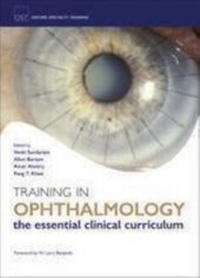
Training in Ophthalmology
1st Edition
Published on 12. February 2009
474 pages
978-0-19-155337-0 (ISBN)
Description

This full colour, new book is the first to take account of the new ophthalmictraining structure and syllabus, as defined by the Royal College of Ophthalmologists(RCOphth). As a theoretical and practical aid for trainee ophthalmologists andfoundation year doctors it guides and helps them progress through the initial yearsof the new postgraduate Ophthalmic Specialist Training. Emphasis is placed on thepractical assessment and management of a variety of key ophthalmic conditions,andincludes case based discussions to help develop clinical decision making skills. Itwill also appeal to candidates preparing for the Fellowship of the Royal College ofOphthalmology (FRCOphth) examination. All topics within the book are presented inhighly illustrated, full colour double-pagespreads.
More details
Other editions
Additional editions
Venki Sundaram | Allon Barsam | Amar Alwitry
Training in Ophthalmology
Book
02/2009
Oxford University Press
€80.47
Article exhausted; check different version
Content
- Intro
- Contents
- Contributors
- Abbreviations
- 1 External eye disease
- Basic sciences
- 1.1 Corneal and conjunctival basic science
- Clinical skills
- 1.2 History taking for anterior segment disease
- 1.3 Examination of the anterior segment
- Clinical knowledge
- 1.4 Blepharitis
- 1.5 Staphylococcal hypersensitivity disorders
- 1.6 Dry eye disease
- 1.7 Conjunctivitis I: classification and adenovirus
- 1.8 Conjunctivitis II: other infectious causes
- 1.9 Conjunctivitis III: allergic
- 1.10 Conjunctivitis IV: miscellaneous
- 1.11 Cicatrizing conjunctival disease
- 1.12 Conjunctival degeneration
- 1.13 Conjunctival neoplasia I
- 1.14 Conjunctival neoplasia II
- 1.15 Corneal degeneration
- 1.16 Infectious keratitis I: bacterial
- 1.17 Infectious keratitis II: protozoal/fungal
- 1.18 Infectious keratitis III: viral
- herpes simplex
- 1.19 Infectious keratitis IV: viral
- herpes zoster
- 1.20 Interstitial keratitis
- 1.21 Peripheral ulcerative keratitis
- 1.22 Metabolic and drug-induced keratopathies
- 1.23 Miscellaneous keratopathies
- 1.24 Corneal dystrophies I
- 1.25 Corneal dystrophies II
- 1.26 Contact lenses
- 1.27 Corneal ectasia
- 1.28 Keratoplasty
- 1.29 Complications of keratoplasty and graft rejection
- 1.30 Anterior uveal tumours
- 1.31 Anterior segment trauma
- 1.32 Chemical injury
- 1.33 Refractive surgery
- Practical skills
- Corneal glue
- Removal of corneal sutures
- Removal of corneal foreign bodies
- Corneal topography
- Corneal pachymetry
- Case-based discussions
- 1.34 Case 1 Chemical injury
- Case 2 Herpes zoster keratitis
- Case 3 Bacterial keratitis
- 2 Oculoplastics
- Basic sciences
- 2.1 Eyelid and nasolacrimal system anatomy
- Clinical knowledge
- 2.2 Lash abnormality
- 2.3 Entropion
- 2.4 Ectropion
- 2.5 Ptosis I
- 2.6 Ptosis II
- 2.7 Benign lid lesions
- 2.8 Premalignant and malignant lid lesions I
- 2.9 Malignant lid lesions II
- 2.10 Epiphora
- 2.11 Acquired nasolacrimal system abnormalities
- 2.12 Congenital abnormalities
- 2.13 Miscellaneous
- Clinical skills
- Ptosis examination
- Evaluation of the patient with acquired epiphora
- Practical skills
- Incision and curettage of chalazion
- Syringing and probing
- Botulinum-toxin injections
- Case-based discussions
- 2.14 Case 1 Epiphora
- Case 2 Ptosis
- Case 3 Lid lump
- 3 Vitreoretinal surgery
- Basic sciences
- 3.1 Retinal anatomy and physiology
- Clinical skills
- 3.2 Posterior segment history taking and examination
- 3.3 Diagnostic lenses
- Practical skills
- 3.4 Optical coherence tomography
- 3.5 Ultrasonography
- 3.6 Retinal photocoagulation
- Clinical knowledge
- 3.7 Vitreous disorders
- 3.8 Retinal detachment I
- 3.9 Retinal detachment II
- 3.10 Peripheral retinal abnormalities
- 3.11 Macular surgery
- 3.12 Submacular surgery
- 3.13 Retinal tumours I
- 3.14 Retinal tumours II
- 3.15 Choroidal tumours I
- 3.16 Choroidal tumours II
- 3.17 Vitreoretinopathies
- 3.18 Retinopathy of prematurity
- 3.19 Posterior segment trauma
- Case-based discussions
- 3.20 Case 1 Retinal detachment
- Case 2 Elevated fundal mass
- 4 Medical retina
- Clinical skills
- 4.1 Fundus fluorescein angiography
- 4.2 Abnormal fiuorescein angiography
- 4.3 Indocyanine green angiography
- 4.4 Electrophysiology
- Clinical knowledge
- 4.5 Diabetic retinopathy I
- 4.6 Diabetic retinopathy II
- 4.7 Hypertensive retinopathy
- 4.8 Retinal vein occlusion I
- 4.9 Retinal vein occlusion II
- 4.10 Retinal artery occlusions
- 4.11 Age-related macular degeneration I
- 4.12 Age-related macular degeneration II
- 4.13 Intravitreal anti-VEGF injections
- 4.14 Central serous chorioretinopathy
- 4.15 Retinal vascular anomalies
- 4.16 Retinal dystrophies I
- 4.17 Retinal dystrophies II
- 4.18 Choroidal dystrophies
- Case based discussions
- 4.19 Case 1 Gradual visual loss
- Case 2 Central visual loss
- Case 3 Visual loss in a hypertensive patient
- Case 4 Sudden, painless visual loss
- Case 5 Diabetic retinopathy
- Case 6 Difficult night vision
- Case 7 Visual loss in child
- Case 8 Macular lesion
- 5 Medical ophthalmology
- Basic sciences
- 5.1 Uveal anatomy
- Clinical knowledge
- 5.2 Anterior uveitis
- 5.3 Intermediate uveitis
- 5.4 Posterior uveitis
- 5.5 Specific non-infectious posterior uveitides I
- 5.6 Specific non-infectious posterior uveitides II
- 5.7 Viral infectious uveitis
- 5.8 Parasitic infectious uveitis
- 5.9 Fungal infectious uveitis
- 5.10 Bacterial infectious uveitis
- 5.11 HIV-related disease
- 5.12 Uveitis: systemic associations I
- 5.13 Uveitis: systemic associations II
- 5.14 Scleritis and episcleritis
- 5.15 Systemic treatment of ocular inflammatory disorders
- 5.16 Biological agents and periocular treatments of ocular inflammatory disorders
- 5.17 Intraocular treatments of ocular inflammatory disorders
- 5.18 Rheumatological disease
- 5.19 Vasculitis
- 5.20 Cardiovascular disease and the eye
- 5.21 Endocrine diseases in ophthalmology
- 5.22 Respiratory and skin diseases in ophthalmology
- Practical skills
- Orbital-floor injection
- Posterior sub-Tenon injection
- Intravitreal injection
- Case-based discussion
- 5.23 Case 1 Scleritis
- 6 Cataract
- Basic sciences
- 6.1 Lens anatomy and embryology
- Clinical knowledge
- 6.2 Acquired cataract
- 6.3 Clinical evaluation of acquired cataract
- 6.4 Treatment for acquired cataract
- 6.5 Intraoperative complications of cataract surgery
- 6.6 Infectious postoperative complications of cataract surgery
- 6.7 Non-infectious postoperative complications of cataract surgery
- 6.8 Congenital cataract
- 6.9 Management of congenital cataract
- 6.10 Lens dislocation
- Practical skills
- 6.11 Biometry
- 6.12 Local anaesthesia
- 6.13 Operating microscope and phacodynamics
- 6.14 Intraocular lenses
- 6.15 Nd:YAG laser capsulotomy
- Case-based discussions
- 6.16 Case 1 Age-related cataract
- Case 2 Postoperative endophthalmitis
- Case 3 Posterior capsular opacification
- 7 Glaucoma
- Basic sciences
- 7.1 Optic nerve head anatomy
- 7.2 Aqueous fluid dynamics
- Clinical skills
- 7.3 Optic nerve head assessment in glaucoma
- 7.4 Tonometry and pachymetry
- 7.5 Gonioscopy
- 7.6 Perimetry I
- 7.7 Perimetry II
- Clinical knowledge
- 7.8 Ocular hypertension
- 7.9 Primary open-angle glaucoma
- 7.10 Acute angle closure
- 7.11 Normal-tension glaucoma
- 7.12 Steroid-induced glaucoma
- 7.13 Traumatic glaucoma
- 7.14 Inflammatory glaucomas
- 7.15 Pseudoexfoliative and pigmentary glaucoma
- 7.16 Neovascular glaucoma
- 7.17 Malignant glaucoma
- 7.18 Iridocorneal endothelial syndrome and iridocorneal dysgenesis
- 7.19 Ocular hypotensive agents I
- 7.20 Ocular hypotensive agents II
- 7.21 Laser therapy for glaucoma
- 7.22 Glaucoma surgery
- Case-based discussions
- 7.23 Case 1 Open-angle glaucoma
- Case 2 Angle closure glaucoma
- Case 3 Steroid glaucoma
- 8 Strabismus and oculomotility
- Basic sciences
- 8.1 Anatomy and actions of the extraocular muscles
- 8.2 Central control of ocular motility
- Clinical skills
- 8.3 Patient assessment I: history, general examination, and cover testing
- 8.4 Patient assessment II: other methods of measuring ocular deviation
- 8.5 Assessment of ocular movements
- 8.6 Visual acuity testing
- 8.7 Tests of stereopsis and binocular single vision
- 8.8 Tests of retinal correspondence and suppression
- 8.9 Hess charts
- Clinical knowledge
- 8.10 Amblyopia
- 8.11 Binocular vision and stereopsis
- 8.12 Concomitant strabismus I: heterophorias
- 8.13 Concomitant strabismus II: esotropia
- 8.14 Concomitant strabismus III: exotropia
- 8.15 Incomitant strabismus
- 8.16 Restrictive ocular motility disorders
- 8.17 Complex ocular motility syndromes
- 8.18 Vertical deviations
- 8.19 Alphabet patterns
- Practical skills
- 8.20 Principles of strabismus surgery I: indications and types
- 8.21 Principles of strabismus surgery II: complications
- 8.22 Other procedures in strabismus
- Case-based discussions
- 8.23 Case 1 Myopic anisometropia
- Case 2 Esotropia
- Case 3 Infantile esotropia
- Case 4 Orbital floor fracture
- Case 5 Consecutive exotropia
- 9 Neuro-ophthalmology
- Basic sciences
- 9.1 Visual pathway and pupil reflex anatomy
- 9.2 Cranial nerve anatomy
- Clinical skills
- 9.3 Neuro-ophthalmology history taking
- 9.4 Neuro-ophthalmology examination I
- 9.5 Neuro-ophthalmology examination II
- 9.6 Neuroimaging
- Clinical knowledge
- 9.7 Chiasmal visual pathway disorders
- 9.8 Retrochiasmal visual pathway disorders
- 9.9 Optic nerve disorders I
- 9.10 Optic nerve disorders II
- 9.11 Papilloedema and idiopathic intracranial hypertension
- 9.12 Congenital optic nerve disorders
- 9.13 Cranial nerve palsies I
- 9.14 Cranial nerve palsies II
- 9.15 Nystagmus
- 9.16 Supranuclear eye movement disorders
- 9.17 Pupil abnormalities
- 9.18 Headache
- 9.19 Non-organic visual loss
- 9.20 Neuromuscular junction disorders
- 9.21 Ocular myopathies
- Case-based discussions
- 9.22 Case 1 Acute visual loss
- Case 2 Sudden-onset diplopia
- Case 3 Headache
- Case 4 Anisocoria
- Case 5 Nystagmus
- 10 Orbit
- Basic sciences
- 10.1 Orbital anatomy
- Clinical skills
- 10.2 Orbital history and examination
- Clinical knowledge
- 10.3 Orbital infections
- 10.4 Orbital inflammatory disease
- 10.5 Orbital vascular malformations
- 10.6 Orbital tumours I
- 10.7 Orbital tumours II
- 10.8 Thyroid eye disease
- 10.9 Orbital fractures and trauma
- 10.10 Orbital surgery
- Case-based discussions
- 10.11 Case 1 Childhood proptosis
- Case 2 Non-axial proptosis
- Case 3 Traumatic proptosis
- Case 4 Orbital pain
- Case 5 Diplopia following trauma
- 11 Professional skills and behaviour
- Professional skills
- 11.1 Good medical practice
- 11.2 Communication
- 11.3 Judgement and decision-making
- 11.4 Clinical governance and patient safety
- 11.5 Audit, appraisal, and revalidation
- 11.6 Consent and confidentiality in the UK
- 11.7 Education, training, and research
- 11.8 Child protection in the UK
- 11.9 NHS structure and economics
- 11.10 The Ophthalmic Trainees' Group (by Jonathan Ross)
- Clinical skills
- Breaking bad news
- Dealing with complaints
- Index
- A
- B
- C
- D
- E
- F
- G
- H
- I
- J
- K
- L
- M
- N
- O
- P
- Q
- R
- S
- T
- U
- V
- W
- X
- Y
- Z
