

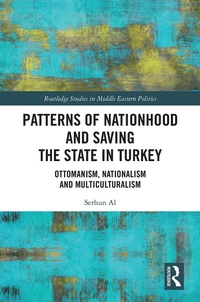
Patterns of Nationhood and Saving the State in Turkey
Ottomanism, Nationalism and Multiculturalism
1st Edition
Published on 16. January 2019
194 pages
978-0-429-75669-6 (ISBN)
Description

Patterns of Nationhood and Saving the State in Turkey tackles a theoretical puzzle in understanding the state policy changes toward minorities and nationhood, first by placing the state in the historical context of the international system and second by unpacking the state through analysis of intra-elite competition in relation to the counter-discourses by minority groups within the context of the Ottoman Empire and Turkey.
What explains the persistence and change in state policies toward minorities and nationhood? Under what conditions do states change their policies toward minorities? Why do the state elites reconsider the state-minority relations and change government policies toward nationhood? Adopting a comparative-historical analysis, the book unpacks these research questions and builds a theoretical framework by looking at three paradigmatic policy changes: Ottomanism in the mid-19th century, Turkish nationalism in the early 1920s, and multiculturalism in Turkey in the early 2000s. While the book reveals the role of international context, intrastate elite competition, and non-state actors in such policy changes, it argues that state elites adopt either exclusionary or inclusionary policies based on the idea of "survival of the state."
The book is primarily an important contribution to studies in ethnicity and nationalism. It is also an essential resource for students and scholars interested in Comparative Politics, Middle East Studies, the Ottoman Empire, and Turkey.
What explains the persistence and change in state policies toward minorities and nationhood? Under what conditions do states change their policies toward minorities? Why do the state elites reconsider the state-minority relations and change government policies toward nationhood? Adopting a comparative-historical analysis, the book unpacks these research questions and builds a theoretical framework by looking at three paradigmatic policy changes: Ottomanism in the mid-19th century, Turkish nationalism in the early 1920s, and multiculturalism in Turkey in the early 2000s. While the book reveals the role of international context, intrastate elite competition, and non-state actors in such policy changes, it argues that state elites adopt either exclusionary or inclusionary policies based on the idea of "survival of the state."
The book is primarily an important contribution to studies in ethnicity and nationalism. It is also an essential resource for students and scholars interested in Comparative Politics, Middle East Studies, the Ottoman Empire, and Turkey.
Reviews / Votes
"Serhun Al makes a major conceptual contribution by developing a fourfold typology of nationhood, while offering "hyphenated Turkishness" both as a theoretical possibility and a better description of empirical reality in a changing society. Theorizing at the intersection of international relations and domestic politics, Al's book inspires fresh thinking about Turkey's past, present, and future." Sener Aktuerk, Koc University, Turkey"This book explains when states change their minority policies through an insightful historical analysis based on the Turkish case. It combines an in-depth case study with rigorous theoretical and conceptual discussion. As such this study will be indispensable to scholars and students interested in nation-building, national identity construction, and state-minority relations." Senem Aslan, Bates College, US
"Serhun Al's theoretically guided, empirically rooted and historically grounded work helps us to understand when and under what conditions state policies toward minorities change. He has produced an important and erudite contribution to a set of hotly contested topics in the study of state-minority relations by focusing on Ottomanism, Turkish nationalism, and multiculturalism. This is a very significant contribution to the literature on nationalism, state-minority relations and Turkish studies. This is a remarkable achievement." Professor M. Hakan Yavuz, University of Utah, US
"Serhun Al has written a theoretically grounded and historically-informed book about identity politics and divergent state elite policies towards minorities from the late Ottoman Empire until the modern era, where policies varied from inclusion to exclusion. Patterns of Nationhood and Saving the State in Turkey is a welcome contribution to the literature on nationalism, state-making and identity politics. Having a genuine comparative perspective from various geographical regions and an interdisciplinary analysis, Patterns of Nationhood establishes linkages between international norms and domestic political actors, while at the same time offering a fresh and astute look at identity-formation and the politics of nationalism from the late nineteenth century until the twenty-first century." Umut Uzer, Istanbul Technical University, Turkey
More details
Series
Edition
1. Auflage
Language
English
Place of publication
London
United Kingdom
Publishing group
Taylor & Francis Ltd
Target group
College/higher education
Product notice
Reflowable
Illustrations
1 Line drawings, black and white; 1 Illustrations, black and white
File size
0,58 MB
ISBN-13
978-0-429-75669-6 (9780429756696)
Copyright in bibliographic data and cover images is held by Nielsen Book Services Limited or by the publishers or by their respective licensors: all rights reserved.
Schweitzer Classification
Other editions
Additional editions
Serhun Al
Patterns of Nationhood and Saving the State in Turkey
Ottomanism, Nationalism and Multiculturalism
Book
09/2020
1st Edition
Routledge
€54.55
Shipment within 15-20 days
Serhun Al
Patterns of Nationhood and Saving the State in Turkey
Ottomanism, Nationalism and Multiculturalism
Book
01/2019
1st Edition
Routledge
€206.10
Shipment within 10-20 days
Person
Serhun Al is Assistant Professor in the Department of Political Science and International Relations at Izmir University of Economics, Turkey. His main research interests include the politics of identity, ethnic conflict, and security studies within the context of Turkish and Kurdish politics. He is the co-editor of a recent book entitled Comparative Kurdish Politics in the Middle East: Actors, Ideas, and Interests (Palgrave, 2018).
Content
Introduction 1. The State-Minority relations and Nationhood: The Question of Inclusion/ Exclusion 2. Patterns of Legal and Ethnic Inclusion/ Exclusion: A Conceptual Framework of Nationhood 3. Imperial Ottoman into a Republican Turk: A Brief History of Transition 4. Anatomy of a Nationhood: The Essentials of Post-Ottoman Turkishness 5. New World Order, Weak State, and the Emergence of Ottomanism and Ottoman Homeland (Vatan) 6. Post World War I Order, Nationalist Elites and the making of Monolithic Turkishness 7. The Post-Cold War World, Decline of the Kemalists, and Back to the Ottoman Future of Unity in Diversity 8. Conclusion: Ontological (In)Security, the State and Minorities References
