

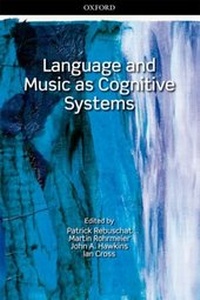
Language and Music as Cognitive Systems
1st Edition
Published on 3. November 2011
357 pages
978-0-19-162549-7 (ISBN)
Description

The past 15 years have witnessed an increasing interest in the comparative study of language and music as cognitive systems. Language and music are uniquely human traits, so it is not surprising that this interest spans practically all branches of cognitive science, including psychology, computer science, linguistics, cognitive neuroscience, and education. Underlying the study of language and music is the assumption that the comparison of these two domains can shed light on the structural and functional properties of each, while also serving as a test case for theories of how the mind and, ultimately, the brain work. This book presents an interdisciplinary study of language and music, bringing together a team of leading specialists across these fields. The volume is structured around four core areas in which the study of music and language has been particularly fruitful: (i) structural comparisons, (ii) evolution, (iii) learning and processing, and (iv) neuroscience. As such it provides a snapshot of the different research strands that have focused on language and music, identifying current trends and methodologies that have been (or could be) applied to the study of both domains, and outlining future research directions. This volume is valuable in promoting the investigation of language and music by fostering interdisciplinary discussion and collaboration. With an ever increasing interest in both music cognition and language, this book will be valuable for students and researchers of psychology, linguistics, neuroscience, and musicology.
More details
Other editions
Additional editions
Patrick Rebuschat | Martin Rohrmeier | John A. Hawkins
Language and Music as Cognitive Systems
Book
11/2011
Oxford University Press
€82.94
Shipment within 15-20 days
Content
- Cover
- Contents
- Contributors
- Introduction
- Section 1 Structural comparisons
- 1 Introduction
- 2 Grouping in the stressing of words, in metrical verse, and in music
- 3 The Fabb-Halle approach to metrical stress theory as a window on commonalities between music and language
- 4 Metrical structure and the prosodic hierarchy
- 5 Metre is music: a reply to Fabb and Halle
- 6 Comments and a conjecture inspired by Fabb and Halle
- 7 Response to commentaries
- Section 2 Evolution
- 8 Introduction
- 9 The biology and evolution of rhythm: unravelling a paradox
- 10 Darwin's musical protolanguage: an increasingly compelling picture
- 11 The significance of stones and bones: understanding the biology and evolution of rhythm requires attention to the archaeological and fossil record
- 12 A grand gesture: vocal and corporeal control in melody, rhythm, and emotion
- 13 An ethnomusicological perspective on animal 'music' and human music: the paradox of 'the paradox of rhythm'
- 14 Reweaving the strands: welcoming diverse perspectives on the biology of music
- Section 3 Learning and processing
- 15 Introduction
- 16 Musical communication as alignment of brain states
- 17 Communicating structure, affect, and movement
- 18 Computer models of (music) cognition
- 19 Alignment in language and music
- 20 Alignment of brain states: response to commentaries
- Section 4 Neuroscience
- 21 Introduction
- 22 Language, music, and the brain: a resource-sharing framework
- 23 Response to target article 'Language, music, and the brain: a resource-sharing framework'
- 24 Advances in neuroimaging techniques: implications for the shared syntactic integration resource hypothesis
- 25 Schemas, not syntax: a reply to Patel
- 26 Advancing the comparative study of linguistic and musical syntactic processing
- 27 Music, language, and modularity in action
- 28 Human subcortical auditory function provides a new conceptual framework for considering modularity
- 29 What remains of modularity?
- 30 Language, music, and children's brains: a rhythmic timing perspective on language and music as cognitive systems
- 31 Towards the role of working memory in pitch processing in language and music
- 32 Modularity in music relative to speech: framing the debate
- Section 5 Conclusion
- 33 Music as a social and cognitive process
- Index
- A
- B
- C
- D
- E
- F
- G
- H
- I
- J
- K
- L
- M
- N
- O
- P
- Q
- R
- S
- T
- U
- V
- W
- X
- Y
- Z
