

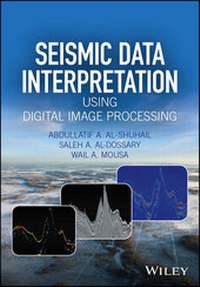
Seismic Data Interpretation using Digital Image Processing
Description

More details
Other editions
Additional editions
Persons
Content
Foreword
Human beings are experts at pattern recognition. We are well equipped to find a missing set of keys in a cluttered drawer, to find a family member in a crowd, to find the image of a cow in the clouds, or to find a mythological character in a constellation of stars. Such pattern recognition is key to seismic data analysis, where a human interpreter identifies and integrates the amplitude, spectral content, waveform, and geometric configuration of the seismic response to the underlying geology with an appropriate tectonic, depositional, or diagenetic model. For a seasoned interpreter, much of this pattern recognition is done subconsciously, requiring little conscious thought, much like pedaling and maintaining your balance on a bicycle. However, advances in seismic acquisition and processing technology are increasing more rapidly than the number of seismic interpreters. Some modern seismic surveys may be 100 Gbytes in size, while merged surveys may be larger still. It has become increasingly intractable for an interpreter to examine each and every seismic voxel.
Seismic attributes attempt to reduce the amount of data the interpreter needs to examine by capturing the same key components used in the conventional interpretation of vertical seismic amplitude sections. All attributes except the input seismic amplitude data itself implicitly or explicitly define an analysis window. Instantaneous attributes are, in reality, not instantaneous, but rather integrate the information of neighboring samples through the use of a Hilbert transform. Spectral magnitude and phase components use the information of neighboring samples on a seismic trace, while post-stack impedance inversion uses the information content of all the overlying samples as well. Geometric attributes such as coherence, curvature, and texture analysis operate in a three-dimensional (3D) window, including neighboring seismic samples and traces, often oriented along structural dip. Amplitude versus offset, inversion for P- and S-impedances, and estimates of amplitude versus azimuth increase the size of the data to be analyzed further. By extracting such key components as an auxiliary attribute volume, an experienced interpreter can now rapidly animate through time or depth slices to identify subtle, and otherwise easily overlooked, channels, mounds, collapse, slumps, faults, and folds, as well as zones of anomalous porosity or anisotropy. Equally important, other professionals, including stratigraphers, structural geologists, drilling engineers, and completion engineers, now have access to images that have removed much of the overprint of the seismic wavelet and begin to mimic interpreted geologic cross-sections and maps.
While geoscientists call such resulting images seismic attribute volumes, most of the scientific world refers to them as the results of image processing. Recent advances in medical X-ray analysis, positron emission tomography-computed tomography scans, video images, and meteorological data have not yet been applied to 3D seismic data volumes. For example, can one apply techniques to map the corkscrew veins seen in 3D images of a human kidney to mapping crosscutting channels in a fluvial deltaic complex? Can one apply techniques used to monitor changes in land use of a suspected terrorist or narcotics site to monitor changes due to reservoir completion? Can one use techniques in Doppler radar to map tornadoes to identify potential drilling hazards seen in seismic anisotropy? While most seismic interpreters have a rudimentary understanding of human anatomy, land use, and weather, few radiologists, security analysts, and meteorologists, let alone algorithm developers with a traditional electric engineering background, have a good understanding of geology and geologic processes, let alone geology convolved with a seismic wavelet.
The authors of Seismic Data Interpretation Using Digital Image Processing, Al-Shuhail, Al-Dossary, and Mousa, are among the few who have bridged the gap between modern image processing practiced by the scientific community at large and the world of geology and reflection seismology. This book bridges the gap in both ways, providing a path for non-geoscience image processors to better understand the seismic interpretation process through real data examples, and a path for geoscientists by presenting modern image-processing algorithms in the context of filters and convolutional operators routinely used in seismic data analysis.
The authors begin in Chapter 1 with a succinct synopsis of the seismic experiment from acquisition to processing, emphasizing the alternative formats of seismic data display.
In Chapter 2 the authors define and illustrate geologic concepts of structure and stratigraphy through their seismic expression. They draw heavily upon online examples published in the Virtual Seismic Atlas, showing slices through the data with and without interpretation of horizons, faults, unconformities, channels, slumps, gas hydrates, and carbonate buildups. In this manner, the reader sees the seismic amplitude data by itself and is able to mentally reconstruct the process by which human interpreters make their analysis. The more algorithmic reader can mentally apply their favorite image-processing method to determine if it might be able to reproduce such an interpretation. The chapter continues with a summary of the more common seismic interpretation tools, including concepts of seismic sequence stratigraphy, seismic facies analysis, direct hydrocarbon indicators, seismic ties to well logs, and the value of seismic modeling. The chapter concludes by summarizing some of the more common interpretation pitfalls to both human interpretation and imaging processing, including velocity pull-up and push-down and over- or undermigrated data.
In contrast to Chapter 2, which focuses on building a bridge for the non-geoscience algorithm developer into the world of geoscience, Chapters 3, Chapters 3, 4, and 5 focus on building a bridge for the geoscientist to cross into the world of image processing. Chapters 3 and 4 introduce concepts of spatial seismic image enhancement, an area geoscientists call data conditioning. These filters, and indeed most filters in the book, are summarized as simple convolutional stencils that are easily grasped by a seismic interpreter. In contrast to Chapter 2, where the authors show the rich diversity of the seismic expression of geology, Chapters 3, 4, and 5 present a single example from the NW Arabian Peninsula to illustrate the rich diversity of image-processing algorithms. The mathematics are presented simply and clearly, with the important concepts of nonlinear versus linear filters accurately addressed. Chapter 3 uses spatial filters oriented along geologic structure, while Chapter Chapters 3, 4 addresses the same problem with two-dimensional spectral filters applied to time or depth slices. The interpretive value of alternative data-conditioning techniques described in Chapters 3 and 4 is demonstrated using a single image-processing tool, the Sobel filter edge detector, allowing easy comparison of alternative workflows.
The input and output of the algorithms described in Chapters 3 and 4 are the original and an enhanced version of the seismic amplitude data. The input of the algorithms described in Chapter 5 is, in general, the enhanced version of the seismic amplitude data, while the output is a quantitative measure of the lateral change in seismic waveform and amplitude. This collection of edge detectors, orientation and shape estimators, and texture analysis image-processing tools are called seismic attributes by geoscientists. Good attributes enhance and delineate subtle features in the geology that might otherwise be overlooked. The various edge-detection algorithms described in Chapter 5 can be used to map faults, joints, channel edges, and slumps. As in Chapter 3, the edge detection and, later in the chapter, noise estimation algorithms of Chapter 5 are presented as simple stencils. The dip and curvature algorithms map folds, flexures, and faults that fall below seismic resolution and appear to be faults.
Chapter 6 begins with multiattribute display using HSI, RGB, and CMYK color gamuts. Such coloring is an interpreter-driven form of clustering and forms the basis for subsequent discussions of image segmentation using projections onto convex sets and graph-based algorithms.
In the final chapter, Chapter 7, the authors give an overview of important image segmentation techniques and show how to adapt them for seismic data interpretation using real seismic data examples. The inputs to these techniques are preferably seismic attribute images, while the outputs are subsets of these images that constitute target geologic elements, including horizons, channels, and diapirs. The chapter concludes with a summary of a popular automatic fault extraction algorithm.
Seismic Data Interpretation Using Digital Image Processing is an excellent book for both undergraduate and graduate students in signal processing, graduate students in geology and geophysics, and experienced seismic interpreters who want to look "under the hood" to learn how these different algorithms work. Most of the chapters are followed by a carefully constructed suite of questions and exercises to solidify mastery of the key concepts. Since most prefer to "learn by doing", the Matlab exercises at the end of each chapter, the Matlab and C codes and seismic data sets available on the book's website are particularly effective parts of the book.
I...
