

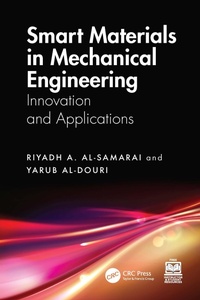
Smart Materials in Mechanical Engineering
Innovation and Applications
Will be published approx. on 16. June 2026
316 pages
978-1-040-88582-6 (ISBN)
Description

Smart Materials in Mechanical Engineering: Innovation and Applications serves as a comprehensive educational resource that bridges traditional mechanical engineering principles with contemporary smart technology applications. This essential guide explores how artificial intelligence, automation, and advanced materials are revolutionizing mechanical engineering across the manufacturing, transportation, energy, and healthcare industries.
Readers gain access to a complete framework for transforming mechanical engineering through smart materials, IoT integration, and AI-driven systems. Content builds progressively from fundamental concepts to advanced topics, including machine learning algorithms, digital twins, and adaptive systems. Each chapter features learning objectives, worked examples, and end-of-chapter problems to support both theoretical understanding and practical application. Detailed case studies examine real-world applications, such as autonomous vehicles, smart prosthetics, and self-healing materials, while addressing critical challenges including cost analysis, security considerations, and ethical implications. Coverage highlights future trends in sustainable mechanical innovation and explores emerging applications across key industry sectors.
This book is designed for undergraduate and graduate students in mechanical, industrial, and materials engineering programs, as well as engineering professionals pursuing continuing education in smart technologies. The structured content supports both classroom instruction and self-directed learning, making it ideal for integrating smart technologies into traditional mechanical engineering practice.
Comprehensive practice problems, extended case studies, and practical applications appear throughout. A complete solutions manual is available for qualified textbook adoption to support effective course delivery and student engagement.
Readers gain access to a complete framework for transforming mechanical engineering through smart materials, IoT integration, and AI-driven systems. Content builds progressively from fundamental concepts to advanced topics, including machine learning algorithms, digital twins, and adaptive systems. Each chapter features learning objectives, worked examples, and end-of-chapter problems to support both theoretical understanding and practical application. Detailed case studies examine real-world applications, such as autonomous vehicles, smart prosthetics, and self-healing materials, while addressing critical challenges including cost analysis, security considerations, and ethical implications. Coverage highlights future trends in sustainable mechanical innovation and explores emerging applications across key industry sectors.
This book is designed for undergraduate and graduate students in mechanical, industrial, and materials engineering programs, as well as engineering professionals pursuing continuing education in smart technologies. The structured content supports both classroom instruction and self-directed learning, making it ideal for integrating smart technologies into traditional mechanical engineering practice.
Comprehensive practice problems, extended case studies, and practical applications appear throughout. A complete solutions manual is available for qualified textbook adoption to support effective course delivery and student engagement.
More details
Language
English
Place of publication
London
United Kingdom
Publishing group
Taylor & Francis Ltd
Target group
College/higher education
Product notice
Reflowable
Illustrations
13 Tables, black and white; 52 Line drawings, color; 108 Halftones, color; 160 Illustrations, color
File size
45,76 MB
ISBN-13
978-1-040-88582-6 (9781040885826)
Copyright in bibliographic data and cover images is held by Nielsen Book Services Limited or by the publishers or by their respective licensors: all rights reserved.
Schweitzer Classification
Other editions
Additional editions
Riyadh A. Al-Samarai | Yarub Al-Douri
Smart Materials in Mechanical Engineering
Innovation and Applications
Book
approx. 06/2026
1st Edition
CRC Press
€161.50
Not yet published
Persons
Riyadh A. Al-Samarai is the Assistant Dean for Scientific Affairs, Faculty of Engineering, at the University of Samarra, Iraq. Prof. Al-Samari has more than three decades of academic and professional experience, including 32 years of research activity, 23 years of university teaching, and 16 years in academic leadership and administrative positions. Prof. Al-Samarai played a pivotal role in establishing the Bachelor's degree programs in the College of Engineering at Samarra University, as well as in launching the MSc program in Electromechanical Engineering at the same institution. In recognition of his outstanding scientific and academic contributions, he was awarded the Iraqi Scientific Excellence Award in 2024 and was honored by the Iraqi Minister of Higher Education and Scientific Research for authoring the Best Engineering Book among Iraqi Universities for the year 2024. His honors and awards also include winning the Creativity Award for Scientists in Malaysia, the Iraqi Forum for Intellectuals and Academics (IFIA) Award, and the Best Research Paper Award at the Conference of Asian Universities in Malaysia. He is the managing editor of the Samarra University of Engineering and Science Journal, with research interests including advanced manufacturing, applied mechanics, materials engineering, and electromechanical systems.
Yarub Al-Douri is a Professor at Al-Bayan University, Iraq; Piri Reis University, Turkey; and University of Malaya, Malaysia. He has 31 years of research experience, 25 years of university teaching experience, 12 years of administrative experience and more than 860 publications. Dr. Al-Douri has supervised many postgraduate students, reviewed for 34 peer-reviewed journals, and organized and chaired international conferences. He is a Fellow of the European Academy of Sciences, the Islamic World Academy of Sciences, and the Arab Thought Forum, as well as an IETI Distinguished Fellow. His awards include the NCPD International Prize (2025), the Khalifa International Award for Date Palm and Agricultural Innovation (2024), the ICTP-Arab Fund Associateships (2024-2026), and the IAAM Scientist Award (2022). Dr. Al-Douri is known for his contributions to nanotechnology and renewable energy, with research interests spanning renewable energy, nanotechnology, nanoelectronics, nanomaterials, modeling and simulation, semiconductors, and optical studies.
Yarub Al-Douri is a Professor at Al-Bayan University, Iraq; Piri Reis University, Turkey; and University of Malaya, Malaysia. He has 31 years of research experience, 25 years of university teaching experience, 12 years of administrative experience and more than 860 publications. Dr. Al-Douri has supervised many postgraduate students, reviewed for 34 peer-reviewed journals, and organized and chaired international conferences. He is a Fellow of the European Academy of Sciences, the Islamic World Academy of Sciences, and the Arab Thought Forum, as well as an IETI Distinguished Fellow. His awards include the NCPD International Prize (2025), the Khalifa International Award for Date Palm and Agricultural Innovation (2024), the ICTP-Arab Fund Associateships (2024-2026), and the IAAM Scientist Award (2022). Dr. Al-Douri is known for his contributions to nanotechnology and renewable energy, with research interests spanning renewable energy, nanotechnology, nanoelectronics, nanomaterials, modeling and simulation, semiconductors, and optical studies.
Content
1. Introduction to Advanced Materials and Their Role in Industry 4.0. 2. Mechanical and Physical Properties of Advanced Materials. 3. Processing and Fabrication Techniques. 4. Fundamentals of Nanostructured Materials. 5. Metallic, Ceramic, and Polymeric Nanomaterials. 6. Industrial Applications of Nanomaterials. 7. Principles of Composite Materials. 8. Perovskite Compounds: Structure, Modification, and Advanced Properties. 9. Automotive and Aerospace Applications of Self-Healing Polymer Nanocomposites. 10. Electronics and Energy Storage Applications of Self-Healing Polymer Nanocomposites.
