

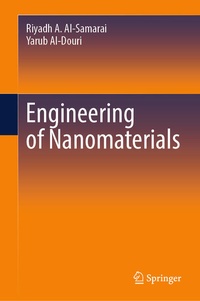
Engineering of Nanomaterials
Description

This book comprehensively covers the development of nanomaterials for applications in life sciences, catalysis and materials engineering. It presents modern, sophisticated solutions to modify the optical, chemical, mechanical and electrical properties of nanomaterials specifically to be used as materials for catalysis, green chemistry, biosensors, medical devices, tissue scaffolds, structural materials, cosmetics, sustainable agriculture, food engineering. In particular, the book deals with carbon nanomaterials (CNMs) for uses in biological, environmental and engineering sciences. The textbook contains didactic elements such as end of chapter problems, worked examples within the chapters and systematic approach to the design of nanomaterials for specific applications; it acts as reference for students and researchers working in the field.
More details
Other editions
Additional editions
Persons
Prof. Dr. Riyadh A. Al-Samarai is Assistant Dean for scientific affairs at the University of Samarra, Faculty of Engineering. Al-Samarrai is Winner of the Iraqi Scientific Excellence Award for the year 2024. He launched a master's program in electromechanical engineering at Samarra University, College of Engineering. He received many honors and awards, including Winner of the Creativity Award for Scientists in Malaysia, and many honors in international forums and scientific conferences, the Iraqi Forum for Intellectuals and Academics (IFIA) Award, and the Best Research Paper Award at the Conference of Asian Universities in Malaysia, a total of 3 awards. Al-Samarai is Managing Editor of the Samarra University of Engineering and Science Journal. Al-Samarai has 32 years of research experience, 23 years of university teaching experience and 16 years of administrative experience.
Prof. Dr. Yarub Al-Douri is Fellow of European Academy of Sciences. Al-Douri is Winner of the prestigious Khalifa International Award for Date Palm and Agricultural Innovation 2024. He has initiated Nanotechnology Engineering M.Sc. Program and Nano Computing Laboratory. He has received numerous accolades including Winner of IAAM Scientist Award by International Association of Advanced Materials, Sweden 2023, 2022, World's Top 2% Scientists by Stanford University, USA, 2025, 2024, 2023, 2022, 2021 and 2020, World's Top 2% Scientist Career-Long Citation Impact by Stanford University, USA, 2020, OeAD Award, Austria, 2020, Japan Society for the Promotion of Science (JSPS) Award 2019, Asian Universities Alliance (AUA) Award 2019, Iraqi Forum for Intellectuals and Academics Award (IFIA) 2019, TWAS-UNESCO Associateship (Twice) Award 2015 and 2012 and Best Paper Award at Global Conference on Energy and Sustainable Development in UK 2015, the total is 81 awards.
Content
Prospects for the Development of Nanomaterials.- Catalysts in Nanomaterials.- Map to Nanomaterials through Green Nanotechnology.- Glucose Sensor using Metal Nanoparticles.- Nanocoatings: Design, Development and Application.- Nanocomposites-based Sensors and Medical Devices.- Nanomaterials' Significance in Engineering Applications.- Thin Film Synthesis and its Applications.- Nanofiber Applications in Tissue Engineering.- Applications of Nanocomposites.
