

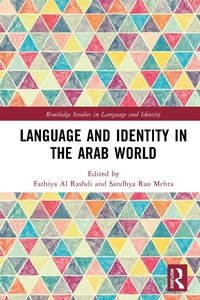
Language and Identity in the Arab World
1st Edition
Published on 5. September 2022
344 pages
978-1-000-61305-6 (ISBN)
Description

Language and Identity in the Arab World explores the inextricable link between language and identity, referring particularly to the Arab world. Spanning Indonesia to the United States, the Arab world is here imagined as a continually changing one, with the Arab diaspora asserting its linguistic identity across the world.
Crucial questions on transforming linguistic landscapes, the role and implications of migration, and the impact of technology on language use are explored by established and emerging scholars in the field of applied and socio-linguistics. The book asks such crucial questions as how language contact affects or transforms identity, how language reflects changing identities among migrant communities, and how language choices contribute to identity construction in social media. As well as appreciating the breadth and scope of the Arab world, this anthology focuses on the transformative role of language within indigenous and migrant communities as they negotiate between their heritage languages and those spoken by the wider society.
Investigating the ways in which identity continues to be imagined and re-constructed in and among Arab communities, this book is indispensable to students, teachers, and anyone who is interested in language contact, linguistic landscapes, and minority language retention as well as the intersections of language and technology.
Crucial questions on transforming linguistic landscapes, the role and implications of migration, and the impact of technology on language use are explored by established and emerging scholars in the field of applied and socio-linguistics. The book asks such crucial questions as how language contact affects or transforms identity, how language reflects changing identities among migrant communities, and how language choices contribute to identity construction in social media. As well as appreciating the breadth and scope of the Arab world, this anthology focuses on the transformative role of language within indigenous and migrant communities as they negotiate between their heritage languages and those spoken by the wider society.
Investigating the ways in which identity continues to be imagined and re-constructed in and among Arab communities, this book is indispensable to students, teachers, and anyone who is interested in language contact, linguistic landscapes, and minority language retention as well as the intersections of language and technology.
More details
Series
Edition
1. Auflage
Language
English
Place of publication
London
United Kingdom
Publishing group
Taylor & Francis Ltd
Target group
Professional and scholarly
Product notice
Reflowable
Illustrations
20 Tables, black and white; 26 Line drawings, black and white; 29 Halftones, black and white; 55 Illustrations, black and white
ISBN-13
978-1-000-61305-6 (9781000613056)
Copyright in bibliographic data and cover images is held by Nielsen Book Services Limited or by the publishers or by their respective licensors: all rights reserved.
Schweitzer Classification
Other editions
Additional editions
Fathiya Al Rashdi | Sandhya Rao Mehta
Language and Identity in the Arab World
Book
10/2024
1st Edition
Routledge
€64.00
Shipment within 10-20 days
Fathiya Al Rashdi | Sandhya Rao Mehta
Language and Identity in the Arab World
Book
09/2022
1st Edition
Routledge
€207.10
Shipment within 10-20 days
Persons
Fathiya Al Rashdi is Assistant Professor in Sociolinguistics and Discourse Analysis, Sultan Qaboos University, Oman, and Editorial Board Member of Discourse, Context and Media .
Sandhya Rao Mehta is Associate Professor of Global Literature, Sultan Qaboos University, Oman, and Editor of three critical anthologies, including Language Studies: Stretching the Boundaries and Language and Literature in a Glocal World.
Sandhya Rao Mehta is Associate Professor of Global Literature, Sultan Qaboos University, Oman, and Editor of three critical anthologies, including Language Studies: Stretching the Boundaries and Language and Literature in a Glocal World.
Content
List of Tables
List of Figures
List of Maps
List of Contributors
Preface
INTRODUCTION
Sandhya Rao Mehta
PART 1: LINGUISTIC LANDSCAPES
Persia and Oman: A Historical and Linguistic Intersection
Roberta Morano
Landscaping in Moroccan Arabic: Practices, Ideologies and Inertias
Adil Moustaoui
Arabic in Michigan: An American Linguistic Landscape
Camelia Suleiman
Translanguaging in Gulf Higher Education
Sarah Hopkyns
Linguistic and Conceptual Challenges of Public Opinion Surveys in the Arab Gulf States
Russell Lucas
PART II: UNPACKING IDENTITIES
A Place to Belong: The Social Construction of Badu identity in Harub, Saudi Arabia
Julie Lowry
Intersecting Scapes, Global Flows, and New Identity Options: Female Qatari Students' Informal Learning of Turkish Language
Sarah Hillman
Arab Influencers and Social Media: A Sociolinguistic Study of a New Culture
Mai Zaki and Meis Al-Kaisi
Multilingualism in Lebanon: Code-switching as a Cultural Representation
Lubna Bassam
Perceptions towards Codeswitching and Identity in the Egyptian Context
Nadia A. Shalaby
PART III: ARABIC IN MIGRANT COMMUNITIES
Dialect Variation among Omani Migrants in Muscat: The Construction of Social Identity through Style Shifting
Suaad Ambu-Saidi
Identity Suppression as a Coping Strategy: The Case of Socotri Africans
Eleonora Esposito and Sarali Gintsburg
The Role of Education and Dialect Contact in the Realization of DHAA & THAA in a Community of Palestinian Refugees in Syria
Ourooba Shetewi
Family Language Policy between Ideology and Practice: A Domain-based Exploration of Arabic as a Heritage Language in the USA
Reda Mohammed
The Linguistics of ?a?rami Arabic in the Speech of ?a?rami-descent Community of Indonesia
Abdullah Al Saqqaf
Index
List of Figures
List of Maps
List of Contributors
Preface
INTRODUCTION
Sandhya Rao Mehta
PART 1: LINGUISTIC LANDSCAPES
Persia and Oman: A Historical and Linguistic Intersection
Roberta Morano
Landscaping in Moroccan Arabic: Practices, Ideologies and Inertias
Adil Moustaoui
Arabic in Michigan: An American Linguistic Landscape
Camelia Suleiman
Translanguaging in Gulf Higher Education
Sarah Hopkyns
Linguistic and Conceptual Challenges of Public Opinion Surveys in the Arab Gulf States
Russell Lucas
PART II: UNPACKING IDENTITIES
A Place to Belong: The Social Construction of Badu identity in Harub, Saudi Arabia
Julie Lowry
Intersecting Scapes, Global Flows, and New Identity Options: Female Qatari Students' Informal Learning of Turkish Language
Sarah Hillman
Arab Influencers and Social Media: A Sociolinguistic Study of a New Culture
Mai Zaki and Meis Al-Kaisi
Multilingualism in Lebanon: Code-switching as a Cultural Representation
Lubna Bassam
Perceptions towards Codeswitching and Identity in the Egyptian Context
Nadia A. Shalaby
PART III: ARABIC IN MIGRANT COMMUNITIES
Dialect Variation among Omani Migrants in Muscat: The Construction of Social Identity through Style Shifting
Suaad Ambu-Saidi
Identity Suppression as a Coping Strategy: The Case of Socotri Africans
Eleonora Esposito and Sarali Gintsburg
The Role of Education and Dialect Contact in the Realization of DHAA & THAA in a Community of Palestinian Refugees in Syria
Ourooba Shetewi
Family Language Policy between Ideology and Practice: A Domain-based Exploration of Arabic as a Heritage Language in the USA
Reda Mohammed
The Linguistics of ?a?rami Arabic in the Speech of ?a?rami-descent Community of Indonesia
Abdullah Al Saqqaf
Index
