

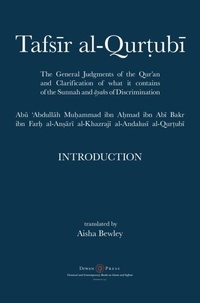
Tafsir al-Qurtubi - Introduction
Description

The tafsir of al-Qur¿ubi is perhaps one of the most compendious of them all and is certainly among the most famous. As its title, al-Jami' li A¿kam al-Qur'an - The General Judgments of the Qur'an, suggests, its main focus is on the rulings and judgments to be found in the Qur'an. However, in the course of doing that, al-Qur¿ubi examines all the relevant sciences necessary, such as the ¿adith pertaining to the ayahs, events in the sirah, what the Companions, their Followers and other noted people of knowledge said about the ayahs, essential aspects of Arabic etymology, syntax and usage, copiously illustrated by examples, and much more. In this introduction, the author lays out some of the key themes of the Qur'an: Its virtues and the reciter's; how to recite it; cautioning against showing off; what the one who knows the Qur'an must do and not neglect to do; learning its syntax; the excellence of tafsir; the excellence of the bearer of the Qur'an; the respect and esteem mandatory for the Qur'an; threats against engaging in tafsir by means of opinion (ra'y); the Book being explained by the Sunnah; how to learn and understand the Book of Allah and the Sunnah of His Prophet s; that it used to be easier to act by it than to memorise it; the words of the Prophet s; "The Qur'an was revealed in seven a¿ruf (dialects/modes)"; the seven readings; the collection of the Qur'an; the memorisation of the Qur'an by the Companions at the time of the Prophet s; the order of the surahs and ayahs of the Qur'an; the meaning of the words surah, ayah, kalimah (word) and ¿arf (letter); non-Arabic words in the Qur'an; the inimitability of the Qur'an; hadiths forged about the excellence of the surahs of the Qur'an; refutation of those who attack the Qur'an; the Seeking Refuge with Allah from Shay¿an and the Basmalah. Diwan Press will be publishing the entire tafsir in 30 volumes along with the Introduction. Abu Mu¿ammad ibn A¿mad ibn Abi Bakr ibn Far¿ al-An¿ari al-Khazraji al-Andalusi al-Qur¿ubi (610-11 AH/1214 CE - 671 AH/1273 CE) was born in Cordoba in Spain, but moved in 1236 to Cairo in Egypt, where he lived until his death. He was Maliki in fiqh, and although he composed other works, he is most famous for this tafsir. Aisha Bewley is the translator of a large number of classical works of Islam and Sufism, often in collaboration with Abdalhaqq Bewley, notably The Noble Qur'an - a New Rendering of Its Meanings in English; Muhammad, Messenger of Allah - the translation of Qa¿i 'Iya¿'s ash-Shifa'; the Muwa¿¿a' of Imam Malik ibn Anas; and Imam an-Nawawi's Riya¿ a¿-¿ali¿in.
More details
Persons
Content
The general virtues of the Qur'an and encouragement to study it. The excellence of the one who seeks it, recites it, listens to it and acts by it.
How to recite the Book of Allah and what is disliked and forbidden in respect of it, and people's disagreement about that
Cautioning the people of the Qur'an and scholars against showing off
What someone who knows the Qur'an must do and not neglect to do
The syntax of the Qur'an, learning it and studying it, and the reward for the one who recites the Qur'an with proper inflections
What is reported about the excellence of tafsir of the Qur'an and those who do it
What is reported about the one who is a bearer of the Qur'an, who he is and those who are hostile to him
The respect and esteem for the Qur'an which is mandatory for someone who recites and bears the Qur'an
What is reported regarding threats against engaging in tafsir of the Qur'an by means of opinion (ra'y) or being bold in doing that, and the ranks of the commentators
The Book being explained by the Sunnah, and what has been transmitted about that
How to learn and understand the Book of Allah and the Sunnah of His Prophet g, and what has been narrated about it being easier for someone who used to act by it without memorising it
The meaning of the words of the Prophet g, "The Qur'an was revealed in seven a¿ruf (dialects/modes)."
Section on the seven readings
Section: The hadith of 'Umar and Hisham
The collection of the Qur'an and the reason 'Uthman had copies of the Qur'an copied out and burned the rest. The memorisation of the Qur'an by the Companions in the time of the Prophet g
Section
Section
What has come about the order of the surahs and ayahs of the Qur'an, its vowelling and dots, its ¿izbs and tens, the number of its letters, juz's, words and ayahs
Section
Section
Section
Section
The meaning of the words surah, ayah, kalimah (word) and ¿arf (letter)
Does the Qur'an contain words which are not Arabic?
Points about the inimitability of the Qur'an, preconditions of the miracle and its reality
Section
Information about hadiths forged about the excellence of the surahs of the Qur'an and other matters
What has come on the refutation of those who attack the Qur'an and oppose the text of 'Uthman by adding to it or removing some of it
Seeking Refuge with Allah from Shay¿an
The Basmalah
