

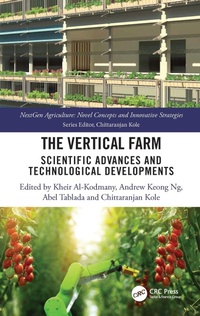
The Vertical Farm
Scientific Advances and Technological Developments
1st Edition
Published on 25. October 2024
228 pages
978-1-040-12674-5 (ISBN)
Description

Amid economic uncertainties, fluctuating oil prices, and a rising environmental consciousness, the need for sustainable and efficient food production has become dire. The Vertical Farm: Scientific Advances and Technological Developments systematically navigates the realm of vertical farming (VF), rooted in a robust, scientific foundation. Unveiling the intricate convergence of plant biology, environmental science, and agronomy, it provides a profound understanding of contemporary agriculture. The book spans lighting systems and climate control mechanisms, focusing on sustainability. From small urban initiatives to significant commercial endeavors, real-world case studies showcase VF's adaptability, scalability, and resilience. Addressing multiple challenges, the book explores economic considerations and public perceptions, recognizing their roles in fostering meaningful advancements in agricultural innovation.
A volume in the Nextgen Agriculture series, this book is valuable to scientists, practitioners, and students in urban agriculture and planning, horticulture, engineering, landscape architecture, and plant/technology sciences.
A volume in the Nextgen Agriculture series, this book is valuable to scientists, practitioners, and students in urban agriculture and planning, horticulture, engineering, landscape architecture, and plant/technology sciences.
More details
Series
Edition
1. Auflage
Language
English
Place of publication
London
United Kingdom
Publishing group
Taylor & Francis Ltd
Target group
Professional and scholarly
Illustrations
30 Tables, black and white; 26 Line drawings, black and white; 57 Halftones, black and white; 83 Illustrations, black and white
ISBN-13
978-1-040-12674-5 (9781040126745)
Copyright in bibliographic data and cover images is held by Nielsen Book Services Limited or by the publishers or by their respective licensors: all rights reserved.
Schweitzer Classification
Other editions
Additional editions
Kheir Al-Kodmany | Andrew Keong Ng | Abel Tablada
The Vertical Farm
Scientific Advances and Technological Developments
Book
10/2024
1st Edition
CRC Press
€205.00
Shipment within 10-20 days
Kheir Al-Kodmany | Andrew Keong Ng | Abel Tablada
The Vertical Farm
Scientific Advances and Technological Developments
Book
10/2024
1st Edition
CRC Press
€67.50
Shipment within 10-20 days
Persons
Dr. Kheir Al-Kodmany, an internationally reputed Professor of Urban Planning at the University of Illinois Chicago (UIC), boasts a prolific career spanning 30 years. His extensive research and teaching portfolio encompass diverse subjects, including vertical urbanism, sustainable design, Geographic Information Systems (GIS), visualization systems, public participation, crowd management, economic development, and skyscrapers. A prolific author, Dr. Al-Kodmany has published 15 books and over 150 scholarly works, earning widespread acclaim for their comprehensive insights into architecture and urban design. His publications are highly regarded, with over 250,000 reads on ResearchGate. Recognized for his academic excellence, he serves on 20 editorial boards of professional journals. Dr. Al-Kodmany's impactful teaching career spans 30 years at UIC and UIUC, where he secured grants totalling several hundred thousand dollars and developed innovative visualization software. Beyond academia, Dr. Al-Kodmany's expertise has been sought by governments, mayors, and organizations worldwide. Notably, the Saudi Government invited him to contribute to the planning of Hajj, earning international recognition for enhancing safety. His involvement in Chicago's "Taste of Chicago" event and contributions to Mayor Daley's bid for the 2016 Summer Olympics further demonstrate his impactful civic engagement. Dr. Al-Kodmany delivered over 200 presentations globally at prestigious institutions as a sought-after keynote speaker and trainer. His leadership roles at UIC, including Director of Graduate Studies, Associate Director of the City Design Center, and the Urban Data Visualization Laboratory Co-Director, demonstrate his commitment to innovative tools in participatory planning and design. Affiliated with esteemed professional organizations such as the APA, ACSP, CTBUH, and URISA, Dr. Al-Kodmany continues to contribute significantly to the field of urban planning, carrying forward the legacy of his early architectural training from his father, Dr. Abdul Muhsen Al-Kodmany, a Le Corbusier trainee and Ecole des Beaux-Arts graduate.
Dr. Andrew Keong Ng is an Associate Professor with Singapore Institute of Technology. He is the Programme Leader of the Master of Science in Mechanical Engineering, the Master of Engineering Technology and the Bachelor of Engineering with Honours in Sustainable Infrastructure Engineering (Land), and the Bachelor of Engineering with Honours in Engineering Systems. Moreover, Dr. Ng is a Chartered Engineer with the UK Engineering Council and serves on the committees of various international and local professional engineering institutions, such as Institute of Electrical and Electronics Engineers (IEEE), Institution of Engineers Singapore (IES), Institution of Engineering and Technology (IET), and Institution of Railway Signal Engineers (IRSE). He is a Senior Member of IEEE and IES; a Consultant and Advisor to startups and multinational corporations; and a Topic Editor of Multidisciplinary Digital Publishing Institute journals. In addition, Dr. Ng is a Principal Investigator of several grants amounting to more than SGD 1.5 million. He holds one international patent and has over 30 publications as both first and corresponding author. His research and development innovations have also garnered him several prestigious awards, such as Outstanding Researcher Award, Teaching Excellence Award, Amity Researcher Award, Young Investigator Award, and National Instruments Editor's Choice Engineering Impact Award. Furthermore, Dr. Ng has been a keynote and an invited speaker at various international conferences. He has also been frequently quoted and interviewed by news media on railway transportation issues and current affairs.
Dr. Abel Tablada is a Full Professor at the Technological University of Havana (CUJAE) where he leads the discipline of Environmental Conditioning and focuses on carbon-neutral architecture and urbanism. He holds a Doctorate in Engineering and a Master of Architecture in Human Settlements from the Katholieke Universiteit Leuven. He also holds a Master of Architecture and Conservation from the Cuban Center for Conservation, Restoration and Museology. Dr. Tablada had a significant role in the Heritage Architecture of the Office of Havana's Historian, focusing on building restoration and research on natural ventilation and thermal comfort. He joined the National University of Singapore in 2011 and cofounded the NUS-CDL Tropical Technologies Lab where he completed a research project on the integration of solar energy and farming systems in productive facades. Dr. Tablada has published over 20 scientific articles and books chapters on urban and building physics, building integrated agriculture, and solar energy systems. He has been a guest professor/lecturer at over 15 universities and institutions and has been awarded with research and design recognitions, including the Japan Prize on urban climate research, two National Prizes on Design and Building Restoration, and a 1st Prize at the Caribbean Biennale of Architecture.
Dr. Chittaranjan Kole is an internationally reputed scientist with an illustrious professional career spanning over thirty-seven years and original contributions in the fields of plant genomics, biotechnology and molecular breeding leading to the publication of more than 160 quality research articles and reviews. He has edited over 150 books for the leading publishers of the world including Springer, Wiley-Blackwell and Taylor and Francis Group. His scientific contributions and editing acumen have been appreciated by seven Nobel Laureates, including Profs. Norman Borlaug, Arthur Kornberg, Werner Arber, Phillip Sharp, Guenter Blobel, Lee Hartwell and Roger Kornberg. He has been honored with a number of Fellowships, Honorary Fellowships, and national and international awards, including the Outstanding Crop Scientist award conferred by the International Crop Science Society. He has served at all prestigious positions in academia including as Vice-Chancellor of BC Agricultural university, Project Coordinator of Indo-Russian Center of Biotechnology in India, and Director of Research of Institute of Nutraceutical Research of Clemson University, in USA. He worked also in the Pennsylvania State University and Clemson University as Visiting Professor in USA. Recently, he has been awarded with the Raja Ramanna Fellow by the Department of Energy, Government of India. He is also heading the International Climate-Resilient Crop Genomics Consortium, International Phytomedomics and Nutriomics Consortium and Genome India International as their founding President.
Dr. Andrew Keong Ng is an Associate Professor with Singapore Institute of Technology. He is the Programme Leader of the Master of Science in Mechanical Engineering, the Master of Engineering Technology and the Bachelor of Engineering with Honours in Sustainable Infrastructure Engineering (Land), and the Bachelor of Engineering with Honours in Engineering Systems. Moreover, Dr. Ng is a Chartered Engineer with the UK Engineering Council and serves on the committees of various international and local professional engineering institutions, such as Institute of Electrical and Electronics Engineers (IEEE), Institution of Engineers Singapore (IES), Institution of Engineering and Technology (IET), and Institution of Railway Signal Engineers (IRSE). He is a Senior Member of IEEE and IES; a Consultant and Advisor to startups and multinational corporations; and a Topic Editor of Multidisciplinary Digital Publishing Institute journals. In addition, Dr. Ng is a Principal Investigator of several grants amounting to more than SGD 1.5 million. He holds one international patent and has over 30 publications as both first and corresponding author. His research and development innovations have also garnered him several prestigious awards, such as Outstanding Researcher Award, Teaching Excellence Award, Amity Researcher Award, Young Investigator Award, and National Instruments Editor's Choice Engineering Impact Award. Furthermore, Dr. Ng has been a keynote and an invited speaker at various international conferences. He has also been frequently quoted and interviewed by news media on railway transportation issues and current affairs.
Dr. Abel Tablada is a Full Professor at the Technological University of Havana (CUJAE) where he leads the discipline of Environmental Conditioning and focuses on carbon-neutral architecture and urbanism. He holds a Doctorate in Engineering and a Master of Architecture in Human Settlements from the Katholieke Universiteit Leuven. He also holds a Master of Architecture and Conservation from the Cuban Center for Conservation, Restoration and Museology. Dr. Tablada had a significant role in the Heritage Architecture of the Office of Havana's Historian, focusing on building restoration and research on natural ventilation and thermal comfort. He joined the National University of Singapore in 2011 and cofounded the NUS-CDL Tropical Technologies Lab where he completed a research project on the integration of solar energy and farming systems in productive facades. Dr. Tablada has published over 20 scientific articles and books chapters on urban and building physics, building integrated agriculture, and solar energy systems. He has been a guest professor/lecturer at over 15 universities and institutions and has been awarded with research and design recognitions, including the Japan Prize on urban climate research, two National Prizes on Design and Building Restoration, and a 1st Prize at the Caribbean Biennale of Architecture.
Dr. Chittaranjan Kole is an internationally reputed scientist with an illustrious professional career spanning over thirty-seven years and original contributions in the fields of plant genomics, biotechnology and molecular breeding leading to the publication of more than 160 quality research articles and reviews. He has edited over 150 books for the leading publishers of the world including Springer, Wiley-Blackwell and Taylor and Francis Group. His scientific contributions and editing acumen have been appreciated by seven Nobel Laureates, including Profs. Norman Borlaug, Arthur Kornberg, Werner Arber, Phillip Sharp, Guenter Blobel, Lee Hartwell and Roger Kornberg. He has been honored with a number of Fellowships, Honorary Fellowships, and national and international awards, including the Outstanding Crop Scientist award conferred by the International Crop Science Society. He has served at all prestigious positions in academia including as Vice-Chancellor of BC Agricultural university, Project Coordinator of Indo-Russian Center of Biotechnology in India, and Director of Research of Institute of Nutraceutical Research of Clemson University, in USA. He worked also in the Pennsylvania State University and Clemson University as Visiting Professor in USA. Recently, he has been awarded with the Raja Ramanna Fellow by the Department of Energy, Government of India. He is also heading the International Climate-Resilient Crop Genomics Consortium, International Phytomedomics and Nutriomics Consortium and Genome India International as their founding President.
Content
Chapter 1: Introduction (Book Editors)
Chapter 2: Cultivating Tomorrow: An Overview of Vertical Farming (K. Al-Kodmany)
Chapter 3: Vertical Farm Lighting Systems: Ways and Means to Increase Their Efficiency (D. A. Filatov)
Chapter 4: Vertical Farming Systems on Building Envelopes (A Tablada & V Kosoric)
Chapter 5: Social acceptance of urban farming on building skins (V Kosoric)
Chapter 6: Digital agriculture: from concept to implementation (Chien Szu-Cheng)
Chapter 7: Internet of Agricultural Things for Indoor Farming (Akmal Nizam Bin Mohammed)
Chapter 8: A Review on Technological Advances and Challenges in Aquaponics (Andrew Keong Ng)
Chapter 9: Microalgae-based recirculating aquaculture system (Wuang Shy Chyi)
Chapter 10: Variety Improvement for Closed Controlled Environments (Kevin M. Folta)
Chapter 11: Critical requirements to implement vertical farming technologies: the challenge to reduce cost (Jorge Flores Velazquez)
Chapter 12: Energy Efficiency in Indoor Farming: A Malaysian Experience (Mohd Faizal Mohideen Batcha)
Chapter 2: Cultivating Tomorrow: An Overview of Vertical Farming (K. Al-Kodmany)
Chapter 3: Vertical Farm Lighting Systems: Ways and Means to Increase Their Efficiency (D. A. Filatov)
Chapter 4: Vertical Farming Systems on Building Envelopes (A Tablada & V Kosoric)
Chapter 5: Social acceptance of urban farming on building skins (V Kosoric)
Chapter 6: Digital agriculture: from concept to implementation (Chien Szu-Cheng)
Chapter 7: Internet of Agricultural Things for Indoor Farming (Akmal Nizam Bin Mohammed)
Chapter 8: A Review on Technological Advances and Challenges in Aquaponics (Andrew Keong Ng)
Chapter 9: Microalgae-based recirculating aquaculture system (Wuang Shy Chyi)
Chapter 10: Variety Improvement for Closed Controlled Environments (Kevin M. Folta)
Chapter 11: Critical requirements to implement vertical farming technologies: the challenge to reduce cost (Jorge Flores Velazquez)
Chapter 12: Energy Efficiency in Indoor Farming: A Malaysian Experience (Mohd Faizal Mohideen Batcha)
