

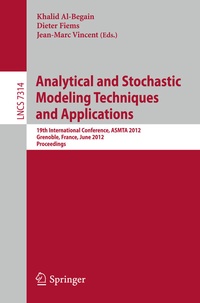
Analytical and Stochastic Modeling Techniques and Applications
19th International Conference, ASMTA 2012, Grenoble, France, June 4-6, 2012. Proceedings
Published on 1. June 2012
X, 303 pages
978-3-642-30782-9 (ISBN)
Description

This book constitutes the refereed proceedings of the 19th International Conference on Analytical and Stochastic Modelling Techniques and Applications, ASMTA 2012, held in Grenoble, France, in June 2012.
The 20 revised full papers presented were carefully reviewed and selected from numerous submissions. The papers are organized in topical sections on queueing systems; networking applications; Markov chains; stochastic modelling.
More details
Other editions
Additional editions

Khalid Al-Begain | Dieter Fiems | Jean-Marc Vincent
Analytical and Stochastic Modeling Techniques and Applications
19th International Conference, ASMTA 2012, Grenoble, France, June 4-6, 2012. Proceedings
Book
05/2012
1st Edition
Springer
€53.49
Shipment within 7-9 days
Content
- Title Page
- Preface
- Organization
- Table of Contents
- Queueing System MAP/M/N as a Model of Call Center with Call-Back Option
- Introduction
- Mathematical Model
- The Process of System States
- Performance Measures
- Distribution of the Sojourn and Waiting Times of a Virtual Customer
- Optimization Problem
- Conclusion
- References
- Two Way Communication Retrial Queues with Balanced Call Blending
- Introduction
- Model
- Assumptions
- Markov Chain and Balance Equations
- Analysis
- Generating Functions
- Stability Condition
- Stationary Distribution
- Factorial Moments
- Recursive Formulae
- First Moments and Cost Model
- Multiple Operators
- Infinitesimal Generator and Matrices
- Stability Condition
- Stationary Distribution
- First Moments and Cost Model
- Conclusion
- References
- Analysis of a Two-Class FCFS Queueing System with Interclass Correlation
- Introduction
- Mathematical Model
- System Analysis
- System Equations at Customer Departure Times
- System Content at Customer Departure Times
- System Content at Random Slot Boundaries
- Discussion of Results and Numerical Examples
- Conclusions
- References
- The Virtual Waiting Time in a Finite-Buffer Queue with a Single Vacation Policy
- Introduction
- The Queueing System and Auxiliary Results
- Equations for the 2-Fold Transform of the Virtual Waiting Time Distribution
- Main Result
- Numerical Examples
- Conclusions
- References
- Analysis of Periodically Gated Vacation Model and Its Application to IEEE 802.16 Network
- Introduction
- Model Description
- Analysis at Characteristic Epochs of the System
- The Number of Customers at G-Epochs
- The Number of Customers at Start of Vacation
- The Number of Customers at End of Vacation
- Analysis at Arbitrary Epoch
- The Number of Customers at Arbitrary Epoch
- The Computational Procedure
- Numerical Example
- Application to the IEEE 802.16 Network
- Analytical Model of the Uplink Non Real-Time Traffic in the IEEE 802.16 Network
- The Mean Packet Delay
- References
- Combined CAC and Forced Handoff for Mobile Network Performability
- Introduction
- Systems Description
- MAHO Scheme Based Model
- MG Scheme: Combined MAHO and GC Schemes
- Our Proposed Scheme: LMG (Load Sharing Maho with Guard Channels)
- Bounding Systems and Stochastic Comparisons
- Stochastic Ordering Theory
- Stochastic Comparison of the Mechanisms
- Numerical Results
- Conclusion
- References
- Modeling CSMA/CA in VANET
- Introduction
- CSMA/CA in 802.11p
- Related Works
- Modeling CCA Mode 1 and 2
- Model for CCA Mode 2
- A Markovian Approach for CCA Mode 1
- Simulations
- Conclusion
- References
- Consolidation and Replication of VMs Matching Performance Objectives
- Introduction
- The System Model
- Example of Consolidation/Replication Actions
- Maximum Consolidation Workload
- Minimum Number of Physical Machines
- Computing the Best Number of Replications
- Matching Performance Objectives
- Constraints on the Utilization of a Class in a Resource
- Constraints on the Total Utilization of a Resource
- Constraints on Mean Resource Residence Time
- Constraints on the System Response Time
- Examples
- Sizing a System
- Replication of Consolidated Servers vs. Replication of Single Servers
- Conclusions
- References
- Analysis of a Discrete-Time Queue with Geometrically Distributed Service Capacities
- Introduction
- Queueing Model Description
- Unfinished Work
- System Equations
- Analysis of the Unfinished Work
- Customer Delay
- Work to Be Performed before the Tagged Customer
- Analysis of the Delay
- Buffer Occupancy
- Geometric Service Demands
- Performance Measures
- Geometric Invariance Property
- Discussion of Numerical Examples
- Conclusions
- References
- Perfect Sampling of Networks with Finite and Infinite Capacity Queues
- Introduction
- Queueing Network Model
- Discrete-Event Definition of JQN
- Network with Infinite Buffers
- Perfect Sampling Algorithm
- Complexity Analysis
- Comparison with the Classical Perfect Sampler
- Numerical Experiments
- Conclusion
- Bibliography
- A Queueing Theoretic Approach to Decoupling Inventory
- Introduction
- Model Description
- Analysis
- Quasi-Birth-Death Process
- Methodology: The Matrix-Geometric Technique
- Performance Measures
- Numerical Examples
- Poisson Arrivals and Exponential Order Processing Times
- Erlang Distributed Set-Up Times
- Markovian Arrival Process for Orders
- Phase-Type Distributed Order Processing Times
- Conclusion
- References
- Controlling Variability in Split-Merge Systems
- Introduction
- Essential Preliminaries
- Parallel Systems
- Theory of Order Statistics david1980
- Heterogeneous Order Statistics
- Controlling Variability in Split-Merge systems
- Case Study
- Conclusions and Future Work
- References
- Some Improvements for the Computation of the Steady-State Distribution of a Markov Chainby Monotone Sequences of Vectors
- Introduction
- A Brief Introduction to I U and I L Algorithms
- Positive Matrices
- Denumerable Markov Chains
- Stochastic Monotonicity
- A Brief Presentation of Stochastic Comparison of DTMC
- Using a Monotone Bound of a Non Monotone Matrix
- Using a Bound of a Monotone Matrix
- Filling the Matrix
- References
- Mean-Field Analysis of Markov Models with Reward Feedback
- Introduction
- Related Work
- Markov Population Models with Accumulations
- Definition
- Mean-Field Approximations
- Higher-Order Moments
- Convergence Properties
- Second-Order Convergence
- Normal Approximations
- Worked Example
- Conclusion and Future Work
- References
- Parameters Used in the Examples
- Lumping and Reversed Processes in Cooperating Automata
- Introduction
- Theoretical Background and Notation
- Feed-Forward Synchronisations
- Exact Computation of Marginal Distribution
- Running Examples
- Theoretical Considerations about Theorem 1 and 2
- Practical Implementation of Exact Lumping
- Final Remarks
- References
- Transform-Domain Solutions of Poisson's Equation with Applicationsto the Asymptotic Variance
- Introduction
- Main Results
- Reflected Random Walks, Skip-Free to the Left
- Reflected Random Walks, Limited Displacement
- Extracting Information from GZ(x,y)
- Application to Asymptotic Variance
- Calculation of f2
- An Application to Heavy Traffic
- Further Applications and Concluding Remarks
- References
- Analytical and Stochastic Modelling of Battery Cell Dynamics
- Introduction
- Some Principles of Battery Cell Dynamics
- The Kinetic Battery Model
- Spatial Diffusion Models
- References
- Branching Processes, the Max-Plus Algebra and Network Calculus
- Introduction
- Branching in the Standard Algebra
- Branching in the Max-Plus Algebra
- Solution
- Discrete State Space
- Continuous State Space
- The Multitype Branching
- Examples
- Stability Conditions
- Deterministic Cruz Type Branching
- Bounds on Branching Process
- Conclusions
- References
- Efficient Generation of PH-Distributed Random Variates
- Introduction
- Notation and Previous Results
- Random-Variate Generation from FE-Diagonal Representations
- Optimisation for FE-Diagonal Representations of the PH Class
- Algorithms for Monocyclic Optimisation
- Discussion
- Application of the Algorithms
- Conclusion
- References
- Finding Prediction Limits for a Future Number of Failures in the Prescribed Time Intervalunder Parametric Uncertainty
- Introduction
- Mathematical Preliminaries for Within-Sample Prediction
- Prediction Limits for Future Order Statistics
- Prediction Limits for Future Number of Failures
- Numerical Example
- Conclusion and Future Work
- References
- Author Index
