

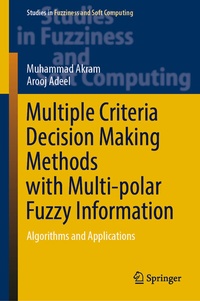
Multiple Criteria Decision Making Methods with Multi-polar Fuzzy Information
Description

This book presents an extension of fuzzy set theory allowing for multi-polar information, discussing its impact on the theoretical and practical development of multi-criteria decision making. It reports on set of hybrid models developed by the authors, and show how they can be adapted, case by case, to the lack of certainty under a variety of criteria. Among them, hybrid models combining m-polar fuzzy sets with rough, soft and 2-tuple linguistic sets, and m-polar hesitant fuzzy sets and hesitant m-polar fuzzy are presented, together with some significant applications. In turn, outranking decision-making techniques such as m-polar fuzzy ELECTRE I, II, III and IV methods, as well as m-polar fuzzy PROMETHEE I and II methods, are developed. The efficiency of these decision-making procedures, as well as other possible extensions studied by the authors, is shown in some real-world applications. Overall, this book offers a guide on methodologies to deal with the multi-polarity and fuzziness of the real-world problems, simultaneously. By including algorithms and computer programming codes, it provides a practice-oriented reference guide to both researchers and professionals working at the interface between computational intelligence and decision making.
More details
Other editions
Additional editions
Persons
Muhammad Akram has received his M.Sc. degree in Mathematics and Computer Science, M.Phil. in Mathematics, and Ph.D. in Fuzzy Mathematics. He is currently serving as a Professor at the Department of Mathematics of the University of the Punjab, in Lahore, Pakistan. Muhammad Akram's research topics cover numerical solutions of parabolic partial differential equations, fuzzy graphs, fuzzy algebras, and fuzzy decision support systems. He has published about 500 research articles in international peer-reviewed journals, and 10 monographs. He has been serving as an Editorial Board Member and as a reviewer of international academic journals.
Arooj Adeel is an Assistant Professor at the Department of Mathematics of the University of Education, in Lahore, Pakistan. She completed her Ph.D. degree in Mathematics at the same University. Her research covers fuzzy sets and graphs, hybrid models, and decision-making techniques. She has published more than 20 articles in international peer-reviewed journals. She is also serving as an Editorial Board Member and as a reviewer of international academic journals.
Content
1. Hybrid Multi-polar Fuzzy Models.- 2. TOPSIS and ELECTRE-I Methods under Multi-polar Fuzzy Linguistic Sets.- 3. Introducing Hesitancy: TOPSIS and ELECTRE-I Models.- 4. Extended ELECTRE I, II Methods with Multi-polar Fuzzy Sets.- 5. Enhanced ELECTRE III Method with Multi-polar Fuzzy Sets.
