

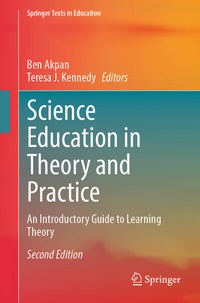
Science Education in Theory and Practice
Description

This book addresses the critical role of science education in the context of global growth and development, emphasizing its significance in the advancement of societal progress. The book identifies and explores the lack of comprehensive resources compiling diverse learning theories and their practical applications in science teaching. Tailored for a global audience, it bridges the knowledge gap with a narrative genre, offering a cohesive exploration of fundamental theories and applications. With contributors from 14 countries, this edition goes beyond its predecessor, delivering updated insights across chapters in research, pedagogy, and educational theory. Each chapter enriches the reader's experience with exercises and reflections, fostering deeper engagement. Notably, the second edition responds to the evolving educational landscape, introducing Chapter 28 on Virtual Technology in the wake of the COVID-19 pandemic. This book is an invaluable resource for students, educators and researchers interested in science education, providing a comprehensive exploration of updated theories and practices.
More details
Other editions
Additional editions
Persons
Ben Akpan , PhD, is the Executive Director of the Science Teachers Association of Nigeria (STAN). He served as President of the International Council of Associations for Science Education (ICASE) and Chair of ICASE World Conferences Standing Committee from 2010 - 2013 and 2013 - 2023 respectively. His areas of interest include chemistry, science education, environmental education, and support for science teacher associations.
Teresa J. Kennedy , PhD, holds a joint appointment as Professor of International STEM and Bilingual/ELL Education in the College of Education and Psychology and in the College of Engineering at the University of Texas at Tyler, United States of America. She served as President of the International Council of Associations for Science Education (ICASE) from 2014 - 2017 and currently serves on the Executive Committee of ICASE as the Representative to UNESCO.
Content
Chapter 1: Introduction - Theory into Practice.- Chapter 2: Intrinsically Motivating Instruction- Thomas Malone.- Chapter 3: The Bildung Theory - from von Humboldt to Klafki and beyond.- Chapter 4: Classical and Operant Conditioning - Ivan Pavlov; Burrhus Skinner.- Chapter 5: Social Learning Theory - Albert Bandura.
