

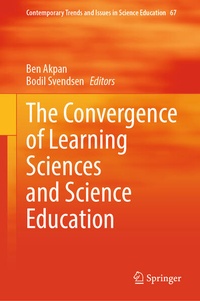
The Convergence of Learning Sciences and Science Education
Description

This edited volume advances science teaching and learning by engaging with the learning sciences-an interdisciplinary field spanning cognitive science, psychology, neuroscience, and education. It compiles empirically grounded strategies that illuminate how learning unfolds in authentic contexts such as homes, schools, and museums, while leveraging innovative pedagogies and emerging technologies. Topics include design thinking, immersive and inclusive learning, and the role of equity and empowerment in fostering diverse partnerships that enrich understanding across settings. By integrating leadership, technology, and assessment, the volume models competencies and problem-solving skills, highlighting how environments and cognitive factors shape learning. Adopting a learner-centered perspective, it offers comprehensive coverage that promotes effective teaching and meaningful student engagement, making it an essential resource for educators, researchers, and practitioners in the learning sciences.
More details
Other editions
Additional editions
Persons
Ben Akpan, PhD, is a professor of science education and the Executive Director of the Science Teachers Association of Nigeria (STAN). He served as President of the International Council of Associations for Science Education (ICASE) from 2010 - 2013; and Chair, World Conferences of ICASE from 2013 - 2023. His areas of interest include chemistry, science education, environmental education, and support for science teacher associations.
Bodil Svendsen (PhD) is an associate professor of the Norwegian University of Science and Technology. She has published extensively on classroom research, focusing on school development, teacher professional development, formative assessment, Natural science education and adapted learning. Her newest project is studying school leaders and their impact on school development.
Content
1. Introduction: The learning sciences in the service of science education.- 2. Teaching the science of learning in science education.- 3. Educational psychology applied to science education.- 4. The role of cognitive psychology in science education.- 5. Social psychology applied to science teaching and learning.- 6. Relevance of neuroscience in science education.- 7. Using computer science as an aid in science teaching and learning.- 8. Design thinking applied to science teaching and learning.- 9. Educational technology in the service of science teaching and learning.- 10. Immersion learning in science education.- 11. Inclusive learning in science education. 12. Lifelong learning through science education.- 13. Updating the knowledge of science teachers on the learning sciences.- 14. Research perspectives in the learning sciences for science education.- 15. Afterword: How learning works in science education.
