

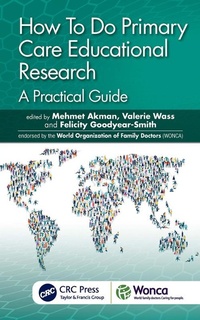
How To Do Primary Care Educational Research
A Practical Guide
1st Edition
Published on 13. July 2021
232 pages
978-1-000-39645-4 (ISBN)
Description

Primary care is a rapidly growing academic branch of learning and developing its own body of research is the hallmark of a maturing academic discipline. This practical guide is the first designed specifically to support those planning, conducting and disseminating primary care educational research. While research informs clinical practice, organisation of primary care services and teaching the discipline, educational practices and modes of delivery are rapidly changing, particularly in response to new information technologies. Primary care practitioners must be engaged in life-long learning and keep abreast of developments in many arenas and educational research into how to address this has thus become of paramount importance.
Key Features:
The first 'how-to' guide to designing, conducting and disseminating primary care educational research
Focus on inter-professional education, co-design and participatory research approaches, in line with current primary care models of care involving inter-disciplinary teams
Wide in scope, exploring the current research environment in the contexts of undergraduate teaching, postgraduate training, continuing professional development, and patient education, for academics and educationalists at all levels
Step-by-step introduction to the processes of literature review (establishing the existing knowledge base), choosing a topic, research questions and methodology, conducting research and disseminating results
Supported by the WONCA Working Parties on Research and Education
This book will encourage and upskill academics at universities and institutions teaching primary care in both undergraduate and postgraduate settings, providing support and guidance on how to conduct their own research and evaluate their own programmes, and will help to grow academic research in this discipline in high and, importantly, also low- and middle-income countries.
Key Features:
The first 'how-to' guide to designing, conducting and disseminating primary care educational research
Focus on inter-professional education, co-design and participatory research approaches, in line with current primary care models of care involving inter-disciplinary teams
Wide in scope, exploring the current research environment in the contexts of undergraduate teaching, postgraduate training, continuing professional development, and patient education, for academics and educationalists at all levels
Step-by-step introduction to the processes of literature review (establishing the existing knowledge base), choosing a topic, research questions and methodology, conducting research and disseminating results
Supported by the WONCA Working Parties on Research and Education
This book will encourage and upskill academics at universities and institutions teaching primary care in both undergraduate and postgraduate settings, providing support and guidance on how to conduct their own research and evaluate their own programmes, and will help to grow academic research in this discipline in high and, importantly, also low- and middle-income countries.
More details
Series
Edition
1. Auflage
Language
English
Place of publication
London
United Kingdom
Publishing group
Taylor & Francis Ltd
Target group
College/higher education
Professional and scholarly
Illustrations
15 Tables, black and white; 6 Line drawings, black and white; 6 Illustrations, black and white
ISBN-13
978-1-000-39645-4 (9781000396454)
Copyright in bibliographic data and cover images is held by Nielsen Book Services Limited or by the publishers or by their respective licensors: all rights reserved.
Schweitzer Classification
Other editions
Additional editions
Mehmet Akman | Valerie Wass | Felicity Goodyear-Smith
How To Do Primary Care Educational Research
A Practical Guide
Book
07/2021
1st Edition
CRC Press
€37.90
Shipment within 15-20 days
Mehmet Akman | Valerie Wass | Felicity Goodyear-Smith
How To Do Primary Care Educational Research
A Practical Guide
Book
07/2021
1st Edition
CRC Press
€88.30
Shipment within 15-20 days
Persons
Mehmet Akman is general practitioner and professor working in the field of primary care. He has a family medicine background, received a master degree in public health, and has an extensive experience as a tutor in under- and post-graduate medical education, primary care and educational research. He is the incoming Chair of the WONCA (world family doctors) Working Party on Research, and member of the Board of Trustees of the Turkish Foundation of Family Medicine (TAHEV). He was advisory board member of the European Forum for Primary Care between 20013-2019 and is associate editor of the Primary Health Care Research and Development journal.
Dr Akman's recent works are mainly about organisation of primary care, multi-professional primary care research, chronic disease management at primary care level, and post graduate training of family doctors. He is involved in international research and projects as a national coordinator, advisor or research coordinator. He has served as consultant for the World Health Organization for assessment of primary care services and capacity building of healthcare professionals. He is the leading or co-author of more than 60 national and international articles published in peer reviewed scientific journals, including primary care educational research, and over ten chapters in medical books. His present position is professor of Family Medicine at Marmara University School of medicine, Family Medicine Department, Istanbul, Turkey.
Val Wass is a general practitioner by trade. She has progressively combined clinical work with academic research throughout her UK career. Past roles include Academic Primary Care at Guy's, Kings and St Thomas's Medical school (1995-2003), Professor of Community Based Medical, University of Manchester (2003-2009), and Head of the School of Medicine at Keele University (2009-2015). She retired in 2015, to take up UK consultancy roles as Professor of Medical Education in Primary Care at Aberdeen University and Emeritus Professor of Medical Education, Keele University. She chairs the WONCA Working Party on Education and is Chief Editor of the journal Education for Primary Care.
The International Masters in Health Profession Education (MHPE) and PhD at Maastricht University offered a strong platform for medical education research both undergraduate and postgraduate and she has published widely with >5,000 citations. Awards for an outstanding contribution to medical education include the United Kingdom (UK) Royal College of General Practitioners William Pickles and President's International Medals, the UK Association for the Study of Medical Education Gold Medal and, in the 2015 UK New Year's Honours, an OBE.
Felicity Goodyear-Smith is a general practitioner and professor of general practice and primary health care at the University of Auckland, Auckland, New Zealand. In collaboration with Prof Bob Mash, she co-edited the two companion books to this current title: International Perspectives in Primary Care Research, CRC Press, 2016 and How To Do Primary Care Research, CRC Press, 2019. She is Chair of the WONCA Working Party on Research, and all three of these books have been written on behalf of WONCA. Felicity was the founding editor-in-chief of the Journal of Primary Health Care. As well as a number of books and book chapters, she has published over 270 peer-reviewed papers, including 18 on various aspects of primary care educational research.
Felicity is passionate about the importance of research underpinning teaching and learning in primary care, to provide a solid evidence base for our educational interventions and innovations. Educational research can also serve to build the research skills of early career academics, who may have been employed to teach, but who have few research skills, enabling clinical teachers to upskill in research methodology, and be co-authors of peer-reviewed publications.
Dr Akman's recent works are mainly about organisation of primary care, multi-professional primary care research, chronic disease management at primary care level, and post graduate training of family doctors. He is involved in international research and projects as a national coordinator, advisor or research coordinator. He has served as consultant for the World Health Organization for assessment of primary care services and capacity building of healthcare professionals. He is the leading or co-author of more than 60 national and international articles published in peer reviewed scientific journals, including primary care educational research, and over ten chapters in medical books. His present position is professor of Family Medicine at Marmara University School of medicine, Family Medicine Department, Istanbul, Turkey.
Val Wass is a general practitioner by trade. She has progressively combined clinical work with academic research throughout her UK career. Past roles include Academic Primary Care at Guy's, Kings and St Thomas's Medical school (1995-2003), Professor of Community Based Medical, University of Manchester (2003-2009), and Head of the School of Medicine at Keele University (2009-2015). She retired in 2015, to take up UK consultancy roles as Professor of Medical Education in Primary Care at Aberdeen University and Emeritus Professor of Medical Education, Keele University. She chairs the WONCA Working Party on Education and is Chief Editor of the journal Education for Primary Care.
The International Masters in Health Profession Education (MHPE) and PhD at Maastricht University offered a strong platform for medical education research both undergraduate and postgraduate and she has published widely with >5,000 citations. Awards for an outstanding contribution to medical education include the United Kingdom (UK) Royal College of General Practitioners William Pickles and President's International Medals, the UK Association for the Study of Medical Education Gold Medal and, in the 2015 UK New Year's Honours, an OBE.
Felicity Goodyear-Smith is a general practitioner and professor of general practice and primary health care at the University of Auckland, Auckland, New Zealand. In collaboration with Prof Bob Mash, she co-edited the two companion books to this current title: International Perspectives in Primary Care Research, CRC Press, 2016 and How To Do Primary Care Research, CRC Press, 2019. She is Chair of the WONCA Working Party on Research, and all three of these books have been written on behalf of WONCA. Felicity was the founding editor-in-chief of the Journal of Primary Health Care. As well as a number of books and book chapters, she has published over 270 peer-reviewed papers, including 18 on various aspects of primary care educational research.
Felicity is passionate about the importance of research underpinning teaching and learning in primary care, to provide a solid evidence base for our educational interventions and innovations. Educational research can also serve to build the research skills of early career academics, who may have been employed to teach, but who have few research skills, enabling clinical teachers to upskill in research methodology, and be co-authors of peer-reviewed publications.
Content
1.Introduction
2.The theoretical underpinnings of primary care educational research
3.Underpinning medical education research with the discplines of sociology and psychology
4.Co-creation and participatory processes in medical education research
5.Educational research and policy-making
6.Scope and Research Environment
7.Integrating primary and secondary care educational research
8.Primary care interprofessional educational research
9.Research on patient education in primary care
10.Finding out what is already known: how to develop a literature review
11.Choosing your topic and defining your research question
12.Choosing your methodology to answer your question
13.Ethical issues for primary care educational research
14.Validity and reliability in primary care educational research
15.Quantitative study designs
16.Big data in primary care educational research
17.Social media and the internet in primary care educational research
18.Use of Delphi technique in educational research
19.Qualitative methods
20.Action research
21.Case study research
22.Individual interviews and focus groups
23.Content analysis: a guide for primary health care education researchers
24.Ethnography
25.Doing a mixed methods research or evaluation project
26.Applying methodologies to the curriculum: researching curriculum development and delivery
27.Programme evaluation
28.Researching the informal and hidden curriculum
29.Mentoring: how to support and mentor early researchers in educational research
30.How to develop critical mass and ensure primary care educational innovations and initiatives are evidence-based
31.Intercultural aspects in primary care educational research
32.Disseminating your primary care educational research
33.Future challenges in primary care educational research
34.Conclusive remarks
2.The theoretical underpinnings of primary care educational research
3.Underpinning medical education research with the discplines of sociology and psychology
4.Co-creation and participatory processes in medical education research
5.Educational research and policy-making
6.Scope and Research Environment
7.Integrating primary and secondary care educational research
8.Primary care interprofessional educational research
9.Research on patient education in primary care
10.Finding out what is already known: how to develop a literature review
11.Choosing your topic and defining your research question
12.Choosing your methodology to answer your question
13.Ethical issues for primary care educational research
14.Validity and reliability in primary care educational research
15.Quantitative study designs
16.Big data in primary care educational research
17.Social media and the internet in primary care educational research
18.Use of Delphi technique in educational research
19.Qualitative methods
20.Action research
21.Case study research
22.Individual interviews and focus groups
23.Content analysis: a guide for primary health care education researchers
24.Ethnography
25.Doing a mixed methods research or evaluation project
26.Applying methodologies to the curriculum: researching curriculum development and delivery
27.Programme evaluation
28.Researching the informal and hidden curriculum
29.Mentoring: how to support and mentor early researchers in educational research
30.How to develop critical mass and ensure primary care educational innovations and initiatives are evidence-based
31.Intercultural aspects in primary care educational research
32.Disseminating your primary care educational research
33.Future challenges in primary care educational research
34.Conclusive remarks
