

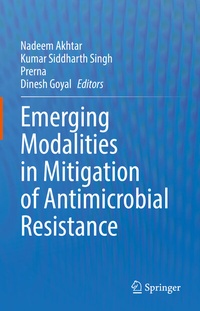
Emerging Modalities in Mitigation of Antimicrobial Resistance
1st Edition
Published on 31. January 2022
XII, 577 pages
978-3-030-84126-3 (ISBN)
Description

Antimicrobial resistance (AMR) is one of the deadliest threats to global public health. This book focuses on dynamics in the landscape of AMR while informing about the latest technologies and strategies to mitigate it. The menace of AMR in different niches, routes of penetration across various domains, socio-economic impact, and the need for a 'One Health' approach in mitigating AMR has been emphasized. Factors involved in AMR, underlying mechanisms, and pharmacometrics in developing antimicrobials are highlighted. Emphasis is given to emerging technologies that are sustainable, scalable, and applicable to the global community, such as big data analytics, bioactive agents, phage therapy, and nanotechnology. The book also explores current and alternative treatment strategies to combat AMR, emphasizing the use of nanoparticles to target pathogens and as a viable alternative to antibiotics.
More details
Series
Language
English
Place of publication
Cham
Switzerland
Publishing group
Springer International Publishing
Target group
Professional and scholarly
Product notice
Reflowable
Illustrations
XII, 577 p. 62 illus. in color.
File size
12,01 MB
ISBN-13
978-3-030-84126-3 (9783030841263)
DOI
10.1007/978-3-030-84126-3
Schweitzer Classification
Other editions
Additional editions
Nadeem Akhtar | Kumar Siddharth Singh | Prerna
Emerging Modalities in Mitigation of Antimicrobial Resistance
Book
02/2022
Springer
€181.89
Shipment within 7-9 days
Persons
Nadeem Akhtar, PhD,
Department of Animal Biosciences, University of Guelph, Ontario N1G 2W1, Canada. Email: nadeembiotech@gmail.com. Dr. Nadeem Akhtar, Ph.D., currently works at the University of Guelph, Canada as a Research Associate. His current research focuses on biotechnology in animal nutrition, where the main objective is to improve animals' health for a better and disease-free lifestyle. Before the Research Associate role, he has worked as a Post-doctoral Researcher in the Department of Chemical Engineering, University of Waterloo, Canada (2019-2020), and in the Department of Animal Biosciences, University of Guelph, Canada (2015-2019). Dr. Akhtar was awarded a Ph.D. from the Department of Biotechnology, Thapar University, India. He has qualified National Eligibility test (NET-2010) and Graduate Aptitude Test (GATE) in Life Sciences (2010) and Biotechnology (2011). His scientific contributions include more than 22 articles in peer-reviewed international journals, 10 book chapters, and a patent. He reviewed several research articles for reputed journals, including RSC Advances, Journal of Applied Microbiology, Scientific Reports, Poultry Science, and many more.
Dr. Kumar Siddharth Singh, Institute for Microbiology, Leibniz University, Hannover, 30419, Germany. Email: ksid21@gmail.com. Dr. Kumar Siddharth Singh is a trained biotechnologist interested in host-microbe interactions, protein science, molecular microbiology, and omics technologies. He has a Master's degree in Biotechnology from Thapar University, Patiala, India, and Bachelor's degree from Anugrah Narayan College, Patna, India. He obtained a Ph.D. in Animal Biotechnology from ICAR-National Dairy Research Institute, Karnal, India, and developed a potential nutraceutical of probiotic origin to protect against gastrointestinal infections. He is also trained in food safety and quality management, emphasizing regulatory standards relevant to thefood and biotechnology industry. He has teaching experience at graduate and post-graduate levels and has many years of mentoring experience. He has industry exposure, more than four years of post-doctoral research experience, and has been awarded many national and international academic awards at different levels of his career from different agencies. He has many scientific articles and reviews to his name and serves as an editorial board member of two journals.
Prerna, Thapar Institute of Engineering and Technology, Patiala, Punjab, India. Email: prerna.biotechnology@gmail.com. Prerna is a Ph.D. Candidate at the Department of Biotechnology, Thapar Institute of Engineering and Technology, India, since July 2013. She received a scholarship under the Government of India scheme TEQIP-II (July 2013- June 2016) and served as a teaching assistant in Biotechnology. Her current research focuses on developing green novel strategies to fabricatevarious nanoparticles and interests, including nanobiotechnology in medicine, industry, and agriculture. She has optimized gram-scale synthesis of nanoparticles from various plants and alga. She is involved in evaluating strategies employed to remediate industrial wastes with a vision to conserve soil and water, promote water reuse efficiency, and protect soil and water quality in diverse agro-ecosystems. As a member of the interdisciplinary research group, she used different plants, algae, fungi, and bacteria to fabricate ZnO nanoparticles. She has extensive experience in characterizing nanoparticles using different spectroscopic, diffractographic, crystallographic, and advanced microscopic analyses. She served as a resource person for different training programs and workshops at STEP (Science and Technology Entrepreneur's Park), Thapar Institute of Engineering and Technology. She has published two research articles, two book chapters and presented her research in many conferences andsymposia.
Dinesh Goyal, Thapar Institute of Engineering and Technology, Patiala, Punjab, India. Email: dgoyal@thapar.edu. Dinesh Goyal, microbiologist graduated from Division of Microbiology, Indian Agricultural Research Institute, New Delhi in 1990. He served at University of Delhi, New Delhi and Thapar Centre for Industrial Research, Patiala before joining Thapar Institute of Engineering and Technology (Deemed to be University), Patiala as a faculty in 2000 and is presently the Professor in the Department of Biotechnology. He did Post-Doctoral Research at the Department of Bioengineering, Tokyo Institute of Technology, Tokyo, Japan during 1993 to 1995 and later underwent two weeks training on Technology Entrepreneurship and Education at Walter A Haas Business School, University of California, Berkeley, online training on Marketing for Incubator managers and entrepreneurs organized by Asia Pacific Incubator's Network (APIN) and accomplished many orientation courses on higher education, human values, IPR and commercialization of technology and innovation.His current interests are in applied microbiology and biotechnology and is focusing on nano-bioremediation and nano-antimicrobials. He has published more than 100 articles, two patents, 14 book chapters, compiled three manuals and guided the research work of 19 Ph.D students, 10 project fellows, B.Tech, 60 M.Sc., and 08 M.Tech. students. He has organized more than thirty-five training programs and workshops in microbiology, biotechnology and entrepreneurship and eight national and one international conference. He was nominated four times (2006-08) as an expert member of National Board of Accreditation (NBA) by All India Council for Technical Education (AICTE) for evaluation and accreditation of B.Tech Biotechnology program. He is also the recipient of prestigious Japanese Govt (Mombusho) Scholarship (1993-95), Fellow of International Congress of Chemistry and Environment (2009), Fellow of Association of Biotechnology and Pharmacy (2010), and Shiksha Rattan Puraskar (2011), Fellow of Association of Microbiologists of India (2012) and Fellow of Institute of Water and Environment (2014).
Dr. Kumar Siddharth Singh, Institute for Microbiology, Leibniz University, Hannover, 30419, Germany. Email: ksid21@gmail.com. Dr. Kumar Siddharth Singh is a trained biotechnologist interested in host-microbe interactions, protein science, molecular microbiology, and omics technologies. He has a Master's degree in Biotechnology from Thapar University, Patiala, India, and Bachelor's degree from Anugrah Narayan College, Patna, India. He obtained a Ph.D. in Animal Biotechnology from ICAR-National Dairy Research Institute, Karnal, India, and developed a potential nutraceutical of probiotic origin to protect against gastrointestinal infections. He is also trained in food safety and quality management, emphasizing regulatory standards relevant to thefood and biotechnology industry. He has teaching experience at graduate and post-graduate levels and has many years of mentoring experience. He has industry exposure, more than four years of post-doctoral research experience, and has been awarded many national and international academic awards at different levels of his career from different agencies. He has many scientific articles and reviews to his name and serves as an editorial board member of two journals.
Prerna, Thapar Institute of Engineering and Technology, Patiala, Punjab, India. Email: prerna.biotechnology@gmail.com. Prerna is a Ph.D. Candidate at the Department of Biotechnology, Thapar Institute of Engineering and Technology, India, since July 2013. She received a scholarship under the Government of India scheme TEQIP-II (July 2013- June 2016) and served as a teaching assistant in Biotechnology. Her current research focuses on developing green novel strategies to fabricatevarious nanoparticles and interests, including nanobiotechnology in medicine, industry, and agriculture. She has optimized gram-scale synthesis of nanoparticles from various plants and alga. She is involved in evaluating strategies employed to remediate industrial wastes with a vision to conserve soil and water, promote water reuse efficiency, and protect soil and water quality in diverse agro-ecosystems. As a member of the interdisciplinary research group, she used different plants, algae, fungi, and bacteria to fabricate ZnO nanoparticles. She has extensive experience in characterizing nanoparticles using different spectroscopic, diffractographic, crystallographic, and advanced microscopic analyses. She served as a resource person for different training programs and workshops at STEP (Science and Technology Entrepreneur's Park), Thapar Institute of Engineering and Technology. She has published two research articles, two book chapters and presented her research in many conferences andsymposia.
Dinesh Goyal, Thapar Institute of Engineering and Technology, Patiala, Punjab, India. Email: dgoyal@thapar.edu. Dinesh Goyal, microbiologist graduated from Division of Microbiology, Indian Agricultural Research Institute, New Delhi in 1990. He served at University of Delhi, New Delhi and Thapar Centre for Industrial Research, Patiala before joining Thapar Institute of Engineering and Technology (Deemed to be University), Patiala as a faculty in 2000 and is presently the Professor in the Department of Biotechnology. He did Post-Doctoral Research at the Department of Bioengineering, Tokyo Institute of Technology, Tokyo, Japan during 1993 to 1995 and later underwent two weeks training on Technology Entrepreneurship and Education at Walter A Haas Business School, University of California, Berkeley, online training on Marketing for Incubator managers and entrepreneurs organized by Asia Pacific Incubator's Network (APIN) and accomplished many orientation courses on higher education, human values, IPR and commercialization of technology and innovation.His current interests are in applied microbiology and biotechnology and is focusing on nano-bioremediation and nano-antimicrobials. He has published more than 100 articles, two patents, 14 book chapters, compiled three manuals and guided the research work of 19 Ph.D students, 10 project fellows, B.Tech, 60 M.Sc., and 08 M.Tech. students. He has organized more than thirty-five training programs and workshops in microbiology, biotechnology and entrepreneurship and eight national and one international conference. He was nominated four times (2006-08) as an expert member of National Board of Accreditation (NBA) by All India Council for Technical Education (AICTE) for evaluation and accreditation of B.Tech Biotechnology program. He is also the recipient of prestigious Japanese Govt (Mombusho) Scholarship (1993-95), Fellow of International Congress of Chemistry and Environment (2009), Fellow of Association of Biotechnology and Pharmacy (2010), and Shiksha Rattan Puraskar (2011), Fellow of Association of Microbiologists of India (2012) and Fellow of Institute of Water and Environment (2014).
Content
1. Antimicrobials in livestock production and its cross-domain dynamics.- 2. Antibiotics and resistance in environment.- 3. Antimicrobials in agriculture and its implications in antimicrobial resistance.- 4. Modern diagnostic tools for rapid detection of multidrug resistance.- 5. The use of antimicrobials in agriculture and socio-economic considerations in a global world.- 6. Epidemiology of microbial infections.- 7. Socioeconomic impact of antimicrobial resistance and their integrated mitigation by One Health approach.- 8. Regulations in antimicrobial drug development: Challenges, and new incentives.- 9. New insights into and updates on antimicrobial agents.- 10. Polyphenols as emerging antimicrobial agents.- 11. Antimicrobial peptides and small molecules as antibiotics substitute.- 12. Molecular mechanisms of antimicrobial resistance in
S. aureus
biofilms.- 13. Antimicrobial resistance: Meaning and developing realization.- 14. Chemical diversity in fungi: strategies to mitigate antimicrobial resistance.- 15. Phage therapy as an alternative treatment in the fight against AMR: Real-world problems and possible futures.- 16. Omics and in-silico approaches in the surveillance and monitoring of antimicrobial resistance.- 17. Antimicrobial activity of bioactive compounds (Thymoquinone & Eugenol) and its nanoformulations therapeutic potential.- 18. Nanoparticles as a future alternative against multiple drug resistance.- 19. Nano-cargos boarded defensins to combat multi-drug resistance.- 20. Implementation of nano-vehicles to disguise and fight multi-drug resistance.- 21. Silver nanoparticles as potent multi-drug resistant in-corporants in biomedicine.- 22. Role of gold nanoparticles against bacterial multidrug resistance (MDR): An emerging therapeutic revolution.- 23. Carbon nanoparticles: A potential cost-effective approach to counter antimicrobial resistance.- 24. Antimicrobial interfaces as augmentative strategy against antimicrobial resistance.- 25. Nano-Strategies against rising antimicrobial resistance (AMR): Metallic nanoparticles as nano-weapon.
