

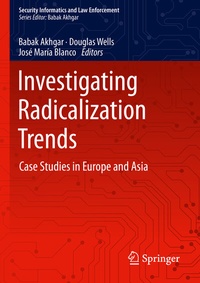
Investigating Radicalization Trends
Description

This book provides a detailed insight into the complex dynamics of radicalization that are in play amongst contemporary society. The authors focus on understanding emerging trends and models that can be used to analyse and understand modern violent extremist and xenophobic discourse. The chapters cover multiple regions, providing a collective analysis of country-specific case studies for the formulation of best practices, recommendations and learning material. It is recommended that this book may serve as a compendium for practitioners, academics, teachers and students wishing to gain state-of-the art knowledge. Topics covered by the authors vary from hands-on practical information to tactical, operational, strategic and ethical guidance. This book provides a holistic, harmonized approach based upon European internal security strategies recognizing that internal security cannot be achieved in isolation from the rest of the world. Additionally, this material resonates with the EU's commitment to fight extremism in a rational manner, alongside promoting human rights, democracy, peace and stability within the EU Member States.
- Presents a comprehensive understanding of the interconnectivities and trends behind emerging radicalisation patterns;
- Features newest conceptual and practical knowledge to monitor, analyse and respond to radicalization around the world;
- Provides a comprehensive view into the methodologies for analysis, through visualizations, case studies and applications.
More details
Other editions
Additional editions
Persons
Babak Akhgar is Professor of Informatics and Director of CENTRIC (Centre of excellence in terrorism, resilience, intelligence and organised crime research). Babak has more than 100 referred publications on security, OSINT, counter terrorism and cybercrime. He is principal investigator and technical lead in several multimillion Euros international security initiatives. He has co-edited two books on intelligence management - Intelligence Management: Knowledge Driven Frameworks for Combating Terrorism and Organised Crime, and Strategic Intelligence Management: National Security Imperatives and Information and Communications Technologies. Prof Akhgar latest books are titled Cyber Crime and Cyber Terrorism, An investigators handbook and Application of Big Data for National Security are published by Elsevier. In addition to his scholarly activities; Prof Akhgar was trustee of Police National Legal Database (PNLD), board member of European Organisation for Securityand member of SAS UK academic board.
Douglas Wells is a leading researcher of CENTRIC, specialising in subjects of domestic extremism, international terrorism and IR critical theory. Douglas graduated from Lancaster University with an MA in Conflict, Development and Security Studies, he is currently researching a PhD into UK police use of OSINT (Open Source Intelligence) towards domestic extremism. Despite his relatively young age, Douglas has taken on significant roles in multiple EU-funded projects for the DG-home and Horizon 2020 FP7 initiatives. Much of his work includes practical, primary research, such as involvement with extremist marches, interviews and recreating crime-scenes and other physical examples of radicalised behaviour.
Jose Maria Blanco is a security expert working for Guardia Civil, Jose manages and oversees several critical areas such as; knowledge management, foresight and horizon scanning of international, nationaland homeland security, and, intelligence analysis. Jose holds two masters, one in Intelligence Analysis from Universidad Rey Juan Carlos, and another in Risk Prevention from INSHT, Madrid. In particular, his education has focused around Intelligence Cycles, Analysis Techniques, Foresight, Dissemination and Competitive Intelligence.
Content
Chapter 1. Introduction.- Chapter 2. Security and European Polarisation.- Chapter 3. The Radicalisation-Factor Model (RFM): Proposing a Framework for the Systematic Investigation and Modelling of Online Radicalisation.- Chapter 4. The So-Called 'Lone Wolf' Phenomenon.- Chapter 5. Cyber Intelligence Against Radicalisation and Violent Extremism.- Chapter 6. Testing for Reliability of the TARGET Threat Analysis Instrument (TTAI) An Interdisciplinary Instrument for the Analysis of School Shooting Threats.- Chapter 7. Counter-Radicalisation Strategies: An Analysis of German and French Approaches and Implementations.- Chapter 8. Radicalisation: No Prevention Without 'Juridicalisation'.- Chapter 9. Countering Radicalisation in the United Kingdom: A Community-Based Approach.- Chapter 10. Enhancing Community Resilience: Assessing the role that black, Asian and minority ethnic law enforcement (LEA) staff associations and networks can play in the fight against radicalisation.- Chapter 11.The 'Choice to Challenge' Extreme Views in the Classroom? Counter-radicalisation and the Prevent Agenda in the University context.- Chapter 12. Mothers' Agency as an Alternative to the War on Terror.
