

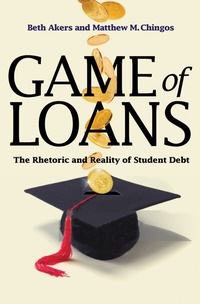
Game of Loans
The Rhetoric and Reality of Student Debt
1st Edition
Published on 20. February 2017
192 pages
978-1-4008-8327-1 (ISBN)
Description

Why fears about a looming student loan crisis are unfounded-and how they obscure what's really wrong with student lending
College tuition and student debt levels have been rising at an alarming pace for at least two decades. These trends, coupled with an economy weakened by a major recession, have raised serious questions about whether we are headed for a major crisis, with borrowers defaulting on their loans in unprecedented numbers and taxpayers being forced to foot the bill. Game of Loans draws on new evidence to explain why such fears are misplaced-and how the popular myth of a looming crisis has obscured the real problems facing student lending in America.
Bringing needed clarity to an issue that concerns all of us, Beth Akers and Matthew Chingos cut through the sensationalism and misleading rhetoric to make the compelling case that college remains a good investment for most students. They show how, in fact, typical borrowers face affordable debt burdens, and argue that the truly serious cases of financial hardship portrayed in the media are less common than the popular narrative would have us believe. But there are more troubling problems with student loans that don't receive the same attention. They include high rates of avoidable defaults by students who take on loans but don't finish college-the riskiest segment of borrowers-and a dysfunctional market where competition among colleges drives tuition costs up instead of down.
Persuasive and compelling, Game of Loans moves beyond the emotionally charged and politicized talk surrounding student debt, and offers a set of sensible policy proposals that can solve the real problems in student lending.
College tuition and student debt levels have been rising at an alarming pace for at least two decades. These trends, coupled with an economy weakened by a major recession, have raised serious questions about whether we are headed for a major crisis, with borrowers defaulting on their loans in unprecedented numbers and taxpayers being forced to foot the bill. Game of Loans draws on new evidence to explain why such fears are misplaced-and how the popular myth of a looming crisis has obscured the real problems facing student lending in America.
Bringing needed clarity to an issue that concerns all of us, Beth Akers and Matthew Chingos cut through the sensationalism and misleading rhetoric to make the compelling case that college remains a good investment for most students. They show how, in fact, typical borrowers face affordable debt burdens, and argue that the truly serious cases of financial hardship portrayed in the media are less common than the popular narrative would have us believe. But there are more troubling problems with student loans that don't receive the same attention. They include high rates of avoidable defaults by students who take on loans but don't finish college-the riskiest segment of borrowers-and a dysfunctional market where competition among colleges drives tuition costs up instead of down.
Persuasive and compelling, Game of Loans moves beyond the emotionally charged and politicized talk surrounding student debt, and offers a set of sensible policy proposals that can solve the real problems in student lending.
All prices
More details
Language
English
Place of publication
Princeton, NJ
United States
Publishing group
De Gruyter
Target group
Professional and scholarly
Edition type
Digital original
Product notice
Reflowable
Illustrations
25 line illus. 7 tables.
File size
1,13 MB
ISBN-13
978-1-4008-8327-1 (9781400883271)
Schweitzer Classification
Other editions
Additional editions
Book
05/2018
Princeton University Press
€17.50
Shipment within 10-20 days
Book
10/2016
Princeton University Press
€27.50
Article not available at the moment
Persons
Beth Akers is a senior fellow at the Manhattan Institute for Policy Research. Matthew M. Chingos is director of the Education Policy Program at the Urban Institute and the coauthor of Crossing the Finish Line: Completing College at America's Public Universities (Princeton).
Content
Acknowledgments vii
1 A Brief Introduction to Student Loans 1
2 What Does Student Borrowing in the United States Really Look Like? 13
3 How Did We Get Here? 40
4 Is a Crisis on the Horizon? 63
5 How Are Student Loans Impacting Borrowers and the Economy? 85
6 The Real Problems in Student Lending 100
7 Solving the Real Problems 122
Notes 145
References 167
Index 179
1 A Brief Introduction to Student Loans 1
2 What Does Student Borrowing in the United States Really Look Like? 13
3 How Did We Get Here? 40
4 Is a Crisis on the Horizon? 63
5 How Are Student Loans Impacting Borrowers and the Economy? 85
6 The Real Problems in Student Lending 100
7 Solving the Real Problems 122
Notes 145
References 167
Index 179

