

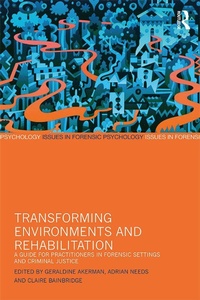
Transforming Environments and Rehabilitation
A Guide for Practitioners in Forensic Settings and Criminal Justice
Published on 11. September 2017
418 pages
978-1-317-33823-9 (ISBN)
Description

How can environments play a role in assisting and sustaining personal change in individuals incarcerated within the criminal justice system? Can a failure to address contextual issues reduce or undermine the effectiveness of clinical intervention? Bringing together a range of leading forensic psychologists, this book explores and illustrates inter-relationships between interventions and the environment in which they take place.
This book examines how the environment can be better utilised to contribute to processes of change and how therapeutic principles and practices can be more strongly embedded through being applied in supportive, facilitative environments. In addition, it expands on emerging conceptualisations of how psychological functioning and environmental context are inextricably linked and offers an alternative to prevailing intrapsychic or 'essentialist' views of areas such as personality and cognition.
Providing new and challenging insights and perspectives on issues of central relevance to forensic psychology and related disciplines, this book contributes to the development of innovative and unifying directions for research, practice and theory. This book will be an essential resource for those who work with or intend to work with offenders, particularly practitioners, researchers and students in the fields of psychology, criminology, psychiatry, psychotherapy and social work.
This book examines how the environment can be better utilised to contribute to processes of change and how therapeutic principles and practices can be more strongly embedded through being applied in supportive, facilitative environments. In addition, it expands on emerging conceptualisations of how psychological functioning and environmental context are inextricably linked and offers an alternative to prevailing intrapsychic or 'essentialist' views of areas such as personality and cognition.
Providing new and challenging insights and perspectives on issues of central relevance to forensic psychology and related disciplines, this book contributes to the development of innovative and unifying directions for research, practice and theory. This book will be an essential resource for those who work with or intend to work with offenders, particularly practitioners, researchers and students in the fields of psychology, criminology, psychiatry, psychotherapy and social work.
Reviews / Votes
"Most of us take our context for granted yet would acknowledge the influence that places and people have upon us. However, within forensic settings our attention has tended to focus on locating problems and change in the individual, devoid of context and the world in which people live. As the authors who contribute to this book clearly argue - attention to the context of the person (past and present; social, cultural, organisational and physical) is long overdue. This book provides a firm foundation for addressing this neglect and provides a challenge to systematically consider the context / environment and how we use research to better understand this. This book balances theory and practice from a wide range of viewpoints and settings, with several chapters including case studies and work that is underway or recently completed. The welcome attention to the social component of the bio-psycho-social framework includes a plethora of ideas such as interpersonal dynamics, context, systemic and organisational factors, climate, environment, milieu and formal frameworks such as TC, PIE, PIPE and EE. Written by experienced practitioners, researchers and academics this is a text that practitioners, commissioners and those involved in forensic services should pay attention to."Jason Davies, Professor of Forensic and Clinical Psychology, Department of Psychology, Swansea University, UK
More details
Series
Language
English
Place of publication
London
United Kingdom
Publishing group
Taylor & Francis Ltd
Target group
College/higher education
Product notice
Reflowable
Illustrations
2 Tables, black and white; 4 Line drawings, black and white; 4 Illustrations, black and white
File size
1,20 MB
ISBN-13
978-1-317-33823-9 (9781317338239)
Copyright in bibliographic data and cover images is held by Nielsen Book Services Limited or by the publishers or by their respective licensors: all rights reserved.
Schweitzer Classification
Other editions
Additional editions
Geraldine Akerman | Adrian Needs | Claire Bainbridge
Transforming Environments and Rehabilitation
A Guide for Practitioners in Forensic Settings and Criminal Justice
Book
09/2017
1st Edition
Routledge
€73.60
Shipment within 10-20 days
Geraldine Akerman | Adrian Needs | Claire Bainbridge
Transforming Environments and Rehabilitation
A Guide for Practitioners in Forensic Settings and Criminal Justice
Book
09/2017
1st Edition
Routledge
€207.60
Shipment within 10-20 days
Persons
Geraldine Akerman is a chartered and HCPC registered Forensic Psychologist and Associate Fellow of the British Psychological Society and Europsych. She currently works as a Therapy Manager at HMP Grendon and is a Visiting Lecturer at the University of Birmingham and Cardiff Metropolitan University.
Adrian Needs is a Forensic Psychologist by background, qualified as a practitioner with experience including 14 years in HM Prison Service. He runs the MSc Forensic Psychology course at the University of Portsmouth and through the BPS played a prominent role in steering the formulation of national standards for postgraduate training in this field. His current research interests include transition and offending in former members of the armed forces.
Claire Bainbridge is a chartered and HCPC registered Forensic Psychologist and Associate Fellow of the British Psychological Society. She has over twenty years' experience of working with offenders in a variety of settings, including prison, health, police and probation services and is currently a Consultant Forensic Psychologist within the Offender Health and Forensic Community Service at Tees, Esk and Wear Valleys NHS Foundation Trust.
Adrian Needs is a Forensic Psychologist by background, qualified as a practitioner with experience including 14 years in HM Prison Service. He runs the MSc Forensic Psychology course at the University of Portsmouth and through the BPS played a prominent role in steering the formulation of national standards for postgraduate training in this field. His current research interests include transition and offending in former members of the armed forces.
Claire Bainbridge is a chartered and HCPC registered Forensic Psychologist and Associate Fellow of the British Psychological Society. She has over twenty years' experience of working with offenders in a variety of settings, including prison, health, police and probation services and is currently a Consultant Forensic Psychologist within the Offender Health and Forensic Community Service at Tees, Esk and Wear Valleys NHS Foundation Trust.
Content
Foreword, Rex Haigh, Introduction, Geraldine Akerman, Adrian Needs and Claire Bainbridge 1. Steps to an ecology of human functioning for forensic psychology, Alethea Adair-Stantiall and Adrian Needs 2. The social context of transition and rehabilitation, Adrian Needs and Alethea Adair-Stantiall 3. Only connect: implications of social processes and contexts for understanding trauma, Adrian Needs 4. Trauma-informed care and 'good lives' in confinement: acknowledging and offsetting adverse impacts of chronic trauma and loss of liberty, Lawrence Jones 5. A campaign for climate change: the role of therapeutic relationships within a climate of control, Sarah Lewis 6. The importance of personal safety to therapeutic outcome in the prison setting, Andrew Day and James Vess 7. Rehabilitating offenders: the enabling environment of forensic therapeutic communities, Michael Brookes 8. Creating a therapeutic community from scratch: where do we start? Geraldine Akerman and Patrick Mandikate 9. Psychologically informed planned environments: a new optimism for criminal justice provision? Nick Benefield, Kirk Turner, Lucinda Bolger and Claire Bainbridge 10. Democratisation, disability and defence mechanisms: reality confrontation in Rampton, Jon Taylor 11. Relationships, social context and personal change: the role of therapeutic communities, Richard Shuker 12. Wearing two hats: working therapeutically as a discipline prison officer, Emma Guthrie, Laura Smillie, Annette McKeown and Claire Bainbridge 13. The Enabling Environments Award as a transformative process, Sarah Paget and Roland Woodward 14. Creating an Enabling Environment in high security prison conditions: an impossible task or the start of a revolution? Alice L. Bennett and Jenny Tew 15. Establishing Enabling Environment principles with young adult males in a custodial setting, Rachel O'Rourke, Annie Taylor and Kevin Leggett 16. The heart and soul of the transforming environment: how a values-driven ethos sustains a therapeutic community for sexual offenders, Andrew Frost and Jason Ware 17. The role of environmental factors in effective gender-responsive programming for women in the United States: current status and future directions, Dana J. Hubbard and Betsy Matthews 18. Contextual influences in prison-based psychological risk assessment: problems and solutions, Jo Shingler and Adrian Needs 19. The importance of organisational factors in transferring the principles of effective intervention to offender rehabilitation in the real world, Dominic A. S. Pearson 20. Nidotherapy: a systematic environmental therapy, Peter Tyrer and Helen Tyrer
