

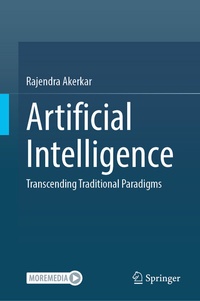
Artificial Intelligence
Description

Artificial Intelligence: Transcending Traditional Paradigms is a significant new introductory text for undergraduate and graduate course use. It introduces students and professionals to the state-of-the-art development of Artificial Intelligence techniques to develop smart real-world solutions. As an active researcher, the author presents the material authoritatively and with insights that reflect a modern, firsthand understanding of the field.
Artificial intelligence is a science still in its infancy, and that makes it special. It's not like more established fields, and the author has tried in writing this textbook to honour this characteristic and the ways it makes AI unique.
More details
Other editions
Additional editions
Person
Rajendra Akerkar is a professor and coordinator of Big Data and Emerging Technologies research at Western Norway Research Institute. His research focuses on developing and applying artificial intelligence techniques to address real-world challenges in emergency management, cybersecurity, and transport and mobility. With over 30 years of academic experience across universities in Asia, Europe, and North America; Rajendra has co-authored more than 150 publications in prestigious international conferences and journals, as well as books and monographs on big data computing, AI, and knowledge-based systems.
Content
Part 1: Foundations of artificial intelligence.- The genesis of artificial intelligence: Origins and evaluation.- The dawn of AI: Early innovations and discoveries.- Part 2: The learning revolution: Data-driven intelligence.- Soft computing paradigms: Bridging precision and flexibility.- Machine learning: Building intelligence from patterns.- Deep learning: The fabric of representation.- Reinforcement learning: Shaping behaviour through rewards.- Part 3: AI Odyssey: Exploring language and intelligent agents.- Journey through language: Models and prompt engineering.- Autonomous decision maker: AI agents.- Part 4: Expanding the frontiers of AI.- The best of both Worlds: Neuro-symbolic AI.- Mimicking the mind: Evolution of cognitive AI.- Robots with a sense of self: Exploring embodied intelligence.- Part 5: Building advanced and responsible AI.- Blueprint for intelligence: Building robust AI systems.- Never stop learning: The principles of continual learning.- Opening the black box: The role of explainability in AI.- Part 6: Conclusion and future outlook.- Epilogue: AI at the threshold.
