

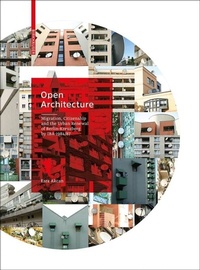
Open Architecture
Description

Eines der wichtigsten Projekte zum Thema "offene Architektur" fand in den 1980er Jahren in Berlin-Kreuzberg statt: In den etwa zur Hälfte von Einwanderern bewohnten Stadtvierteln nahe der Berliner Mauer wurden rund 10.000 Wohnungen neu gebaut oder mieterfreundlich saniert. Die renommierte Autorin Esra Akcan, der Türkei, Berlin und den USA vielfältig verbunden, rekonstruiert die Geschichte und Wirkung dieses architektur-politischen Experiments.
Reviews / Votes
"Einem derart häufig publizierten Thema wie der West-Berliner IBA 1984/87 noch eine neue Facette zu entlocken, ist kein einfaches Unterfangen. Umso erstaunlicher, mit welch wissenschaftlicher Leichtigkeit das Esra Akcan in ihrem Buch gelingt." (In BauNetz , 02.2020)
" Open Architecture is a tremendous accomplishment that invites the reader to act as a kind of postcolonial fläneur, a non-gendered figure who strolls Kreuzberg's streets, peering- at times voyeuristically-into the open doors, hallways, courtyards, and stairwells of its trademark buildings and the intimate places that inhabitants call home. [...] Open Architecture is much more than a city tour or a history of buildings and their visionaries. It is a somber reminder of the human stakes involved in a participatory urbanism that privileges rights-bearing citzens. Akcan's call for an attention in urban planning to migrants, exiles, refugees, and other stateless persons who lack the legal and social protections of citizenship could not be more prescient at this moment." (Christina Schenkel in The Berlin Journal 32, S. 102-103, 2018)
"This is a commendable undertaking a field that has traditionally been dominated by coffee-table books and biographical accounts. Akcan wonderfully lays bare the tensions between the ideals of the designers of our built environment and its everyday experience, offering us insightful and the same time entertaining anecdotes about impractical floor plans and creative resident interventions. [...] This book is clearly a work of love and passion by someone interested in the history of Kreuzberg and its residents for more than academic reasons." (Tim Verlaan in H-Soz-Kult , 09.2021)
"In her pathbreaking book Open Architecture: Migration, Citizenship, and the Urban Renewal of Berlin-Kreuzberg by IBA-1984/87 , Esra Akcan achieves three quite different things, each of them enormously important. First, she provides the best account we have of the International Building Exhibition (IBA) held in Berlin in the 1980s. Second, she makes a major contribution to the literature on Turkish guest workers in Germany. Third and finally, she proposes a new approach to the production of architecture that she terms 'open architecture.' The ambitious interweaving of these themes cuts across the usual borders between architectural history, urban sociology, and architectural theory." (Kathleen James-Chakraborty in YILLIK. Annual of Istanbul Studies , 3 , 2021)
More details
Other editions
Additional editions
Person
Esra Akcan , Associate Professor, Department of Architecture, Cornell University, USA
Content
- Intro
- Content
- Preface
- Introduction
- PART 1 Open Architecture as Collectivity
- STOP I Critical Reconstruction: Open Architecture as Collaboration?
- STROLL 1 From Schinkelplatz to Checkpoint Charlie
- STOP II Buildings That Die More Than Once: Open Architecture as Collectivity
- STROLL 2 From Checkpoint Charlie to Potsdamer Platz
- STOP III Opened after Habitation
- STROLL 3 From Potsdamer Platz to Tiergarten
- PART 2 Open Architecture as Democracy
- STOP IV Gentle Urban Renewal: Participation and Radical Democracy
- STROLL 4 From Kottbusser Tor to Schlesisches Tor
- STOP V A Building with Many Speakers: Open Architecture as Critical Participation
- STROLL 5 From Schlesisches Tor to Fraenkelufer
- PART 3 Open Architecture as Multiplicity
- STOP VI Open History in the Past Subjunctive Tense
- STROLL 6 A History of a Possible Kreuzberg
- STOP VII Exit Implies Entries' Lament: Open Architecture in John Hejduk's IBA-1984 / 87 Immigrant Housing
- Appendix
- Acknowledgments
- Illustration Credits
- About the Author
- Index
- Captions to the "Map of Stops and Strolls"
