

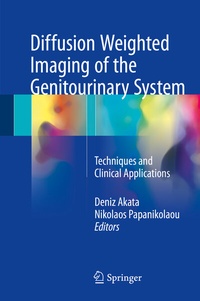
Diffusion Weighted Imaging of the Genitourinary System
Description

This book discusses diffusion weighted imaging (DWI) and its evolving clinical role.
DWI has frequently been used in the abdomen and pelvis but is now increasingly being used in other clinical applications, especially for the diagnostic workup of oncologic patients. Standardization and clinical validation of quantitative DWI related biomarkers is still ongoing, although efforts have been undertaken, especially in the prostate, to provide standardized imaging guidelines for different clinical indications. The technical aspects and clinical applications of DWI presented focus on the respective anatomical region and its pathologies. The book is unique in providing tables of technical details (imaging protocols, artifacts, optimization techniques) for each chapter, making this complex area as simple and practical as possible.
The book is intended for radiologists interested in urogenital radiology and also for radiology residents.
More details
Other editions
Additional editions
Persons
Nikolaos Papanikolaou is a Principal Investigator for Oncologic Imaging at Champalimaud Foundation in Lisbon, and an affiliated researcher of the Karolinska Institute in Stockholm. He received his Ph.D. in Medicine from the University of Crete, Greece.
Prof. Papanikolaou has published 60 papers in international peer reviewed journals, 17 book chapters, and held 72 invited lectures for international congresses and educational courses. He is an honorary member of SEDIA and a fellow member of ESGAR.
His main research focus is on Diffusion Weighted Imaging, modelling, post processing and clinical applications.
Deniz Akata has been a Professor of Radiology since 2004 and Chair of the Department of Radiology at Hacettepe University School of Medicine, Ankara since October 2015.
Her expertise is in abdominal imaging and in oncologic imaging of the female pelvis and the abdomen. She completed her fellowship in abdominal and digital imaging at the Medical College of Wisconsin, US.
She has published more than 100 articles in professional journals and has held more than 30 scientific presentations all around the world. She has given more than 30 invited lectures for international organizations and more than 100 invited lectures for national conferences.
Moreover she has duties in connection with professional organizations, primarily as an Executive Council Member, European Society of Radiology. She was Co-Chair of the Abdominal and Gastrointestinal Subcommittee (Abdominal Viscera), ECR 2014, Member of the Program Planning Committee of the European Congress of Radiology (ECR) in 2011, 2012 and 2017, and President of the Scientific Committee of TURKRAD 2008 - the Turkish Society of Radiology National Congress. She is also a fellow member ESGAR.
Content
DW MRI: Techniques, Protocols and Post Processing Aspects.- DW MRI of the native and transplanted kidneys.- Renal masses.- DW MRI of adrenal gland and retroperitoneal masses (2 possible authors).- Bladder ca and urothelial tumor.- Ovary.- Cervical masses.- Uterus.- Prostate gland.
