

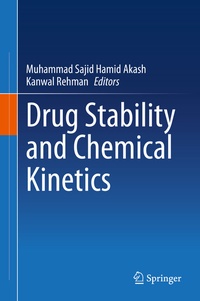
Drug Stability and Chemical Kinetics
Description

This book comprehensively reviews drug stability and chemical kinetics: how external factors can influence the stability of drugs, and the reaction rates that trigger these effects. Explaining the important theoretical concepts of drug stability and chemical kinetics, and providing numerous examples in the form of illustrations, tables and calculations, the book helps readers gain a better understanding of the rates of reactions, order of reactions, types of degradation and how to prevent it, as well as types of stability studies. It also offers insights into the importance of the rate at which the drug is degraded and/or decomposed under various external and internal conditions, including temperature, pH, humidity and light. This book is intended for researchers, PhD students and scientists working in the field of pharmacy, pharmacology, pharmaceutical chemistry, medicinal chemistry and biopharmaceutics.
More details
Other editions
Additional editions
Persons
Dr. Muhammad Sajid Hamid Akash (PAS Gold Medal)
Dr. Akash is currently working as associate professor and chairman at Department of Pharmaceutical Chemistry, Government College University Faisalabad (GCUF), Pakistan. He got his bachelor and master degrees in pharmacy from Bahauddin Zakariya University Multan, Pakistan and PhD degree in Pharmaceutical Analysis from Zhejiang University, China. He has published more than 100 articles (with cumulative Impact Factor 250 with total citations of 2800) in internationally recognized peer-reviewed ISI-indexed journals. He has also published 30 book chapters and 2 books with international publishers. Currently, he is focusing on the investigating the effect of endocrine disrupting chemicals (EDCs) on various molecular and metabolic pathways that are involved in metabolic disorders and the treatment strategies of these EDCs-induced metabolic disorders funded by Higher Education Commission (HEC) of Pakistan. His Research work is the cutting edge and worthy of extension in developing countries like Pakistan, where it can be most beneficial and cost-effective especially for diabetic patients. Based on his significant scientific contributions in the field of Pharmaceutical Sciences, he has been awarded "Research Productivity Award" from Pakistan Council for Science and Technology (PCST), PAS Gold Medal from Pakistan Academy of Sciences and A.R. Shakoori Gold Medal from Zoological Society of Pakistan.
Dr. Kanwal Rehman
Dr. Kanwal Rehman is working as Assistant Professor at Department of Pharmacy in University of Agriculture Faisalabad, Pakistan. Dr. Kanwal Rehman has done her PhD in Pharmacology and Toxicology from Zhejiang University, Hangzhou, China during which she has done some excellent work on exploring the effect of arsenic compounds including molecular mechanisms involved in arsenic- induced carcinogenic and anticancer effects. She nurturesa keen interest in pathogenesis of metabolic disorders like diabetes mellitus, obesity and new therapeutic modalities for its treatment. Other work includes detection of environmental pollutants and their cytotoxic effects. She has published about 90 articles with cumulative impact factor of 240. She has also published 30 book chapters and 2 books with international publishers. She is currently working on three research projects funded by Higher Education Commission (HEC) of Pakistan. Currently, she is focusing on the investigation of role of pharmacogenomics based upon gene polymorphism on various molecular and metabolic pathways that are involved in mitogenic disorders and treatment strategies like natural biogenic compounds against different risk factors of metabolic disorders including pancreatitis, cardiometabolic disorders and hormonal imbalance. Dr. Kanwal Rehman has also been awarded Research productivity award by Pakistan Council for Science and Technology (PCST), Pakistan.Content
1 Principles of pharmaceutical analysis in drug stability and chemical kinetics.- 2 Guidelines for drug stability and stability testing.- 3 Chemical kinetics and its applications in drug stability.- 4 Methods and protocols for drug stability studies.- 5 Physical basis of degradation of pharmaceutical products.- 6 Role of microbiological degradation on drug stability.- 7 Role of decomposition on drug stability.- 8 Role of catalysis in drug stability.- 9 Analytical techniques for the assessment of drug stability.- 10 Stability of pharmaceutical products.- 11 Role of kinetic models in drug stability.- 12 Stability studies of vaccines.- 13 Stability studies of proteinous compounds.- 14 Stability studies of extemporaneous pharmaceutical products.- 15 Stability studies of parenteral products.- 16 Stability studies of solid dosage forms.
