

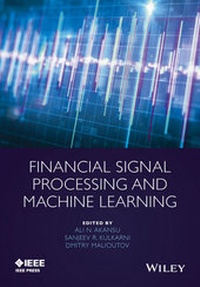
Financial Signal Processing and Machine Learning
Description

More details
Other editions
Additional editions
Persons
Content
List of Contributors xiii
Preface xv
1 Overview 1
Ali N. Akansu, Sanjeev R. Kulkarni, and Dmitry Malioutov
1.1 Introduction 1
1.2 A Bird's-Eye View of Finance 2
1.2.1 Trading and Exchanges 4
1.2.2 Technical Themes in the Book 5
1.3 Overview of the Chapters 6
1.3.1 Chapter 2: "Sparse Markowitz Portfolios" by Christine De Mol 6
1.3.2 Chapter 3: "Mean-Reverting Portfolios: Tradeoffs between Sparsity and Volatility" by Marco Cuturi and Alexandre d'Aspremont 7
1.3.3 Chapter 4: "Temporal Causal Modeling" by Prabhanjan Kambadur, Aurélie C. Lozano, and Ronny Luss 7
1.3.4 Chapter 5: "Explicit Kernel and Sparsity of Eigen Subspace for the AR(1) Process" by Mustafa U. Torun, Onur Yilmaz and Ali N. Akansu 7
1.3.5 Chapter 6: "Approaches to High-Dimensional Covariance and Precision Matrix Estimation" by Jianqing Fan, Yuan Liao, and Han Liu 7
1.3.6 Chapter 7: "Stochastic Volatility: Modeling and Asymptotic Approaches to Option Pricing and Portfolio Selection" by Matthew Lorig and Ronnie Sircar 7
1.3.7 Chapter 8: "Statistical Measures of Dependence for Financial Data" by David S. Matteson, Nicholas A. James, and William B. Nicholson 8
1.3.8 Chapter 9: "Correlated Poisson Processes and Their Applications in Financial Modeling" by Alexander Kreinin 8
1.3.9 Chapter 10: "CVaR Minimizations in Support Vector Machines" by Junya Gotoh and Akiko Takeda 8
1.3.10 Chapter 11: "Regression Models in Risk Management" by Stan Uryasev 8
1.4 Other Topics in Financial Signal Processing and Machine Learning 9
References 9
2 Sparse Markowitz Portfolios 11
ChristineDeMol
2.1 Markowitz Portfolios 11
2.2 Portfolio Optimization as an Inverse Problem: The Need for Regularization 13
2.3 Sparse Portfolios 15
2.4 Empirical Validation 17
2.5 Variations on the Theme 18
2.5.1 Portfolio Rebalancing 18
2.5.2 Portfolio Replication or Index Tracking 19
2.5.3 Other Penalties and Portfolio Norms 19
2.6 Optimal Forecast Combination 20
Acknowlegments 21
References 21
3 Mean-Reverting Portfolios 23
Marco Cuturi and Alexandre d'Aspremont
3.1 Introduction 23
3.1.1 Synthetic Mean-Reverting Baskets 24
3.1.2 Mean-Reverting Baskets with Sufficient Volatility and Sparsity 24
3.2 Proxies for Mean Reversion 25
3.2.1 Related Work and Problem Setting 25
3.2.2 Predictability 26
3.2.3 Portmanteau Criterion 27
3.2.4 Crossing Statistics 28
3.3 Optimal Baskets 28
3.3.1 Minimizing Predictability 29
3.3.2 Minimizing the Portmanteau Statistic 29
3.3.3 Minimizing the Crossing Statistic 29
3.4 Semidefinite Relaxations and Sparse Components 30
3.4.1 A Semidefinite Programming Approach to Basket Estimation 30
3.4.2 Predictability 30
3.4.3 Portmanteau 31
3.4.4 Crossing Stats 31
3.5 Numerical Experiments 32
3.5.1 Historical Data 32
3.5.2 Mean-reverting Basket Estimators 33
3.5.3 Jurek and Yang (2007) Trading Strategy 33
3.5.4 Transaction Costs 33
3.5.5 Experimental Setup 36
3.5.6 Results 36
3.6 Conclusion 39
References 39
4 Temporal Causal Modeling 41
Prabhanjan Kambadur, Aurélie C. Lozano, and Ronny Luss
4.1 Introduction 41
4.2 TCM 46
4.2.1 Granger Causality and Temporal Causal Modeling 46
4.2.2 Grouped Temporal Causal Modeling Method 47
4.2.3 Synthetic Experiments 49
4.3 Causal Strength Modeling 51
4.4 Quantile TCM (Q-TCM) 52
4.4.1 Modifying Group OMP for Quantile Loss 52
4.4.2 Experiments 53
4.5 TCM with Regime Change Identification 55
4.5.1 Model 56
4.5.2 Algorithm 58
4.5.3 Synthetic Experiments 60
4.5.4 Application: Analyzing Stock Returns 62
4.6 Conclusions 63
References 64
5 Explicit Kernel and Sparsity of Eigen Subspace for the AR(1) Process 67
Mustafa U. Torun, Onur Yilmaz, and Ali N. Akansu
5.1 Introduction 67
5.2 Mathematical Definitions 68
5.2.1 Discrete AR(1) Stochastic Signal Model 68
5.2.2 Orthogonal Subspace 69
5.3 Derivation of Explicit KLT Kernel for a Discrete AR(1) Process 72
5.3.1 A Simple Method for Explicit Solution of a Transcendental Equation 73
5.3.2 Continuous Process with Exponential Autocorrelation 74
5.3.3 Eigenanalysis of a Discrete AR(1) Process 76
5.3.4 Fast Derivation of KLT Kernel for an AR(1) Process 79
5.4 Sparsity of Eigen Subspace 82
5.4.1 Overview of Sparsity Methods 83
5.4.2 pdf-Optimized Midtread Quantizer 84
5.4.3 Quantization of Eigen Subspace 86
5.4.4 pdf of Eigenvector 87
5.4.5 Sparse KLT Method 89
5.4.6 Sparsity Performance 91
5.5 Conclusions 97
References 97
6 Approaches to High-Dimensional Covariance and Precision Matrix Estimations 100
Jianqing Fan, Yuan Liao, and Han Liu
6.1 Introduction 100
6.2 Covariance Estimation via Factor Analysis 101
6.2.1 Known Factors 103
6.2.2 Unknown Factors 104
6.2.3 Choosing the Threshold 105
6.2.4 Asymptotic Results 105
6.2.5 A Numerical Illustration 107
6.3 Precision Matrix Estimation and Graphical Models 109
6.3.1 Column-wise Precision Matrix Estimation 110
6.3.2 The Need for Tuning-insensitive Procedures 111
6.3.3 TIGER: A Tuning-insensitive Approach for Optimal Precision Matrix Estimation 112
6.3.4 Computation 114
6.3.5 Theoretical Properties of TIGER 114
6.3.6 Applications to Modeling Stock Returns 115
6.3.7 Applications to Genomic Network 118
6.4 Financial Applications 119
6.4.1 Estimating Risks of Large Portfolios 119
6.4.2 Large Panel Test of Factor Pricing Models 121
6.5 Statistical Inference in Panel Data Models 126
6.5.1 Efficient Estimation in Pure Factor Models 126
6.5.2 Panel Data Model with Interactive Effects 127
6.5.3 Numerical Illustrations 130
6.6 Conclusions 131
References 131
7 Stochastic Volatility 135
Matthew Lorig and Ronnie Sircar
7.1 Introduction 135
7.1.1 Options and Implied Volatility 136
7.1.2 Volatility Modeling 137
7.2 Asymptotic Regimes and Approximations 141
7.2.1 Contract Asymptotics 142
7.2.2 Model Asymptotics 142
7.2.3 Implied Volatility Asymptotics 143
7.2.4 Tractable Models 145
7.2.5 Model Coefficient Polynomial Expansions 146
7.2.6 Small "Vol of Vol" Expansion 152
7.2.7 Separation of Timescales Approach 152
7.2.8 Comparison of the Expansion Schemes 154
7.3 Merton Problem with Stochastic Volatility: Model Coefficient Polynomial Expansions 155
7.3.1 Models and Dynamic Programming Equation 155
7.3.2 Asymptotic Approximation 157
7.3.3 Power Utility 159
7.4 Conclusions 160
Acknowledgements 160
References 160
8 Statistical Measures of Dependence for Financial Data 162
David S. Matteson, Nicholas A. James, and William B. Nicholson
8.1 Introduction 162
8.2 Robust Measures of Correlation and Autocorrelation 164
8.2.1 Transformations and Rank-Based Methods 166
8.2.2 Inference 169
8.2.3 Misspecification Testing 171
8.3 Multivariate Extensions 174
8.3.1 Multivariate Volatility 175
8.3.2 Multivariate Misspecification Testing 176
8.3.3 Granger Causality 176
8.3.4 Nonlinear Granger Causality 177
8.4 Copulas 179
8.4.1 Fitting Copula Models 180
8.4.2 Parametric Copulas 181
8.4.3 Extending beyond Two Random Variables 183
8.4.4 Software 185
8.5 Types of Dependence 185
8.5.1 Positive and Negative Dependence 185
8.5.2 Tail Dependence 187
References 188
9 Correlated Poisson Processes and Their Applications in Financial Modeling 191
Alexander Kreinin
9.1 Introduction 191
9.2 Poisson Processes and Financial Scenarios 193
9.2.1 Integrated Market-Credit Risk Modeling 193
9.2.2 Market Risk and Derivatives Pricing 194
9.2.3 Operational Risk Modeling 194
9.2.4 Correlation of Operational Events 195
9.3 Common Shock Model and Randomization of Intensities 196
9.3.1 Common Shock Model 196
9.3.2 Randomization of Intensities 196
9.4 Simulation of Poisson Processes 197
9.4.1 Forward Simulation 197
9.4.2 Backward Simulation 200
9.5 Extreme Joint Distribution 207
9.5.1 Reduction to Optimization Problem 207
9.5.2 Monotone Distributions 208
9.5.3 Computation of the Joint Distribution 214
9.5.4 On the Frechet-Hoeffding Theorem 215
9.5.5 Approximation of the Extreme Distributions 217
9.6 Numerical Results 219
9.6.1 Examples of the Support 219
9.6.2 Correlation Boundaries 221
9.7 Backward Simulation of the Poisson-Wiener Process 222
9.8 Concluding Remarks 227
Acknowledgments 228
Appendix A 229
A. 1 Proof of Lemmas 9.2 and 9.3 229
A.1.1 Proof of Lemma 9.2 229
A.1.2 Proof of Lemma 9.3 230
References 231
10 CVaR Minimizations in Support Vector Machines 233
Jun-ya Gotoh and Akiko Takeda
10.1 What Is CVaR? 234
10.1.1 Definition and Interpretations 234
10.1.2 Basic Properties of CVaR 238
10.1.3 Minimization of CVaR 240
10.2 Support Vector Machines 242
10.2.1 Classification 242
10.2.2 Regression 246
10.3 ¿-SVMs as CVaR Minimizations 247
10.3.1 ¿-SVMs as CVaR Minimizations with Homogeneous Loss 247
10.3.2 ¿-SVMs as CVaR Minimizations with Nonhomogeneous Loss 251
10.3.3 Refining the ¿-Property 253
10.4 Duality 256
10.4.1 Binary Classification 256
10.4.2 Geometric Interpretation of ¿-SVM 257
10.4.3 Geometric Interpretation of the Range of ¿ for ¿-SVC 258
10.4.4 Regression 259
10.4.5 One-class Classification and SVDD 259
10.5 Extensions to Robust Optimization Modelings 259
10.5.1 Distributionally Robust Formulation 259
10.5.2 Measurement-wise Robust Formulation 261
10.6 Literature Review 262
10.6.1 CVaR as a Risk Measure 263
10.6.2 From CVaR Minimization to SVM 263
10.6.3 From SVM to CVaR Minimization 263
10.6.4 Beyond CVaR 263
References 264
11 Regression Models in Risk Management 266
Stan Uryasev
11.1 Introduction 267
11.2 Error and Deviation Measures 268
11.3 Risk Envelopes and Risk Identifiers 271
11.3.1 Examples of Deviation Measures D, Corresponding Risk Envelopes Q, and Sets of Risk Identifiers QD(X) 272
11.4 Error Decomposition in Regression 273
11.5 Least-Squares Linear Regression 275
11.6 Median Regression 277
11.7 Quantile Regression and Mixed Quantile Regression 281
11.8 Special Types of Linear Regression 283
11.9 Robust Regression 284
References, Further Reading, and Bibliography 287
Index 289
Chapter 1
Overview
Financial Signal Processing and Machine Learning
Ali N. Akansu1, Sanjeev R. Kulkarni2 and Dmitry Malioutov3
1New Jersey Institute of Technology, USA
2Princeton University, USA
3IBM T.J. Watson Research Center, USA
1.1 Introduction
In the last decade, we have seen dramatic growth in applications for signal-processing and machine-learning techniques in many enterprise and industrial settings. Advertising, real estate, healthcare, e-commerce, and many other industries have been radically transformed by new processes and practices relying on collecting and analyzing data about operations, customers, competitors, new opportunities, and other aspects of business. The financial industry has been one of the early adopters, with a long history of applying sophisticated methods and models to analyze relevant data and make intelligent decisions - ranging from the quadratic programming formulation in Markowitz portfolio selection (Markowitz, 1952), factor analysis for equity modeling (Fama and French, 1993), stochastic differential equations for option pricing (Black and Scholes, 1973), stochastic volatility models in risk management (Engle, 1982; Hull and White, 1987), reinforcement learning for optimal trade execution (Bertsimas and Lo, 1998), and many other examples. While there is a great deal of overlap among techniques in machine learning, signal processing and financial econometrics, historically, there has been rather limited awareness and slow permeation of new ideas among these areas of research. For example, the ideas of stochastic volatility and copula modeling, which are quite central in financial econometrics, are less known in the signal-processing literature, and the concepts of sparse modeling and optimization that have had a transformative impact on signal processing and statistics have only started to propagate slowly into financial applications. The aim of this book is to raise awareness of possible synergies and interactions among these disciplines, present some recent developments in signal processing and machine learning with applications in finance, and also facilitate interested experts in signal processing to learn more about applications and tools that have been developed and widely used by the financial community.
We start this chapter with a brief summary of basic concepts in finance and risk management that appear throughout the rest of the book. We present the underlying technical themes, including sparse learning, convex optimization, and non-Gaussian modeling, followed by brief overviews of the chapters in the book. Finally, we mention a number of highly relevant topics that have not been included in the volume due to lack of space.
1.2 A Bird's-Eye View of Finance
The financial ecosystem and markets have been transformed with the advent of new technologies where almost any financial product can be traded in the globally interconnected cyberspace of financial exchanges by anyone, anywhere, and anytime. This systemic change has placed real-time data acquisition and handling, low-latency communications technologies and services, and high-performance processing and automated decision making at the core of such complex systems. The industry has already coined the term big data finance, and it is interesting to see that technology is leading the financial industry as it has been in other sectors like e-commerce, internet multimedia, and wireless communications. In contrast, the knowledge base and exposure of the engineering community to the financial sector and its relevant activity have been quite limited. Recently, there have been an increasing number of publications by the engineering community in the finance literature, including A Primer for Financial Engineering (Akansu and Torun, 2015) and research contributions like Akansu et al., (2012) and Pollak et al., (2011). This volume facilitates that trend, and it is composed of chapter contributions on selected topics written by prominent researchers in quantitative finance and financial engineering.
We start by sketching a very broad-stroke view of the field of finance, its objectives, and its participants to put the chapters into context for readers with engineering expertise. Finance broadly deals with all aspects of money management, including borrowing and lending, transfer of money across continents, investment and price discovery, and asset and liability management by governments, corporations, and individuals. We focus specifically on trading where the main participants may be roughly classified into hedgers, investors, speculators, and market makers (and other intermediaries). Despite their different goals, all participants try to balance the two basic objectives in trading: to maximize future expected rewards (returns) and to minimize the risk of potential losses.
Naturally, one desires to buy a product cheap and sell it at a higher price in order to achieve the ultimate goal of profiting from this trading activity. Therefore, the expected return of an investment over any holding time (horizon) is one of the two fundamental performance metrics of a trade. The complementary metric is its variation, often measured as the standard deviation over a time window, and called investment risk or market risk.1 Return and risk are two typically conflicting but interwoven measures, and risk-normalized return (Sharpe ratio) finds its common use in many areas of finance. Portfolio optimization involves balancing risk and reward to achieve investment objectives by optimally combining multiple financial instruments into a portfolio. The critical ingredient in forming portfolios is to characterize the statistical dependence between prices of various financial instruments in the portfolio. The celebrated Markowitz portfolio formulation (Markowitz, 1952) was the first principled mathematical framework to balance risk and reward based on the covariance matrix (also known as the variance-covariance or VCV matrix in finance) of returns (or log-returns) of financial instruments as a measure of statistical dependence. Portfolio management is a rich and active field, and many other formulations have been proposed, including risk parity portfolios (Roncalli, 2013), Black-Litterman portfolios (Black and Litterman, 1992), log-optimal portfolios (Cover and Ordentlich, 1996), and conditional value at risk (cVaR) and coherent risk measures for portfolios (Rockafellar and Uryasev, 2000) that address various aspects ranging from the difficulty of estimating the risk and return for large portfolios to the non-Gaussian nature of financial time series, and to more complex utility functions of investors.
The recognition of a price inefficiency is one of the crucial pieces of information to trade that product. If the price is deemed to be low based on some analysis (e.g. fundamental or statistical), an investor would like to buy it with the expectation that the price will go up in time. Similarly, one would shortsell it (borrow the product from a lender with some fee and sell it at the current market price) when its price is forecast to be higher than what it should be. Then, the investor would later buy to cover it (buy from the market and return the borrowed product back to the lender) when the price goes down. This set of transactions is the building block of any sophisticated financial trading activity. The main challenge is to identify price inefficiencies, also called alpha of a product, and swiftly act upon it for the purpose of making a profit from the trade. The efficient market hypothesis (EMH) stipulates that the market instantaneously aggregates and reflects all of the relevant information to price various securities; hence, it is impossible to beat the market. However, violations of the EMH assumptions abound: unequal availability of information, access to high-speed infrastructure, and various frictions and regulations in the market have fostered a vast and thriving trading industry.
Fundamental investors find alpha (i.e., predict the expected return) based on their knowledge of enterprise strategy, competitive advantage, aptitude of its leadership, economic and political developments, and future outlook. Traders often find inefficiencies that arise due to the complexity of market operations. Inefficiencies come from various sources such as market regulations, complexity of exchange operations, varying latency, private sources of information, and complex statistical considerations. An arbitrage is a typically short-lived market anomaly where the same financial instrument can be bought at one venue (exchange) for a lower price than it can be simultaneously sold at another venue. Relative value strategies recognize that similar instruments can exhibit significant (unjustified) price differences. Statistical trading strategies, including statistical arbitrage, find patterns and correlations in historical trading data using machine-learning methods and tools like factor models, and attempt to exploit them hoping that these relations will persist in the future. Some market inefficiencies arise due to unequal access to information, or the speed of dissemination of this information. The various sources of market inefficiencies give rise to trading strategies at different frequencies, from high-frequency traders who hold their positions on the order of milliseconds, to midfrequency trading that ranges from intraday (holding no overnight position) to a span of a few days, and to long-term trading ranging from a few weeks to years. High-frequency trading requires state-of-the-art computing, network communications, and trading infrastructure: a...
