

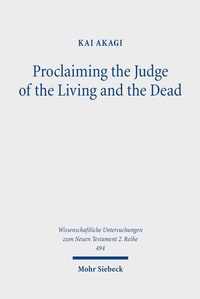
Proclaiming the Judge of the Living and the Dead
The Christological Significance of Judgement in Acts 10 and 17
1st Edition
Published on 11. September 2019
213 pages
978-3-16-156904-3 (ISBN)
Description

Kai Akagi betrachtet die christologische Bedeutung der Rolle Jesu im Gericht in Apg 10,34-43 und 17,22-31. Liest man diese Reden als Teil des Narrativ des lukanischen Doppelwerks, sowie im Kontext jüdischer Literatur aus der Zeit des Zweiten Tempels, deutet Jesu Rolle als Richter seine göttliche Autorität und seine Identität des Messias an.
More details
Other editions
Additional editions
Kai Akagi
Proclaiming the Judge of the Living and the Dead
The Christological Significance of Judgement in Acts 10 and 17
Book
08/2019
1st Edition
Mohr Siebeck
€89.00
Article exhausted; check different version
Person
Content
- Cover
- Titel
- Preface
- Table of Contents
- List of Abbreviations
- Chapter 1 : Introduction
- 1. The Question of Jesus and Judgment in Acts 10:42 and 17:31
- 2. The Intersection of Three Fields
- 2.1. Studies of the Acts Speeches and Early Christian Proclamation
- 2.1.1 Form-Critical Studies and Early Christian Kerygma
- 2.1.2 Rhetorical Studies of the Acts Speeches
- 2.1.3 Studies of the Speeches in the Acts Narrative
- 2.2 Studies of Lukan Theology' and Christology
- 2.2.1 Hans Conzelmann
- 2.2.2 Darrell L. Bock
- 2.2.3 H. Douglas Buckwalter
- 2.2.4 Christopher M. Tuckett
- 2.2.5 C. Kavin Rowe
- 2.2.6 Other Studies
- 2.3. Studies of Early Christology'
- 2.3.1 From "Low" to "High" Christology: Bousset, Bultmann, and Dunn
- 2.3.2 Early "High" Christology: Hurtado. Bauckham, and Henrichs-Tarasenkova
- 2.3.3 Three Studies of Similarity: Boyarin, Kirk, and Fletcher-Louis
- 2.3.4 Summary'
- 3. An Approach to Christology and Judgment in Acts 10 and 17
- 3.1 A Reading of the Presentation of Jesus's Judgment in the Speeches
- 3.2 Reading Acts in the Context of Second Temple Judaism
- 3.3 Differentiated Similarity
- 3.4 Attention to Scriptural Use and Influence
- 3.5 Judgment and the Judgment Process
- 3.6 Reading Luke-Acts as a Narrative
- 4. Conclusion and Outline
- Chapter 2: Judgment Figures in Pseudepigraphal Literature
- 1. Method for Analysis
- 1.1 Provenance and Dating
- 1.2 Texts
- 1.3 Representation
- 1.4 Categories for Analysis
- 2. Analysis
- 2.1 The Similitudes of Enoch
- 2.1.1 Nature of Judgment
- 2.1.2 Activity Associated with Judgment
- 2.1.3 Nature of Figure
- 2.1.4 Principal Use of Scripture
- 2.2 4 Ezra
- 2.2.1 Nature of Judgment
- 2.2.2 Activity Associated with Judgment
- 2.2.3 Nature of Figure
- 2.2.4 Principal Use of Scripture
- 2.3 2 Baruch
- 2.3.1 Nature of Judgment
- 2.3.2 Activity Associated with Judgment
- 2.3.3 Nature of Figure
- 2.3.4 Principal Use of Scripture
- 3. Conclusion
- Chapter 3: Judgment Figures in Qurnran Literature
- 1. Method for Analysis
- 2. Analysis
- 2.1 lQRule of Benedictions (lQSb/lQ28b)
- 2.2 4QIsaiah Pesher3 (4Q161)
- 2.3 4QAramaic Apocalypse (4Q246)
- 2.4 4QSefer ha-Milhamah (4QSM/4Q285)
- 2.5 4QMessianic Apocalypse (4Q521)
- 2.6 1 lQMelchizedek (1 lQMelch/11Q13)
- 2.6.1 Nature of Judgment
- 2.6.2 Activity Associated with Judgment
- 2.6.3 Nature of Figure
- 2.6.4 Principal Use of Scripture
- 3. Conclusion
- Chapter 4: Divine Authority and Messianic Identity in Acts 10:34-13
- 1. Previous Study of Acts 10:34-43
- 2. Acts 10:42 and Divine Authority
- 2.1 The Scope of Jesus's Judgment Is Beyond Other Future Judgment Figures
- 2.2 The Scope of Jesus's Judgment in Acts 10:42 Is Elsewhere Unique to God
- 2.2.1 God Is Singularly the Final Judge in Contemporary Jewish Literature
- 2.2.2 God Appears to Be the Judge of the Dead prior to This Point in Luke-Acts
- 2.3 Jesus Parallels God in His Role and the Response to Hun in the Speech's Structure
- 2.4 Correspondence of Acts 10:34-43 to Deuteronomy 10:17-20
- 2.5 Jesus's Authority as Judge and the Divine Prerogative of Forgiveness
- 3. Acts 10:42 and Messianic Identity
- 3.1 Other Messianic Figures Appear as Unique Judges
- 3.2 The Scope of Jesus's Judgment Suggests Judgment Unique to the Messiah
- 3.3 Jesus's Role as Judge Is the Content of the Apostolic Message
- 3.4 Appointment Associates Jesus's Judgment with Messianic Identity
- 3.4.1 Jesus's Baptism
- 3.4.2 Selected Other Passages
- 4. Excursus: Jesus as Ttavzcov tcvpio^in 10:36
- 5. The Nature of Jesus in Acts 10:34-43
- 6. Conclusion
- Chapter 5: Divine Authority and Messianic Identity in Acts 17:22-31
- 1. Previous Approaches
- 2. Correspondence with Stoicism?
- 2.1 Creation. Providence, and Immanence
- 2.2 Critique of Cultic Objects
- 2.3 Early Patristic Interpretation
- 3. Jesus 's Judgment in Acts 17:31 and Divine Authority
- 3.1 Jewish Polemic and the Uniqueness of Israel's God
- 3.1.1 A Pattern of Jewish Polemic in the Areopagus Speech
- 3.1.2 The Function of the Jewish Polemic Pattern
- 3.2 Psalm 96. Coming for Judgment, and Scriptural Enactment
- 3.2.1 The Content of Acts 17:22-31 Corresponds Specifically to Psalm 96
- 3.2.2 The Athens Episode Enacts What Psalm 96 Describes
- 3.2.3 Jesus's Judgment in Acts 17:31 and Yahweh's Judgment in Psalm 96
- 3.3 The Object of Paul's Proclamation
- 3.4 Acts 17:31 Presents Jesus as Judging with God's Final Judgment
- 4. Jesus 's Judgment in Acts 17:31 Expresses Messianic Identity
- 4.1 Jesus's Appointment and Messianic Identity
- 4.2 The Content of Apostolic Testimony and Messianic Identity-
- 4.3 The Logic of Demonstrating Jesus's Judgment and Messianic Identity'
- 5. The Nature of Jesus in Acts 17:22-31
- 6. Conclusion
- Chapter 6: Conclusion
- Bibliography
- Index of Ancient Sources
- Index of Modern Authors
- Subject Index
