

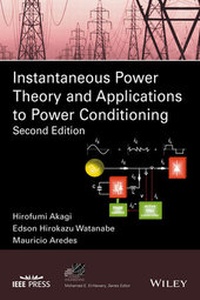
Instantaneous Power Theory and Applications to Power Conditioning
Description

More details
Other editions
Additional editions
Persons
Content
CHAPTER 1 INTRODUCTION 1
1.1 Concepts and Evolution of Electric Power Theory 1
1.2 Applications of the P-q Theory to Power Electronics Equipment 4
1.3 Harmonic Voltages in Power Systems 5
1.4 Identified and Unidentified Harmonic-Producing Loads 6
1.5 Harmonic Current and Voltage Sources 8
1.6 Basic Principles of Harmonic Compensation 9
1.7 Basic Principle of Power Flow Control 13
References 15
CHAPTER 2 ELECTRIC POWER DEFINITIONS: BACKGROUND 17
2.1 Power Definitions Under Sinusoidal Conditions 18
2.2 Voltage and Current Phasors and Complex Impedance 20
2.3 Complex Power and Power Factor 21
2.4 Concepts of Power Under Nonsinusoidal Conditions: Conventional Approaches 22
2.4.1 Power Definitions by Budeanu 22
2.4.1.A Power Tetrahedron and Distortion Factor 25
2.4.2 Power Definitions by Fryze 27
2.5 Electric Power in Three-Phase Systems 28
2.5.1 Classifications of Three-Phase Systems 28
2.5.2 Power in Balanced Three-Phase Systems 31
2.5.3 Power in Three-Phase Unbalanced Systems 33
2.6 Summary 34
2.7 Exercises 34
References 35
CHAPTER 3 THE INSTANTANEOUS POWER THEORY 37
3.1 Basis of the p-q Theory 37
3.1.1 Historical Background of the p-q Theory 38
3.1.2 The Clarke Transformation 39
3.1.2.A Calculation of Voltage and Current Vectors When Zero-Sequence Components Are Excluded 41
3.1.3 Three-Phase Instantaneous Active Power in Terms of Clarke Components 43
3.1.4 The Instantaneous Powers of the p-q Theory 44
3.2 The p-q Theory in Three-Phase, Three-Wire Systems 44
3.2.1 Comparisons with the Conventional Theory 48
3.2.1.A Example #1-Sinusoidal Voltages and Currents 49
3.2.1.B Example #2-Balanced Voltages and Capacitive Loads 49
3.2.1.C Example #3-Sinusoidal Balanced Voltage and Nonlinear Load 50
3.2.2 Use of the p-q Theory for Shunt Current Compensation 54
3.2.2.A Examples of Appearance of Hidden Currents 59
3.2.3 The Dual p-q Theory 63
3.3 The p-q Theory in Three-Phase, Four-Wire Systems 65
3.3.1 The Zero-Sequence Power in a Three-Phase Sinusoidal Voltage Source 67
3.3.2 Presence of Negative-Sequence Components 68
3.3.3 General Case Including Distortions and Imbalances in the Voltages and in the Currents 69
3.3.4 Physical Meanings of the Instantaneous Real, Imaginary, and Zero-Sequence Powers 74
3.3.5 Avoiding the Clarke Transformation in the p-q Theory 75
3.3.6 Modified p-q Theory 77
3.4 Instantaneous abc Theory 81
3.4.1 Active and Nonactive Current Calculation by Means of a Minimization Method 83
3.4.2 Generalized Fryze Currents Minimization Method 88
3.5 Comparisons Between the p-q Theory and the abc Theory 91
3.5.1 Selection of Power Components to be Compensated 95
3.6 The p-q-r Theory 97
3.7 Summary 104
3.8 Exercises 105
References 106
CHAPTER 4 SHUNT ACTIVE FILTERS 111
4.1 General Description of Shunt Active Filters 113
4.1.1 PWM Converters for Shunt Active Filters 114
4.1.2 Active Filter Controllers 115
4.2 Three-Phase, Three-Wire Shunt Active Filters 118
4.2.1 Active Filters for Constant Power Compensation 119
4.2.2 Active Filters for Sinusoidal Current Control 135
4.2.2.A Positive-Sequence Voltage Detector 138
4.2.2.B Simulation Results 145
4.2.3 Active Filters for Current Minimization 145
4.2.4 Active Filters for Harmonic Damping 149
4.2.4.A Shunt Active Filter Based on Voltage Detection 151
4.2.4.B Active Filter Controller Based on Voltage Detection 152
4.2.4.C An Application Case of an Active Filter for Harmonic Damping 156
4.2.5 A Digital Controller 171
4.2.5.A System Configuration of the Digital Controller 172
4.2.5.B Current Control Methods 177
4.3 Three-Phase, Four-Wire Shunt Active Filters 180
4.3.1 Converter Topologies for Three-Phase, Four-Wire Systems 181
4.3.2 Dynamic Hysteresis-Band Current Controller 182
4.3.3 Active Filter dc Voltage Regulator 184
4.3.4 Optimal Power Flow Conditions 185
4.3.5 Constant Instantaneous Power Control Strategy 187
4.3.6 Sinusoidal Current Control Strategy 189
4.3.7 Performance Analysis and Parameter Optimization 192
4.3.7.A Influence of the System Parameters 192
4.3.7.B Dynamic Response of the Shunt Active Filter 193
4.3.7.C Economical Aspects 198
4.3.7.D Experimental Results 199
4.4 Compensation Methods Based on the p-q-r Theory 204
4.4.1 Reference Power Control Method 206
4.4.2 Reference Current Control Method 211
4.4.3 Alternative Control Method 213
4.4.4 The Simplified Sinusoidal Source Current Strategy 215
4.4.4.A The PLL Circuit and the Positive-Sequence Detector 215
4.4.4.B The Sinusoidal Source Current Control Strategy with Energy Balance Inside the Active Filter 217
4.5 Comparisons Between Control Methods Based on the p-q Theory and the p-q-r Theory 218
4.6 Shunt Selective Harmonic Compensation 224
4.7 Summary 231
4.8 Exercises 231
References 233
CHAPTER 5 HYBRID AND SERIES ACTIVE FILTERS 237
5.1 Basic Series Active Filter 237
5.2 Combined Series Active Filter and Shunt Passive Filter 239
5.2.1 Example of an Experimental System 242
5.2.1.A Compensation Principle 243
5.2.1.B Filtering Characteristics 245
5.2.1.C Control Circuit 246
5.2.1.D Filter to Suppress Switching Ripples 248
5.2.1.E Experimental Results 249
5.2.2 Some Remarks about the Hybrid Filters 252
5.3 Series Active Filter Integrated with a Double-Series Diode Rectifier 253
5.3.1 The First-Generation Control Circuit 255
5.3.1.A Circuit Configuration and Delay Time 255
5.3.1.B Stability of the Active Filter 257
5.3.2 The Second-Generation Control Circuit 258
5.3.3 Stability Analysis and Characteristics Comparison 260
5.3.3.A Transfer Function of the Control Circuits 260
5.3.3.B Characteristics Comparisons 261
5.3.4 Design of a Switching-Ripple Filter 263
5.3.4.A Design Principle 263
5.3.4.B Effect on the System Stability 263
5.3.4.C Experimental Testing 264
5.3.5 Experimental Results 266
5.4 Comparisons Between Hybrid and Pure Active Filters 268
5.4.1 Low-Voltage Transformerless Hybrid Active Filter 268
5.4.2 Low-Voltage, Transformerless, Pure Shunt Active Filter 271
5.4.3 Comparisons through Simulation Results 273
5.5 Hybrid Active Filters for Medium-Voltage Motor Drives 274
5.5.1 Hybrid Active Filter for a Three-Phase Six-Pulse Diode Rectifier 275
5.5.1.A System Configuration 275
5.5.1.B Experimental System 277
5.5.1.C Control System 277
5.5.1.D Common Sixth-Harmonic Zero-Sequence Voltage Injection 281
5.5.1.E Three-Phase Second-Harmonic Negative Sequence Voltages Injection 283
5.5.1.F Experimental Results 286
5.5.1.G Appendix 292
5.5.2 Hybrid Active Filter for a Three-Phase 12-Pulse Diode Rectifier 292
5.5.2.A Medium-Voltage High-Power Motor Drive Systems 293
5.5.2.B Experimental System 295
5.5.2.C Control System 298
5.5.2.D Three-Phase Second-Harmonic Negative Sequence Voltages Injection 300
5.5.2.E Experimental Results 303
5.5.2.F Overall System Efficiency 308
5.6 Summary 308
5.7 Exercises 309
References 310
CHAPTER 6 COMBINED SERIES AND SHUNT POWER CONDITIONERS 313
6.1 The Unified Power Flow Controller 314
6.1.1 FACTS and UPFC Principles 315
6.1.1.A Voltage Regulation Principle 317
6.1.1.B Power Flow Control Principle 318
6.1.2 A Controller Design for the UPFC 321
6.1.3 UPFC Approach Using a Shunt Multipulse Converter 328
6.1.3.A Six-Pulse Converter 328
6.1.3.B Quasi 24-Pulse Converter 332
6.1.3.C Control of Active and Reactive Power in Multipulse Converters 334
6.1.3.D Shunt Multipulse Converter Controller 336
6.2 The Unified Power Quality Conditioner 339
6.2.1 General Description of the UPQC 340
6.2.2 A Three-Phase, Four-Wire UPQC 342
6.2.2.A Power Circuit of the UPQC 343
6.2.2.B The UPQC Controller 344
6.2.2.C Analysis of the UPQC Dynamic 353
6.2.3 The UPQC Combined with Passive Filters (the Hybrid UPQC) 370
6.2.3.A Controller of the Hybrid UPQC 374
6.2.3.B Experimental Results 380
6.3 The Universal Active Power Line Conditioner 386
6.3.1 General Description of the UPLC 386
6.3.2 The Controller of the UPLC 389
6.3.2.A Controller for Configuration #2 of the UPLC 396
6.3.3 Performance of the UPLC 397
6.3.3.A Normalized System Parameters 397
6.3.3.B Simulation Results of Configuration #1 of the UPLC 401
6.3.3.C Simulation Results of Configuration #2 of the UPLC 409
6.3.4 General Aspects 411
6.4 Combined Shunt-Series Filters for AC and DC Sides of Three-Phase Rectifiers 411
6.4.1 The Combined Shunt-Series Filter 414
6.4.2 Instantaneous Real and Imaginary Powers in the ac Source 415
6.4.3 The Instantaneous Power in the dc Side of the Rectifier 416
6.4.4 Comparison of Instantaneous Powers on the ac and dc Sides of the Rectifier 418
6.4.5 Control Algorithm of the Active Shunt-Series Filter 418
6.4.6 The Common dc Link 421
6.4.7 Digital Simulation 424
6.4.8 Experimental Results 426
6.5 Summary 427
6.6 Exercises 428
References 429
INDEX 431
CHAPTER 1
INTRODUCTION
THE INSTANTANEOUS ACTIVE AND REACTIVE POWER theory, or the so-called "p-q theory," was introduced by Akagi, Kanazawa, and Nabae in 1983. Since then, it has been extended by the authors of this book, as well as other research scientists. This book deals with the theory in a complete form for the first time, including comparisons with other sets of instantaneous power definitions. The usefulness of the p-q theory is confirmed in the following chapters dealing with applications in controllers of compensators that are generically classified here as active power line conditioners.
The term "power conditioning" used in this book has much broader meaning than the term "harmonic filtering." In other words, the power conditioning is not confined to harmonic filtering, but contains harmonic damping, harmonic isolation, harmonic termination, reactive-power control for power factor correction, power flow control, and voltage regulation, load balancing, voltage-flicker reduction, and/or their combinations. Active power line conditioners are based on leading edge power electronics technology that includes power conversion circuits, power semiconductor devices, analog/digital signal processing, voltage/current sensors, and control theory.
Concepts and evolution of electric power theory are briefly described later. Then, the need for a consistent set of power definitions is emphasized to deal with electric systems under nonsinusoidal conditions. Problems with harmonic pollution in alternating current systems (ac systems) are classified, including a list of the principal harmonic-producing loads. Basic principles of harmonic compensation are introduced. Finally, this chapter describes the fundaments of power flow control. All these topics are the subjects of scope and will be discussed deeply in the following chapters of the book.
1.1 Concepts and Evolution of Electric Power Theory
One of main points in the development of alternating current (ac) transmission and distribution power systems at the end of the nineteenth century was based on sinusoidal voltage at constant-frequency generation. Sinusoidal voltage with constant frequency has made easier the design of transformers and transmission lines, including very long distance lines. If the voltage were not sinusoidal, complications would appear in the design of transformers, machines, and transmission lines. These complications would not allow, certainly, such a development as the generalized "electrification of the human society." Today, there are very few communities in the world without ac power systems with "constant" voltage and frequency.
With the emergence of sinusoidal voltage sources, the electric power network could be made more efficient if the load current were in phase with the source voltage. Therefore, the concept of reactive power was defined to represent the quantity of electric power due to the load current that is not in phase with the source voltage. The average of this reactive power during one period of the line frequency is zero. In other words, this power does not contribute to energy transfer from the source to the load. At the same time, the concepts of apparent power and power factor were created. Apparent power gives the idea of how much power can be delivered or consumed if the voltage and current are sinusoidal and perfectly in phase. The power factor gives a relation between the average power actually delivered or consumed in a circuit and the apparent power at the same point. Naturally, the higher the power factor, the better the circuit utilization. As a consequence, the power factor is more efficient not only electrically but also economically. Therefore, electric power utilities have specified lower limits for the power factor. Loads operated at low power factor pay an extra charge for not using the circuit efficiently.
For a long time, one of the main concerns related to electric equipment was power factor correction, which could be done by using capacitor banks or, in some cases, reactors. For all situations, the load acted as a linear circuit drawing a sinusoidal current from a sinusoidal voltage source. Hence, the conventional power theory based on active-, reactive-, and apparent-power definitions was sufficient for design and analysis of power systems. Nevertheless, some papers were published in the 1920s, showing that the conventional concept of reactive and apparent power loses its usefulness in nonsinusoidal cases [1,2]. Then, two important approaches to power definitions under nonsinusoidal conditions were introduced by Budeanu [3,4] in 1927 and Fryze [5] in 1932. Fryze defined power in the time domain, whereas Budeanu did it in the frequency domain. At that time, nonlinear loads were negligible, and little attention was paid to this matter for a long time.
Since power electronics was introduced in the late 1960s, nonlinear loads that consume nonsinusoidal current have increased significantly. In some cases, they represent a very high percentage of the total loads. Today, it is common to find a house without linear loads such as conventional incandescent lamps. In most cases, these lamps have been replaced by electronically controlled fluorescent lamps. In industrial applications, an induction motor that can be considered as a linear load in a steady state is now equipped with a rectifier and inverter for the purpose of achieving adjustable speed control. The induction motor together with its drive is no longer a linear load. Unfortunately, the previous power definitions under nonsinusoidal currents were dubious, thus leading to misinterpretations in some cases. Chapter 2 presents a review of some theories dealing with nonsinusoidal conditions.
As pointed out earlier, the problems related to nonlinear loads have significantly increased with the proliferation of power electronics equipment. The modern equipment behaves as a nonlinear load drawing a significant amount of harmonic current from the power network. Hence, power systems in some cases have to be analyzed under nonsinusoidal conditions. This makes it imperative to establish a consistent set of power definitions that are also valid during transients and under nonsinusoidal conditions.
The power theories presented by Budeanu [3,4] and Fryze [5] had basic concerns related to the calculation of average power or root-mean-square values (rms values) of voltage and current. The development of power electronics technology has brought new boundary conditions to the power theories. Exactly speaking, the new conditions have not emerged from the research of power electronics engineers. They have resulted from the proliferation of power converters using power semiconductor devices such as diodes, thyristors, insulated-gate bipolar transistors (IGBTs), gate-turn-off thyristors, and so on. Although these power converters have a quick response in controlling their voltages or currents, they may draw reactive power as well as harmonic current from power networks. This has made it clear that conventional power theories based on average or rms values of voltages and currents are not applicable to the analysis and design of power converters and power networks. This problem has become more serious and clear during comprehensive analysis and design of active filters intended for reactive-power compensation as well as harmonic compensation.
From the end of the 1960s to the beginning of the 1970s, Erlicki and Emanuel-Eigeles [6], Sasaki and Machida [7], and Fukao et al. [8] published their pioneer papers presenting what can be considered as a basic principle of controlled reactive-power compensation. For instance, Erlicki and Emanuel-Eigeles [6] presented some basic ideas like "compensation of distortive power is unknown to date.." They also determined that "a non-linear resistor behaves like a reactive-power generator while having no energy-storing elements" and presented the very first approach to active power-factor control. Fukao et al. [8] stated that "by connecting a non-active-power source in parallel with the load, and by controlling it in such a way as to supply reactive power to the load, the power network will only supply active power to the load. Therefore, ideal power transmission would be possible."
Gyugyi and Pelly [9] presented the idea that reactive power could be compensated by a naturally commutated cycloconverter without energy storage elements. This idea was explained from a physical point of view. However, no specific mathematical proof was presented. In 1976, Harashima et al. [10] presented, probably for the first time, the term "instantaneous reactive power" for a single-phase circuit. That same year, Gyugyi and Strycula [11] used the term "active ac power filters" for the first time. A few years later, in 1981, Takahashi et al. published two papers [12,13] giving a hint of the emergence of the instantaneous power theory or "p-q theory." In fact, the formulation they reached can be considered a subset of the p-q theory that forms the main scope of this book. However, the physical meaning of the variables introduced to the subset was not explained by them.
The p-q theory in its first version was published in the Japanese language in 1982 [14] in a local conference, and later in Transactions of the Institute of Electrical Engineers of Japan...
