

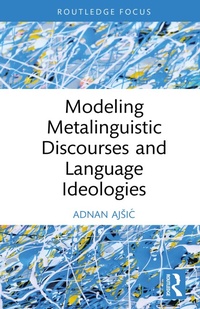
Modeling Metalinguistic Discourses and Language Ideologies
Published on 18. June 2025
112 pages
978-1-040-40559-8 (ISBN)
Description

This volume offers a comprehensive treatment of corpus linguistic approaches to the study of metalinguistic discourses and language ideologies.
The book traces the historical trajectories of research on language ideology and metalinguistic discourse, respectively, as a foundation for exploring both the opportunities and challenges of classic corpus linguistic approaches as applied to data sets from comparative South Slavic and English case studies. This analysis paves the way for exploring methodological innovations afforded by multivariate approaches, such as factor analysis, cluster analysis, and topic modelling by applying it to the same data sets. The book concludes by reflecting on challenges and lessons learned toward outlining future directions for the further development of research at the intersection of metalinguistic discourses and language ideologies.
This book will be of interest to students and scholars in corpus linguistics, discourse analysis, sociolinguistics, and applied linguistics.
The book traces the historical trajectories of research on language ideology and metalinguistic discourse, respectively, as a foundation for exploring both the opportunities and challenges of classic corpus linguistic approaches as applied to data sets from comparative South Slavic and English case studies. This analysis paves the way for exploring methodological innovations afforded by multivariate approaches, such as factor analysis, cluster analysis, and topic modelling by applying it to the same data sets. The book concludes by reflecting on challenges and lessons learned toward outlining future directions for the further development of research at the intersection of metalinguistic discourses and language ideologies.
This book will be of interest to students and scholars in corpus linguistics, discourse analysis, sociolinguistics, and applied linguistics.
More details
Series
Language
English
Place of publication
London
United Kingdom
Publishing group
Taylor & Francis Ltd
Target group
College/higher education
Illustrations
15 Tables, black and white; 12 Line drawings, black and white; 3 Halftones, black and white; 15 Illustrations, black and white
File size
8,79 MB
ISBN-13
978-1-040-40559-8 (9781040405598)
Copyright in bibliographic data and cover images is held by Nielsen Book Services Limited or by the publishers or by their respective licensors: all rights reserved.
Schweitzer Classification
Other editions
Additional editions
Book
06/2025
1st Edition
Routledge
€78.10
Shipment within 15-20 days
Person
Adnan Ajsic is Associate Professor of English at the American University of Sharjah, UAE.
Content
1. Introduction
1.1 What is this volume about and who is it for?
1.2 Why this volume?
2. Metalinguistic discourse, language ideology, and the evolution of methodological approaches
2.1 Definitions
2.2 Qualitative research
2.3 Quantitative and mixed-methods research
3. Classic corpus linguistic tools: Case study #1
3.1 Frequency
3.2 Collocation analysis
3.3 Concordance analysis
3.4 Keyword analysis
4. Multivariate corpus linguistic approaches
4.1 Exploratory factor analysis and cluster analysis: Case study #2
4.2 Topic modeling for triangulation: Case study #3
4.3 Topic modeling for exploration
4.3.1 Thematically heterogeneous corpora: Case study #4
4.3.2 Thematically homogeneous subcorpora (immigration): Case study #5
4.3.2 Thematically homogeneous subcorpora (language): Case study #6
5. Challenges and lessons learned
5.1 Theoretical issues
5.2 Methodological challenges
6. Epilogue
Appendix A
Appendix B
Appendix C
Index
1.1 What is this volume about and who is it for?
1.2 Why this volume?
2. Metalinguistic discourse, language ideology, and the evolution of methodological approaches
2.1 Definitions
2.2 Qualitative research
2.3 Quantitative and mixed-methods research
3. Classic corpus linguistic tools: Case study #1
3.1 Frequency
3.2 Collocation analysis
3.3 Concordance analysis
3.4 Keyword analysis
4. Multivariate corpus linguistic approaches
4.1 Exploratory factor analysis and cluster analysis: Case study #2
4.2 Topic modeling for triangulation: Case study #3
4.3 Topic modeling for exploration
4.3.1 Thematically heterogeneous corpora: Case study #4
4.3.2 Thematically homogeneous subcorpora (immigration): Case study #5
4.3.2 Thematically homogeneous subcorpora (language): Case study #6
5. Challenges and lessons learned
5.1 Theoretical issues
5.2 Methodological challenges
6. Epilogue
Appendix A
Appendix B
Appendix C
Index
