

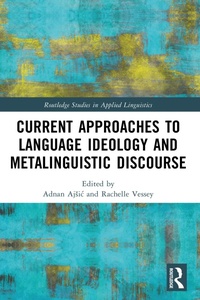
Current Approaches to Language Ideology and Metalinguistic Discourse
Published on 29. August 2025
264 pages
978-1-040-38174-8 (ISBN)
Description

This collection brings together research on cutting-edge developments at the intersection of language ideology and metalinguistic discourse, showcasing the potential of diverse approaches.
With interest in language ideology and metalinguistic discourse growing, numerous qualitative and quantitative approaches have been established but have often resulted in a siloing of methods. Despite methodological advances, research on language ideology and metalinguistic discourse often relies on either qualitative methods (e.g., ethnography, content analysis) or traditional corpus linguistic techniques (e.g., concordance, collocation), with limited overlap between these "camps," a division which has hindered a comprehensive understanding of the field. The book makes the case for bridging this gap by exploring the overlap between different approaches, demonstrating the nuanced insights a mixed methods perspective can provide. Featuring a wide range of applications across domains such as education, policy, minorities, traditional and social media, popular culture, and literature, the volume highlights the potential of integrating diverse methods. An afterword by Tommaso Milani ties these strands together, offering a forward-looking view of the field and potential directions for further research.
This book will appeal to students and scholars in applied linguistics, language and education, and sociolinguistics.
With interest in language ideology and metalinguistic discourse growing, numerous qualitative and quantitative approaches have been established but have often resulted in a siloing of methods. Despite methodological advances, research on language ideology and metalinguistic discourse often relies on either qualitative methods (e.g., ethnography, content analysis) or traditional corpus linguistic techniques (e.g., concordance, collocation), with limited overlap between these "camps," a division which has hindered a comprehensive understanding of the field. The book makes the case for bridging this gap by exploring the overlap between different approaches, demonstrating the nuanced insights a mixed methods perspective can provide. Featuring a wide range of applications across domains such as education, policy, minorities, traditional and social media, popular culture, and literature, the volume highlights the potential of integrating diverse methods. An afterword by Tommaso Milani ties these strands together, offering a forward-looking view of the field and potential directions for further research.
This book will appeal to students and scholars in applied linguistics, language and education, and sociolinguistics.
More details
Series
Language
English
Place of publication
London
United Kingdom
Publishing group
Taylor & Francis Ltd
Target group
College/higher education
Professional and scholarly
Illustrations
15 Tables, black and white; 8 Line drawings, black and white; 2 Halftones, black and white; 10 Illustrations, black and white
File size
2,11 MB
ISBN-13
978-1-040-38174-8 (9781040381748)
Copyright in bibliographic data and cover images is held by Nielsen Book Services Limited or by the publishers or by their respective licensors: all rights reserved.
Schweitzer Classification
Other editions
Additional editions
Adnan Ajsic | Rachelle Vessey
Current Approaches to Language Ideology and Metalinguistic Discourse
Book
08/2025
1st Edition
Routledge
€206.50
Shipment within 10-20 days
Persons
Adnan Ajsic is Associate Professor of English at the American University of Sharjah, United Arab Emirates.
Rachelle Vessey is Assistant Professor in the School of Linguistics and Language studies at Carleton University, Canada.
Rachelle Vessey is Assistant Professor in the School of Linguistics and Language studies at Carleton University, Canada.
Content
Contents
List of Contributors
Chapter 1: Introduction (Rachelle Vessey and Adnan Ajsic)
Part One: Language ideology and education
Chapter 2: A discourse analytic framework for the study of language ideologies: A case study of multilingual Iran (Jaffer Sheyholislami and Rachelle Vessey)
Chapter 3: Teacher Language Ideology and Associated Instructional Practice: The Influence of Monoglossia and Heteroglossia in the TESOL Classroom (Leah Davis, Cassie Hoopes, Shari Manhas)
Chapter 4: Developing Pre-Service ESOL Teachers' Metalinguistic Awareness of the Spanish Language: Challenging Language Ideologies (Brian Hibbs)
Chapter 5: Understanding Dialect Accommodation and Linguistic Self-Esteem during a Study Abroad Program (Covadonga Lamar Prieto, Alvaro Gonzalez Alba)
Part Two: Standard language ideology and minoritized languages
Chapter 6: Perceptual Insights into the Martinican Creole Continuum: Standardization, Ideologies of (Linguistic) Differentiation and New Indexicalities (Chiara Ardoino, Noemie Francois-Haugrin, Stephane Terosier)
Chapter 7: From global connections to local roots: exploring language ideologies in Emilian and Esperanto for language revitalisation (Jessica Hampton)
Chapter 8: Metalinguistic comments and language attitudes in the novel Pour sur by France Daigle: The representation of an Acadian French vernacular (Catherine Leger, Pierre-Don Giancarli)
Part Three: Language ideology and the media
Chapter 9: "pues nada hija que te sigan los catalanes!!": Challenging and defending the use of Catalan in social media (Alba Mila-Garcia, Anna Tudela-Isanta)
Chapter 10: Raciolinguistic Ideologies in Social Media: A Critical Discourse Analysis of
Facebook reactions to the new Oxford Dictionary of African American English (Julian Canjura)
Chapter 11: Challenges in the corpus-based study of metalinguistic discourses and language ideologies (Adnan Ajsic)
Chapter 12: Commentary: Language ideology - A personal reflection (Tommaso Milani)
Index
List of Contributors
Chapter 1: Introduction (Rachelle Vessey and Adnan Ajsic)
Part One: Language ideology and education
Chapter 2: A discourse analytic framework for the study of language ideologies: A case study of multilingual Iran (Jaffer Sheyholislami and Rachelle Vessey)
Chapter 3: Teacher Language Ideology and Associated Instructional Practice: The Influence of Monoglossia and Heteroglossia in the TESOL Classroom (Leah Davis, Cassie Hoopes, Shari Manhas)
Chapter 4: Developing Pre-Service ESOL Teachers' Metalinguistic Awareness of the Spanish Language: Challenging Language Ideologies (Brian Hibbs)
Chapter 5: Understanding Dialect Accommodation and Linguistic Self-Esteem during a Study Abroad Program (Covadonga Lamar Prieto, Alvaro Gonzalez Alba)
Part Two: Standard language ideology and minoritized languages
Chapter 6: Perceptual Insights into the Martinican Creole Continuum: Standardization, Ideologies of (Linguistic) Differentiation and New Indexicalities (Chiara Ardoino, Noemie Francois-Haugrin, Stephane Terosier)
Chapter 7: From global connections to local roots: exploring language ideologies in Emilian and Esperanto for language revitalisation (Jessica Hampton)
Chapter 8: Metalinguistic comments and language attitudes in the novel Pour sur by France Daigle: The representation of an Acadian French vernacular (Catherine Leger, Pierre-Don Giancarli)
Part Three: Language ideology and the media
Chapter 9: "pues nada hija que te sigan los catalanes!!": Challenging and defending the use of Catalan in social media (Alba Mila-Garcia, Anna Tudela-Isanta)
Chapter 10: Raciolinguistic Ideologies in Social Media: A Critical Discourse Analysis of
Facebook reactions to the new Oxford Dictionary of African American English (Julian Canjura)
Chapter 11: Challenges in the corpus-based study of metalinguistic discourses and language ideologies (Adnan Ajsic)
Chapter 12: Commentary: Language ideology - A personal reflection (Tommaso Milani)
Index
