

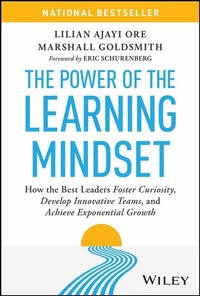
The Power of the Learning Mindset
Description

Develop a passion for learning and adaptability to advance your career in the modern workplace.
In an era of rampant technological change and economic upheaval, The Power of the Learning Mindset is a guidebook to open up new paths to career advancement by cultivating a new approach to adaptability, curiosity, and resilience. In this book, award-winning international scholar, speaker, and executive Dr. Lilian Ajayi Ore and Thinkers50 #1 Executive Coach and New York Times bestselling author Dr. Marshall Goldsmith reveal new, research-proven pedagogical techniques to succeed in the modern workplace, along with the tools you need to inculcate not only the ability to learn and adapt but also the passion that leads to exponential growth.
Drawing on the expertise of Marshall Goldsmith-widely recognized as the world's #1 executive coach, with decades of experience advising global CEOs and senior leaders-and Dr. Ore's 17 years of experience working with Fortune 100 and Fortune 500 companies, along with more than a decade in talent development, this book explores topics such as:
- Tools and processes enabled by emerging research and human motivational theories, and how to separate real value from ephemeral trends
- The importance of soft skills, including emotional intelligence, in becoming a respected, effective leader
- Mindsets around learning, leadership, and coaching prowess
- Our past, present, future, and desired future selves, and how to enjoy the journey as one evolves into the next
The Power of the Learning Mindset earns a well-deserved spot on the bookshelves of all executives and managers seeking to thrive in their current roles and set themselves up for success in the future as the world of work continues to undergo rapid transformation and change.
More details
Other editions
Additional editions
Persons
LILIAN AJAYI ORE, Ed.D., is an award-winning international scholar, speaker, and executive with over 17 years of experience working with Fortune 100 and Fortune 500 companies and 12 years of experience in talent development. She specializes in leadership development and organizational transformation.
MARSHALL GOLDSMITH is the author of several bestselling books, including Triggers and What Got You Here Won't Get You There. He was recognized as one of the Top Ten Business Thinkers in the World and has been rated the world's best executive coach at the Thinkers50 ceremony since 2011.
Content
Foreword by Eric Schurenberg xiii
Introduction: The Rise, Fall, and Rebirth of the Learning Prowess xvii
Part 1 The Learning Prowess 1
1 The Quest for Prowess 3
2 Investing in Your Prowess: Why It Matters 19
3 How Does Continuous Learning Build Credibility? 43
Part 2 Developing Leadership Prowess 67
4 What Is Leadership Prowess? 69
5 Why Do Leaders Fail, and How Can You Succeed? 95
6 How Can You Leverage Leadership Accountability? 113
Part 3 Embracing Coaching Prowess 139
7 What Is Coaching Prowess? 141
8 Why Should Leaders Embrace Coaching? 161
9 How Can Humanizing Coaching Inspire Change? 181
Final Thoughts: The Reader's Challenge 199
Further Reading 203
Acknowledgments 205
About the Authors 209
Index 211
Introduction: The Rise, Fall, and Rebirth of the Learning Prowess
Has Truth Lost Its Relevance?
In today's world, we are overwhelmed by the distractions of misinformation, disinformation, clickbait headlines, declining institutional trust, and self-proclaimed experts. Not to mention the allure of celebrity gossip, the endless scroll of social media opinions from friends and strangers alike, political noise, digital scams, and the lingering effects of post-pandemic fatigue.
Americans now spend an average of 21 hours per week streaming content-a trend mirrored around the globe-while daily social media use continues to climb. These digital habits often pull us away from meaningful relationships, personal growth, and the pursuit of healthier routines.
We are in the midst of a personal time crisis-one that's reshaping how we relate to truth itself. As the boundaries between reality and illusion swing like a pendulum, the very idea of truth becomes blurred, leaving us to question not just what is true but also whether truth still matters at all.
Are we also losing our ability to distinguish fact from fiction? In the midst of this information overload, our mental models are shifting. We may find ourselves clinging to familiar "truths" simply because they feel recognizable-even if they no longer serve us.
At the same time, we often absorb what's presented to us without urgency, curiosity, or critical examination. In this environment, convenience can replace credibility, and familiarity can override fact.
This phenomenon surprisingly isn't new. Sociologists have long discussed social influence theory, which explains the human tendency to seek conformity and social proof from loved ones, peers, and society at large-especially when our social ties influence our perceptions of reality.
This need for validation often stops us from exploring deeper truths and instead leaves us settling for surface-level narratives, keeps us busy, and swayed by a disappearing reverence for the unvarnished truth.
Eric Schurenberg, founder of the Alliance for Trust in Media and former editor-in-chief of Fast Company and Inc. Magazine-a friend, mentor, and fellow member of the Marshall Goldsmith 100 Coaches-captured this dilemma during a classroom discussion.
Eric shares, "we are witnessing the erosion of truth-telling and its effect on everyone. This is the time to invest in our mental immunity. Get outside your bubble to get a different perspective. Don't imagine that you, or your group, have a monopoly on truth."
Eric, a distinguished business journalist and media executive, leads an organization at the forefront of the fight against misinformation and disinformation-working to restore trust in professional journalism and protect our shared understanding of truth in a rapidly changing media landscape.
Society's continued acceptance of others' interpretations of truth underscores why the subtitle to this Introduction is titled, "The Rise, Fall, and Rebirth of the Learning Prowess."
Prowess represents the relentless pursuit of knowledge and the drive to live out our aspirations. It is a personal journey and a commitment to self-betterment, creating value not only for ourselves but also for others.
Prowess embodies the desire to learn, reskill, and show up differently in a world rife with distraction and noise. Prowess is often mistaken for mastery, but is there a difference between the two? We say yes.
Mastery is often viewed as a fixed destination-a state of complete skill and expertise in a specific area, suggesting an endpoint achieved through consistent effort and control.
Prowess, however, extends beyond mastery; it is a continuous journey toward excellence, truth, and adaptability. Unlike mastery, which implies a final achievement, prowess emphasizes resilience, authenticity, and the ongoing refinement of skills and knowledge. It is a commitment to lifelong learning.
It's an evolving commitment to growth, challenging individuals to constantly expand their potential and integrate new insights. This perspective on prowess is essential for organizations seeking to cultivate a talent pool that values continuous growth over static achievement.
By fostering a culture where the power of the learning mindsets is prioritized, organizations can develop teams that are adaptable, curious, innovative, and driven to excel beyond mere mastery. However, research reveals a concerning trend: many organizations today struggle to build a workplace culture that genuinely rewards the pursuit of prowess over static achievement or, at times, disengagement.
Leadership's Role in Creating a Culture of Prowess
Ultimately, creating an environment that prioritizes prowess lies with leadership. Leaders set the tone and serve as role models, amplifying the importance of continuous growth and signaling to employees that learning, adaptability, and innovation are highly valued.
By actively engaging in their own development and encouraging a shared commitment to learning, leaders can inspire a culture where prowess is celebrated over mere compliance.
To amplify the need for prowess, leaders must do more than encourage learning; they must cultivate a growth-oriented mindset at all levels. This means recognizing and rewarding progress, promoting open-mindedness, and providing opportunities for employees to pursue challenging, meaningful work that fosters ongoing skill refinement.
Leaders should also create safe spaces for experimentation, where employees feel empowered to take risks and explore new ideas without fear of failure or judgment.
Addressing the challenge of cultivating prowess-oriented cultures is crucial for strengthening a collective commitment to growth and fostering an environment where knowledge, innovation, and meaningful success can thrive.
This book is dedicated to supporting leaders and organizations on their journey back to prowess-reclaiming the paradox of truth for seekers and lifelong learners alike.
By prioritizing intentional learning, curiosity, and the development of a growth-oriented mindset, we can create environments where thoughtfulness, innovation, and authentic growth are not only encouraged but thrive.
Leaders who champion prowess inspire their teams to think critically, challenge assumptions, and pursue excellence-not as a static achievement but as an ongoing, dynamic process.
Together, we can strengthen the foundations of leadership and learning, building a future where organizations and individuals alike are empowered to grow, adapt, and lead with integrity.
Leading with the WIN Mindset
In a world where everyone wants to win and avoid losing, we're often told that success is reserved for the privileged or the exceptionally courageous. But Marshall and I believe winning isn't just for the select few-it's a mindset shift accessible to all.
Winning is about adopting a mindset that empowers us to take control of our growth, confront our fears, and shape our futures.
Take Tony Robbins, bestselling author and renowned performance coach, for example. In high school, he began to realize the power of what we call the WIN mindset-a shift in thinking that transformed his reality.
Tony frequently wondered why his family struggled financially while others could afford luxury vacations and enjoy stability. His determination to reshape his future led him to adopt a mindset focused on change, monetary success, social impact, and achievement.
By concentrating on what he could accomplish, Robbins moved from modest beginnings to becoming a multimillionaire, demonstrating that mindset is a powerful driver of success.
Our WIN mindset model, with its foundation in Willingness, Intentionality, and Nurturing, is accessible to everyone who's ready to make a change. It's not merely about achieving goals but about nurturing a mindset that fuels growth, resilience, and sustained progress.
A Quest for Prowess: Learning, Leadership, and Coaching
The purpose of this book is to support leaders and aspiring leaders in shaping their professional legacy, amplifying thought leadership, and achieving both career and life aspirations. Through personal anecdotes and real-life examples, we will share how our commitment to learning prowess transformed our leadership and coaching abilities. The WIN mindset model of willingness, intentionality, and nurturing will guide you through your next leadership transformation journey.
The WIN mindset model will serve as your road map to mastering learning, leadership, and coaching prowess while helping you achieve your goals and aspirations and uplifting your team and supporting their prowess. Through practical advice, actionable strategies, and reflective exercises, you'll be equipped to apply these principles daily, enhancing your ability to lead, inspire, and drive positive change.
By picking up this book, you've already committed to shaping your learning prowess and developing the ability to learn faster, lead better, and inspire transformation in yourself, your team, and the world around you.
Like you, Marshall and I have sought answers and professional growth through a journey of learning. This quest transformed us into the leaders we are today, and in this book, we...
