

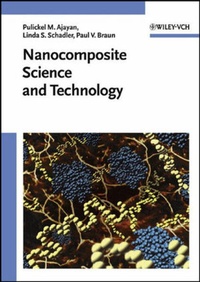
Nanocomposite Science and Technology
Description

This book contains the essence of this emerging technology, the underlying science and motivation behind the design of these structures and the future, particularly from the perspective of applications. It is intended to be a reference handbook for future scientists and hence carries the basic science and the fundamental engineering principles that lead to the fabrication and property evaluation of nanocomposite materials in different areas of materials science and technology.
Reviews / Votes
"...captures the essence of this emerging technology. It examines the underlying science and motivation behind the design of these structures, and looks into the future, particularly from the perspective of applications."PROCESS worldwide
"This book grew on me the more I read it. It really does achieve the editors' aim of providing examples and concepts that elucidate the nature of the field. The style is clear and the writing excellent. It is much more readable than the catalogue-style literature review often presented, and the authors have clearly not only exercised judgment in their selection of topics, they are all able to weave them into a coherent narrative. Even the fourth chapter, in which modelling of nanocomposites is surveyed in seven pages without a single equation, is an elegant tour de de force...This book will repay the thoughtful reader and is to be recommended as a guide to this exciting field."
Stephen Kukureka FIMMM (Senior Lecturer, University of Birmingham), Materials World 2/04
"...a valuable up-tp-date reference source...an excellent book...which gives the essence of this emerging material science field..."
Polymer News
"...will repay the thoughtful reader and is to be recommended as a guide to this exciting field..." Materials World, Vol 12(2), Feb 200
Erwähnung in: Tehnicki V Jesnik 10/03
Erwähnung mit Cover in: Process April 2004
"...Nanocomposite Science and Technology is an excellent book that provides systematic coverage of all basic nanocomposite principles and in-depth discussions on selected topics."
Polymer News, 2004 Vol. 29
"... the book can serve as a valuable source of inspiration for materials scientists and engineers in general. It can be recommended as a further reading for a relatively wide audience."
Willi Pabst, Ceramics - Silikáty, Institute of Chemical Technology, Prague, 3/2004
More details
Other editions
Additional editions
Persons
Linda S. Schadler is Associate Professor at Rensselaer Polytechnic Institute. She graduated from Cornell University in 1985 with a B.S. in materials science and engineering and received a PhD in materials science and engineering in 1990 from the University of Pennsylvania. After two years of post-doctoral work at IBM Yorktown Heights, Schadler served as a faculty member at Drexel University in Philadelphia, PA before coming to Rensselaer. Professor Schadler is a current member of the National Materials Advisory Board. She serves on numerous professional committees and as education and outreach coordinator for the Center "Directed Assembly of Nanostructures".
Dr. Schadler received a National Science Foundation National Young Investigator award in 1994 and the ASM International Bradley Staughton Award for Teaching in 1997. She received a Dow Outstanding New Faculty member award from the American Society of Engineering Education in 1998.
Paul V. Braun received his BS degree, with distinction, from Cornell University, and his PhD in Materials Science and Engineering from the University of Illinois at Urbana-Champaign in 1998. Following a one year post-doctoral appointment at Bell Labs, Lucent Technologies, he joined the faculty at the University of Illinois at U-C in 1999 as an assistant professor of materials Science and Engineering. He is the recipient of a 2001 Beckman Young Investigator Award, a 3M Nontenured Faculty Award, the 2002 Robert Lansing Hardy Award from TMS, and a Willett Faculty Scholar Award from the University of Illinois at U-C College of Engineering.
Content
BIO-NANOCOMPOSITES: NANOCOMPOSITES FROM AND INSPIRED BY NATURE
Synthesis
Processing
Characterization
Applications
POLYMER BASED AND POLYMER FILLED NANOCOMPOSITES
Synthesis
Processing
Characterization
Applications
BULK METAL AND CERAMICS NANOCOMPOSITES
Synthesis
Processing
Characterization
Applications
ACTIVE STRUCTURES
Chemically Active Structures
Biologically Active Structures
MODELING OF NANOSCALE COMPOSITE SYSTEMS
