

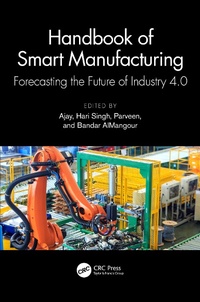
Handbook of Smart Manufacturing
Forecasting the Future of Industry 4.0
1st Edition
Published on 17. July 2023
384 pages
978-1-000-89833-0 (ISBN)
Description

This handbook covers smart manufacturing development, processing, modifications, and applications. It provides a complete understanding of the recent advancements in smart manufacturing through its various enabling manufacturing technologies, and how industries and organizations can find the needed information on how to implement smart manufacturing towards sustainability of manufacturing practices.
Handbook of Smart Manufacturing: Forecasting the Future of Industry 4.0 covers all related advances in manufacturing such as the integration of reverse engineering with smart manufacturing, industrial internet of things (IIoT), and artificial intelligence approaches, including Artificial Neural Network, Markov Decision Process, and Heuristics Methodology. It offers smart manufacturing methods like 4D printing, micro-manufacturing, and processing of smart materials to assist the biomedical industries in the fabrication of human prostheses and implants. The handbook goes on to discuss how to accurately predict the requirements, identify errors, and make innovation for the manufacturing process more manageable by implementing various advanced technologies and solutions into the traditional manufacturing process. Strategies and algorithms used to incorporate smart manufacturing into different sectors are also highlighted within the handbook.
This handbook is an invaluable resource for stakeholders, industries, professionals, technocrats, academics, research scholars, senior graduate students, and human healthcare professionals.
Handbook of Smart Manufacturing: Forecasting the Future of Industry 4.0 covers all related advances in manufacturing such as the integration of reverse engineering with smart manufacturing, industrial internet of things (IIoT), and artificial intelligence approaches, including Artificial Neural Network, Markov Decision Process, and Heuristics Methodology. It offers smart manufacturing methods like 4D printing, micro-manufacturing, and processing of smart materials to assist the biomedical industries in the fabrication of human prostheses and implants. The handbook goes on to discuss how to accurately predict the requirements, identify errors, and make innovation for the manufacturing process more manageable by implementing various advanced technologies and solutions into the traditional manufacturing process. Strategies and algorithms used to incorporate smart manufacturing into different sectors are also highlighted within the handbook.
This handbook is an invaluable resource for stakeholders, industries, professionals, technocrats, academics, research scholars, senior graduate students, and human healthcare professionals.
More details
Edition
1. Auflage
Language
English
Place of publication
London
United Kingdom
Publishing group
Taylor & Francis Ltd
Target group
College/higher education
Professional and scholarly
Illustrations
44 Tables, black and white; 107 Line drawings, black and white; 70 Halftones, black and white; 177 Illustrations, black and white
ISBN-13
978-1-000-89833-0 (9781000898330)
Copyright in bibliographic data and cover images is held by Nielsen Book Services Limited or by the publishers or by their respective licensors: all rights reserved.
Schweitzer Classification
Other editions
Additional editions
Book
12/2024
1st Edition
CRC Press
€94.60
Shipment within 10-20 days
Book
07/2023
1st Edition
CRC Press
€247.90
Shipment within 10-20 days
Persons
Dr. Ajay is currently serving as an Associate Professor in Mechanical Engineering Department, School of Engineering and Technology, JECRC University, Jaipur, Rajasthan, India. He received his Ph.D. in the field of Advanced Manufacturing from Guru Jambheshwar University of Science & Technology, Hisar, India after B.Tech. (Hons.) in mechanical engineering and M.Tech. (Distinction) in manufacturing and automation. His areas of research include Incremental Sheet Forming, Artificial Intelligence, Sustainable Materials, Additive Manufacturing, Smart Manufacturing, Industry 4.0, Waste Management, and Optimization Techniques. He has over 60 publications in international journals of repute including SCOPUS, Web of Science and SCI indexed database and refereed international conferences. He has also co-authored and co-edited many books and proceedings including the following CRC Press titles: Incremental Sheet Forming Technologies Principles, Merits, Limitations, and Applications, Advancements in Additive Manufacturing: Artificial Intelligence, Nature Inspired and Bio-manufacturing, Handbook of Sustainable Materials: Modelling, Characterization, and Optimization, and Waste Recovery and Management: An Approach Towards Sustainable Development Goals.
He has organized various national and international events including an international conference on Mechatronics and Artificial Intelligence (ICMAI-2021) as conference chair. He has more than 20 national and international patents to his credit. He has supervised more than 8 M.Tech, Ph.D scholars and numerous undergraduate projects/ thesis. He has a total of 15 years of experience in teaching and research. He is Guest Editors and Review Editor of the reputed journals including Frontiers in Sustainability. He has contributed to many international conferences/ symposiums as a session chair, expert speaker, and member of the editorial board. He has won several proficiency awards during the course of his career, including merit awards, best teacher awards, and so on. He is adviser of QCFI, Delhi Chapter student cell at JECRC University and has also authored many in-house course notes, lab manuals, monographs and invited chapters in books. He has organized a series of Faculty Development Programs, International Conferences, workshops, and seminars for researchers, PhD, UG and PG level students. He is associated with many research, academic, and professional societies in various capacities.
Dr. Hari Singh is a Professor in the Mechanical Engineering Department at NIT Kurukshetra, India. He completed his Bachelor in Mechanical Engineering with Honours in 1987, his Master in Mechanical Engg in 1994, and his Ph.D. in 2001 from Regional Engineering College, Kurukshetra (now, NIT Kurukshetra). He has 34 years of teaching and research experience in the present institute and has published 150 research papers in various journals of repute and national/international conference proceedings. He has three patents to his credit and his areas of interest include Conventional and Unconventional Manufacturing Processes, Product and Process Improvement, Single and Multi-Response Optimization, Design of Experiments, Taguchi Methods, and Response Surface Methodology.
Dr. Parveen Kumar is currently serving as an Assistant Professor in the Department of Mechanical Engineering, Rawal Institute of Engineering and Technology, Faridabad, Haryana, India. Currently, he is pursuing a Ph.D. from the National Institute of Technology, Kurukshetra, Haryana, India. He completed his B.Tech. (Hons.) from Kurukshetra University, Kurukshetra, India and M.Tech. (Distinction) in Manufacturing and Automation from Maharshi Dayanand University, Rohtak, India. His areas of research include Materials, Die less Forming, Additive Manufacturing, CAD/CAM, and optimization techniques. He has over 20 publications in international journals of repute including SCOPUS, Web of Science and SCI indexed database and refereed international conferences. He has more than 6 national and international patents to his credit along with 12 years of experience in teaching and research.
Bandar AlMangour is currently an Assistant Professor at King Fahd University of Petroleum and Minerals (KFUPM) in the Department of Mechanical Engineering. Prior to joining KFUPM, AlMangour has served in multiple operational and research roles within SABIC, Saudi Arabia, and has pursued his Postdoctoral Fellowship at Harvard University. Dr. AlMangour received his Ph.D./MSc, with distinction, in Materials Science and Engineering from UCLA in 2017 and 2014 respectively, an MEng in Materials Engineering from McGill University in 2012, and a BSc in Mechanical Engineering from KFUPM in 2005. He sits on the Editorial (Advisory) Board of several international journals and is also a Committee Member for the Journal of Materials Engineering and Performance, ASM International. Dr. AlMangour is a member of several professional organizations and serves as a reviewer for several internationally recognized journals. His research is generally concerned with the investigation of fundamental industrial problems related to the processing, microstructure, and behavior of materials, ranging from metals to (nano-) composites, for advanced structural and biomedical applications. His current research focuses on scalable materials processing including additive manufacturing and powder metallurgy, mechanical behavior at multiple length scales, bulk nanostructured alloys and composites, and surface engineering. AlMangour has authored more than 40 peer-reviewed papers in internationally recognized journals. AlMangour has more than 2,100 citations from his numerous refereed publications on additive manufacturing and surface engineering, and his research developments have been presented at well over two dozen international conferences, including invited talks in UAE, Turkey, and Greece.
He has organized various national and international events including an international conference on Mechatronics and Artificial Intelligence (ICMAI-2021) as conference chair. He has more than 20 national and international patents to his credit. He has supervised more than 8 M.Tech, Ph.D scholars and numerous undergraduate projects/ thesis. He has a total of 15 years of experience in teaching and research. He is Guest Editors and Review Editor of the reputed journals including Frontiers in Sustainability. He has contributed to many international conferences/ symposiums as a session chair, expert speaker, and member of the editorial board. He has won several proficiency awards during the course of his career, including merit awards, best teacher awards, and so on. He is adviser of QCFI, Delhi Chapter student cell at JECRC University and has also authored many in-house course notes, lab manuals, monographs and invited chapters in books. He has organized a series of Faculty Development Programs, International Conferences, workshops, and seminars for researchers, PhD, UG and PG level students. He is associated with many research, academic, and professional societies in various capacities.
Dr. Hari Singh is a Professor in the Mechanical Engineering Department at NIT Kurukshetra, India. He completed his Bachelor in Mechanical Engineering with Honours in 1987, his Master in Mechanical Engg in 1994, and his Ph.D. in 2001 from Regional Engineering College, Kurukshetra (now, NIT Kurukshetra). He has 34 years of teaching and research experience in the present institute and has published 150 research papers in various journals of repute and national/international conference proceedings. He has three patents to his credit and his areas of interest include Conventional and Unconventional Manufacturing Processes, Product and Process Improvement, Single and Multi-Response Optimization, Design of Experiments, Taguchi Methods, and Response Surface Methodology.
Dr. Parveen Kumar is currently serving as an Assistant Professor in the Department of Mechanical Engineering, Rawal Institute of Engineering and Technology, Faridabad, Haryana, India. Currently, he is pursuing a Ph.D. from the National Institute of Technology, Kurukshetra, Haryana, India. He completed his B.Tech. (Hons.) from Kurukshetra University, Kurukshetra, India and M.Tech. (Distinction) in Manufacturing and Automation from Maharshi Dayanand University, Rohtak, India. His areas of research include Materials, Die less Forming, Additive Manufacturing, CAD/CAM, and optimization techniques. He has over 20 publications in international journals of repute including SCOPUS, Web of Science and SCI indexed database and refereed international conferences. He has more than 6 national and international patents to his credit along with 12 years of experience in teaching and research.
Bandar AlMangour is currently an Assistant Professor at King Fahd University of Petroleum and Minerals (KFUPM) in the Department of Mechanical Engineering. Prior to joining KFUPM, AlMangour has served in multiple operational and research roles within SABIC, Saudi Arabia, and has pursued his Postdoctoral Fellowship at Harvard University. Dr. AlMangour received his Ph.D./MSc, with distinction, in Materials Science and Engineering from UCLA in 2017 and 2014 respectively, an MEng in Materials Engineering from McGill University in 2012, and a BSc in Mechanical Engineering from KFUPM in 2005. He sits on the Editorial (Advisory) Board of several international journals and is also a Committee Member for the Journal of Materials Engineering and Performance, ASM International. Dr. AlMangour is a member of several professional organizations and serves as a reviewer for several internationally recognized journals. His research is generally concerned with the investigation of fundamental industrial problems related to the processing, microstructure, and behavior of materials, ranging from metals to (nano-) composites, for advanced structural and biomedical applications. His current research focuses on scalable materials processing including additive manufacturing and powder metallurgy, mechanical behavior at multiple length scales, bulk nanostructured alloys and composites, and surface engineering. AlMangour has authored more than 40 peer-reviewed papers in internationally recognized journals. AlMangour has more than 2,100 citations from his numerous refereed publications on additive manufacturing and surface engineering, and his research developments have been presented at well over two dozen international conferences, including invited talks in UAE, Turkey, and Greece.
Content
1. Smart Manufacturing and Industry 4.0: State-of-the-Art Review. 2. Study And Analysis Of Iot (Industry 4.0): A Review. 3. Recent advances in Cybersecurity in Smart Manufacturing Systems in the Industry. 4. Integration of Circular Supply Chain and Industry 4.0 to Enhance Smart Manufacturing Adoption. 5. Artificial Intelligence with Additive Manufacturing. 6. Robotic additive manufacturing vision towards smart manufacturing and envisage the trend with patent landscape. 7. Smart Materials for Smart Manufacturing. 8. Smart Biomaterials in Industry and Healthcare. 9. Ferroelectric polymer composites and evaluation of their properties. 10. 4D print today and envisaging the trend with patent landscape for versatile applications. 11. Investigating the work generation potential of SMA wire actuator. 12. Troubleshooting on the sample preparation during Fused Deposition Modelling. 13. Hybrid Additive Manufacturing Technologies. 14. Smart Manufacturing Using 4d Printing. 15. Developments in 4D Printing and Associated Smart Materials. 16. Role of smart manufacturing systems in improving electric vehicle production. 17. Safety management with application of Internet of Things, Artificial Intelligence and Machine Learning for Industry 4.0 environment.
