

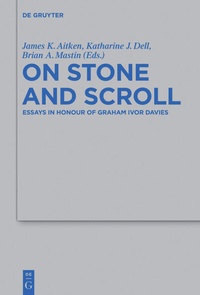
On Stone and Scroll
Description

The volume On Stone and Scroll addresses biblical exegesis from the historical, archaeological, theological, and linguistic perspectives, and discusses many of the issues central to the interpretation of the Bible. It is written by colleagues and former students of Graham Davies in his honour on his retirement. It covers three main areas central to his work: inscriptional and archaeological, including socio-historical, studies; theological and exegetical studies, especially of Exodus and the Prophets; and semantic studies. A lasting focus of Graham's work has been the combination of sources that he has utilised in the interpretation of the biblical text. His approach has been distinctive in biblical studies in his combining of archaeological, inscriptional, linguistic and theological evidence for a deeper understanding of text. His work has ranged from archaeological studies, through an edition of Hebrew inscriptions, contributions to Hebrew semantics and biblical theology, to exegesis of the Pentateuch and Prophets. The essays in this volume reflect that broad view of Old Testament study.
More details
Other editions
Additional editions
Persons
Content
2 - Table of Contents [Seite 10]
3 - List of Contributors [Seite 14]
4 - Table of Abbreviations [Seite 18]
5 - Biographical Note: Graham Ivor Davies [Seite 30]
6 - Publications of Graham Ivor Davies [Seite 32]
7 - The Contribution by Graham Davies to Old Testament Studies [Seite 40]
8 - Part I: Archaeology [Seite 50]
8.1 - Treasures of Merenptah in the Karnak Temple at Luxor: The Record of the Walls of the Cour de la Cachette [Seite 52]
8.2 - Prophetic Speech in the Egyptian Royal Cult [Seite 68]
8.3 - The Palestinian Campaign of Pharaoh Shishak [Seite 84]
8.4 - Who Built and Who Used the Buildings at Kuntillet 'Ajrud? [Seite 98]
8.5 - The Phoenician Inscriptions from Arslan Tash and Some. Old Testament Texts (Exodus 12 [Seite 116]
8.6 - A Literal Analysis of the Shiloah (Siloam) Tunnel Inscription [Seite 130]
8.7 - Incense-the Ancient Room Freshener: The Exegesis of Daniel 2:46 [Seite 140]
8.8 - Between Scroll and Codex? Reconsidering the Qumran Opisthographs [Seite 152]
8.9 - Liberty in the Coin Legends of the Jewish Revolts [Seite 168]
8.10 - "... wie es eigentlich gewesen": Historical "Facts" and the Reconstruction of the History of "Ancient Israel" [Seite 182]
8.11 - The "Way of the Wilderness" on Sixteenth-Century Maps [Seite 198]
9 - Part II: Biblical Texts [Seite 222]
9.1 - "Couch" or "Crouch"? Genesis 4:7 and the Temptation of Cain [Seite 224]
9.2 - The Flood and the Ten Antediluvian Figures in Berossus and in the Priestly Source in Genesis [Seite 240]
9.3 - "P" as Editor: The Case of Exodus 4:18-26 [Seite 254]
9.4 - "Kingdom of Priests": What is Priestly in Exodus 19:6? [Seite 268]
9.5 - The Fifth Commandment in Context [Seite 282]
9.6 - Deuteronomy and the Babylonian Diaspora [Seite 298]
9.7 - The Dead Sea Scrolls and the Date of the Final Stage of the Pentateuch [Seite 316]
9.8 - Reading Joshua after Samuel [Seite 334]
9.9 - Why Did Jael Kill Sisera? A Canonical Perspective [Seite 346]
9.10 - By Stone and Sling: 1 Samuel 17:50 and the Problem of Misreading David's Victory over Goliath [Seite 358]
9.11 - Why does the Deuteronomistic History Make no Mention of the Prophets to Whom Books are Attributed? [Seite 372]
9.12 - The Practicalities of Prophetic Writing in Isaiah 8:1 [Seite 386]
9.13 - "And he shall hear a rumour ..." (Isaiah 37:7 [Seite 400]
9.14 - About Third Isaiah [Seite 404]
9.15 - Penitential Innovations within the Twelve [Seite 420]
9.16 - Hosea, Creation, and Wisdom: An Alternative Tradition [Seite 438]
9.17 - Acrostics and Lamentations [Seite 454]
9.18 - "Slaves" in Biblical Narrative and in Translation [Seite 470]
9.19 - The Repentance of God [Seite 482]
10 - Part III: Language and Literacy [Seite 492]
10.1 - Literacy, Orality, and Literature in Israel [Seite 494]
10.2 - Light on .. [Seite 508]
10.3 - The Operation of a Syntactic Rule in Classical Biblical Hebrew and in Hebrew Inscriptions of the Monarchic Period [Seite 522]
10.4 - The Significance of Rhetoric in the Greek Pentateuch [Seite 536]
10.5 - Midrash in Greek? An Exploration of the Versions of Aquila and Symmachus in Exodus [Seite 552]
10.6 - LXX Exodus 23 and the Figure of the High Priest [Seite 566]
10.7 - Robert Hatch Kennett (1864-1932): The Old Testament in a Time of Transition [Seite 580]
11 - Index of Modern Authors [Seite 594]
