

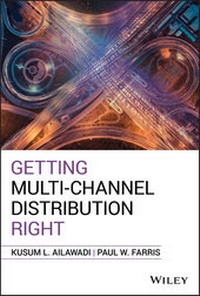
Getting Multi-Channel Distribution Right
Description

Focusing on the challenges of managing multiple channels of distribution in an evolving marketplace--rather than the process of designing a distribution channel from scratch--it leans more heavily on metrics and tools and incorporates perspectives from academic research, as well as in-depth case studies from marketing and general management practice.
* Introduces an organizing framework of pull and push marketing for how suppliers work together with their channel partners.
* Integrates across physical and digital, independent and company-owned, routes to market.
* Maps the functions of traditional and newer intermediaries in the channel ecosystem and identifies the root causes of conflict between them.
* Provides tools and frameworks for how much distribution coverage is required and where.
* Shows how product line, pricing, trade promotions, and other channel incentives can help to coordinate multiple channels and manage conflict.
* Illustrates how push and pull metrics can be combined into valuable dashboards for identifying positive feedback opportunities and sustaining the channel partnership.
With the help of Getting Multi-Channel Distribution Right you'll discover how to successfully develop, execute, and adapt distribution strategy to the evolving marketplace.
More details
Other editions
Additional editions
Persons
KUSUM L. AILAWADI is Charles Jordan Professor of Marketing at the Tuck School of Business at Dartmouth. Her research focuses on the interaction, distribution of power, and performance of manufacturers and their distribution channel partners. She has published extensively in the top marketing journals, and several of her articles have been honored for best contributions to marketing theory, practice, and academic-practitioner collaboration, and for long-term impact. She is an Associate Editor for the Journal of Marketing, Journal of Marketing Research, and Marketing Science. She is also an Academic Trustee of the Marketing Science Institute and President-Elect of the INFORMS Society for Marketing Science.
PAUL W. FARRIS is Emeritus Landmark Professor of Marketing at the Darden School of Business, University of Virginia. Over his career he has worked in marketing for UNILEVER and was a director on boards for six companies including retailers, manufacturers, and distributors. He has consulted for Apple, Best Buy, Google, Kroger, and Procter & Gamble among other companies. His authored or co-authored books and articles include award-winning research on distribution channels, marketing metrics, retail power, marketing strategy, and budgeting. He has served on several editorial boards for marketing journals and as an Academic Trustee of the Marketing Science Institute.
Content
About the Authors xxi
Acknowledgments xxiii
Preface xxv
Chapter 1 Distribution Channels Today 1
1.1 Introduction 1
1.2 What is New: Radical Changes in the Navigation of Distribution Channels 4
1.2.1 Changing Business Models 5
1.2.2 Omni-Channel Retailing 6
1.2.3 Data 7
1.2.4 Regulation 9
1.3 The Road Ahead 10
Part I The Bedrock of Channel Functions, Power, and Conflict 13
Chapter 2 Push, Pull, and Total Channel Performance 15
2.1 Introduction 15
2.2 An Organizing Framework Illustrated with Natura's Distribution Channel 16
2.2.1 Push 16
2.2.2 Pull 17
2.2.3 Supplier Inputs, Downstream Effects, and Channel Performance 17
2.3 Push-Pull Inputs and Downstream Effects in PepsiCo's Channel 20
2.4 Push and Pull for Services and Digital Channels 21
2.5 Beneficial and Harmful Feedback Loops in the Push-Pull System 23
2.6 Conclusion 26
Chapter 3 Root Causes of Channel Conflict 29
3.1 Introduction 29
3.1.1 Examples of Channel Conflict 31
3.1.2 Myopia and Four Root Causes of Conflict that Strain the Partnership 32
3.2 Uncoordinated Pricing and Selling Effort 33
3.2.1 Double, Triple, and Quadruple Marginalization 33
3.2.2 Loss Leaders Have Their Own Problems 37
3.3 Over- and Under-Distribution 40
3.3.1 Under-Distribution 40
3.3.2 Over-Distribution 42
3.3.3 Competing with Your Customers 44
3.3.4 Unauthorized Distribution 45
3.4 Division of Work and Pay: Who Sold That? 46
3.4.1 The Case of Leather Italia: Functions Performed and Margin Earned 46
3.4.2 Free Riding on Showrooms, Webrooms, and Billboards 49
3.5 Adapting to Change: Where Does the Future Lie? 51
3.6 Conclusion 52
Chapter 4 Middlemen in Today's Channel Ecosystem and Their Functions 57
4.1 Introduction 57
4.2 Brick-and-Mortar Intermediaries 60
4.3 New Digital Intermediaries 64
4.4 Support Service Providers 67
4.5 What's Different about Today's Channel Functions 69
4.5.1 The Critical Nature of Delivery and Returns 69
4.5.2 Increasingly Targeted Selling and Peer Persuasion 71
4.5.3 Location Means More, Not Less 72
4.5.4 Agglomeration is Alive and Well 74
4.6 Conclusion 74
Chapter 5 The Sources and Indicators of Power in the Channel 79
5.1 Introduction 79
5.2 Power in the Channel and Its Sources 81
5.2.1 How Social Psychologists and Economists Think about Power 81
5.2.2 Sources of Power in the Distribution Channel 83
5.3 Consumer Search Loyalty: The Ultimate Source of Power 85
5.3.1 Loyalty to the Brand or to the Channel? 86
5.3.2 Search Loyalty: Hard to Get, Harder to Measure in the Physical World 87
5.3.3 Fake It Till You Make It? 89
5.3.4 is Loyalty a Dinosaur in the Digital World? 89
5.4 Economic Indicators of Power 91
5.4.1 Monopoly Power: The Lerner Index and Price Elasticity 91
5.4.2 Manufacturer versus Retailer Price Elasticity and How It Can Distort Power Assessment 93
5.4.3 Profitability as a Sign of Power 94
5.5 Conclusion 96
Chapter 6 Using Power Without Using It Up 99
6.1 Introduction 99
6.2 Applying Power in Channel Relationships 100
6.3 Investments and Safeguards: Efficient Partnership or Power Struggle? 103
6.3.1 Make Partner-Specific Investments with Open Eyes 103
6.3.2 Safeguards Protect Each Party's Interests 104
6.3.3 Safeguards Can Outlive Their Usefulness 105
6.3.4 How Automobile Dealer Safeguards Came to Be 106
6.4 The Challenge of Preserving Power 107
6.4.1 Using Up Power: The "Objectification" of Leather Italia USA 108
6.4.2 Pushing Power Too Far or Giving It Up: Retailers and Their Private Labels 110
6.4.3 Should National Brand Manufacturers Produce Private Labels? 111
6.5 Vertical Restraints: Welfare Enhancing or Anticompetitive? 112
6.6 Conclusion 116
Part II Metrics, Tools, and Frameworks for Getting the Right Distribution 121
Chapter 7 Metrics for Intensity and Depth of Distribution Coverage 123
7.1 Introduction 123
7.2 A Framework for Measuring Distribution and Matching It to Demand 124
7.3 Measuring Stocking Outlet Findability: Metrics for Intensity of Distribution Coverage 127
7.3.1 Importance of Outlets Can Be Measured by Their ACV, PCV, and GMV 128
7.3.2 Traffic and Search are Important, Perhaps Even More Than Sales Volume 131
7.3.3 Online or Offline, Stocking Outlets Have to Be Findable 133
7.3.4 The Double-Edged Sword of Increasing Importance of a Channel Member 136
7.3.5 Integrate Metrics Across Offline and Online Channels 137
7.4 Metrics for Distribution Depth 138
7.4.1 Total Distribution Provides More Information Than Brand Distribution 139
7.4.2 Aggregate Other Depth Metrics Only Across Stocking Outlets 140
7.4.3 Getting the Data to Monitor These Metrics 141
7.5 Conclusion 142
Appendix: An Example to Calculate Basic Distribution Metrics 143
Chapter 8 What are You Managing Towards? 147
8.1 Introduction 147
8.2 A Hierarchy of Performance Metrics 149
8.2.1 Compliance Metrics Can Catch Problems Early 150
8.2.2 Cross- and Omni-Channel Metrics are Increasing in Importance 152
8.2.3 Both Parties Care about Sales, Share, and Sales Velocity but in Slightly Different Forms 154
8.2.4 Gross and Net Margins, Category, and Customer Profitability 156
8.3 Conclusion 160
Chapter 9 The Challenge of Optimizing Distribution Breadth 163
9.1 Introduction 163
9.2 Classic Categorizations of Products and Distribution Coverage 165
9.3 Consumer Search Loyalty and Distribution Elasticity 167
9.3.1 How Consumer Search Loyalty Reduces Distribution Elasticity 169
9.3.2 Empirical Evidence of Distribution 170
9.3.3 Feedback Effects and Longer-Term Distribution Elasticity 172
9.4 The Difficulties of Optimizing Distribution Coverage 172
9.4.1 The Complexity of Distribution Costs 173
9.4.2 Discontinuities Arising from Retail Structure 175
9.4.3 Distribution is Not under the Complete Control of the Supplier 175
9.5 Conclusion 176
Chapter 10 Using Velocity Graphs to Guide Sustainable Distribution Coverage 179
10.1 Introduction 179
10.2 The Concept of a Velocity Graph 180
10.2.1 Sustainable Positions Likely Lie Close to the Velocity Graph 181
10.2.2 Special Logistics Can Allow a Brand to Persist "Off" the Graph 182
10.2.3 Three Main Variants of Velocity Graphs 182
10.3 Insights from Velocity Graphs: An Illustration with Laundry Detergents 183
10.3.1 Brand Distribution Velocity Graphs 183
10.3.2 Total Distribution Velocity Graphs 186
10.4 Velocity Graphs, State Franchise Laws, and Overdistribution of U.S. Auto Makers 188
Chapter 11 Augmenting the Distribution Mix: Digital Channels and Own Bricks and Clicks 193
11.1 Introduction 193
11.2 A Variety of Own-Stores to Augment Distribution by Independent Resellers 194
11.2.1 Store-Within-a-Store to Improve Distribution Depth 194
11.2.2 Flagship Stores and Outlets Stores are at Two Extremes of the Branding Spectrum 196
11.2.3 Look Before You Leap with Regular Physical and Web Stores 198
11.2.4 Showrooms are a Little Like Flagship Stores 200
11.3 The Inevitability and Challenge of Online Distribution 201
11.3.1 Whether to Be Online is No Longer Debatable 201
11.3.2 Coverage Versus Control is a Steeper Trade-off Online 202
11.3.3 How Viable is the Online Channel's Revenue and Profit Model? 205
11.4 Be Clear about "Why" to Decide "How" to Distribute Online 205
11.4.1 Which Segments are You Trying to Reach and Why Do They Go Online? 206
11.4.2 Own Website is Usually Not Enough and Omni-Channel Retailers Will Expect to Sell Online 208
11.4.3 Think Hard About the Functions That Pure Play Web Intermediaries Perform 209
11.4.4 Whether and How to Do Business with Tech Behemoths is a Strategic Question All Its Own 209
Chapter 12 Is Three Cases on Online Distribution 215
12.1 Introduction 215
12.2 The Saga of Brooks Running and Amazon.com 215
12.2.1 What Do Segments of Runners Search for Online and Where? 216
12.2.2 Coverage without Sacrificing Control 218
12.3 Aggregation: Work Worth the Pay in the Online Travel Channel? 220
12.3.1 Why Online Travel Intermediaries Thrive 221
12.3.2 Power from Consolidation and Pull Marketing 223
12.3.3 Limits to Power from Regulation and Competition 224
12.3.4 What is Sustainable? 228
12.4 Building a Viable Revenue Model Online: News, Music, and TV 229
12.4.1 Online Erosion of a Two-Sided Platform's Business Model 230
12.4.2 Music and Pay-TV Tread More Carefully 231
12.5 Conclusion 235
Part III Aligning the Marketing Mix to Manage Distribution 239
Chapter 13 Using the Product Line to Manage Multiple Channels 241
13.1 Introduction 241
13.2 Channel-Motivated Expansion of SKUs, Brands, and Categories 243
13.3 Portfolios of SKUs for a Portfolio of Channels 245
13.3.1 Product Line Length is Tied to Marketing and Distribution Structure 245
13.3.2 Product Line Guidance from Total Distribution and SKU Distribution Velocity Graphs 246
13.3.3 Use the Opportunity to Be a "Category Captain" Judiciously 248
13.3.4 Be Clear About Why and How SKUs are Aligned with Channels 250
13.4 Portfolios of Brands to Protect Equity and Mitigate Channel Conflict 252
13.4.1 Get Clarity on Your Brand Portfolio Strategy and Brand Architecture 252
13.4.2 Real Differentiation is Harder than It Looks 254
13.5 Expanding to Support an Exclusive or Direct Channel 255
13.5.1 Enticing Consumers to the Direct Channel Requires Greater Scale and Scope 255
13.5.2 Sometimes It Makes Sense to Sacrifice Profits to Support the Channel 257
13.5.3 But Make Sure the Long Tail is Not Wagging the Strategy Dog 258
13.6 Cautions at All Three Levels of Product Line Expansion 259
13.6.1 Preempt, Monitor, and Control Unauthorized Distribution 259
13.6.2 Curation is More Important than Ever 260
13.7 Conclusion 261
Chapter 14 Harnessing the Power of Price and Price Promotions 267
14.1 Introduction 267
14.2 Why One "Everyday" Price to Resellers is Usually Not a Smart Idea 268
14.2.1 Variable Supplier Prices Can Alleviate Double Marginalization 268
14.2.2 Trade Promotions Fund Retail Promotions to Consumers 271
14.3 The Many Varieties of Trade Promotions 272
14.3.1 Trade Promotion Goals Evolve Over the Product Life Cycle 274
14.3.2 Pay-for-Performance Trade Promotions Tie Funding to Reseller Actions 275
14.4 The Challenge of Assessing the Costs and Profitability of Trade Promotions 276
14.4.1 What is the Cost of a Trade Promotion? 277
14.4.2 How Much of the Sales (and Profit) Bump is Incremental for Whom? 278
14.4.3 Additional Metrics for Key Value Items and Loss-Leaders 281
14.4.4 Baseline Sales Evolve Over Time 282
Appendix: Trade Promotion, Retail Price Discrimination, and Promotion "Cost": A Numerical Example 284
Chapter 15 Managing Prices and Incentives Across Channels 287
15.1 Introduction 287
15.2 The Goals and Challenges of Channel Incentives 288
15.2.1 Sales and Channel Management Goals 288
15.2.2 Challenges in Implementing Incentives 288
15.2.3 Conditioning Incentives on Reseller Efforts or Performance 291
15.3 How to Maintain Reseller Prices 293
15.3.1 Incentives to Keep Reseller Prices from Being Too Low 293
15.3.2 Control Inventory to Control Price 294
15.4 Decide Whether to Differentiate or Harmonize Across Multiple Channels 296
15.4.1 Different Products, Retail Prices, and RetailServices Across Channels 296
15.4.2 Harmonized Retail Prices Across Channels Can Reduce Showrooming 297
15.4.3 Minimum Advertised Price (MAP) Policies Can Help 298
15.4.4 Differential Incentives for Valuable Channels that Serve as Showrooms 299
15.4.5 Use Targeting to Reduce Channel Conflict 301
15.5 Challenges Even When You Control Retail Price Directly 303
15.5.1 Don't Erode Your Own Price to Get the Buy Box 304
15.5.2 Paywalls: When Information Wants to Be Free but Two-Sided Markets Fall Apart 305
15.6 Conclusion 307
Appendix: Excerpts from Mizuno's MAP Policy 309
Chapter 16 Summary: Dashboards and Principles for Managing New Directions in Distribution 313
16.1 Pulling (and Pushing) It all Together 313
16.1.1 An Expanded View of the Push-Pull System 314
16.1.2 A Note About Pull 316
16.1.3 What Does It Mean to Coordinate Pull and Push? 318
16.1.4 Measure, Match, and Manage to Nurture Beneficial Feedback Loops 320
16.2 Distribution Dashboards 321
16.2.1 A Simple Illustration of the Insight from Push-Pull Dashboards 322
16.2.2 A Distribution Dashboard for Pete and Gerry's Organic Eggs 323
16.2.3 A More Complicated Distribution Dashboard for Hotel Companies 326
16.3 The Magical Number Seven Plus or Minus Two Nuggets of Wisdom 330
16.3.1 Consumer Search Loyalty Bestows Power and Can Create Conflict 330
16.3.2 Prevent Power Outages: Power is Precious and It's Easy to Use It Up 331
16.3.3 Be the Expert on Where and Why Your Target Consumer Visits, (Re)Searches, and Buys 331
16.3.4 Form Should Follow Function with Channel Pay and Incentives 332
16.3.5 The Direct Approach Can Work, but You Really Have to Know What You're Doing 332
16.3.6 The Devil is in the Details, and So is the Profit 333
16.3.7 Avoid Future Shock by Planning and Managing the Rate of Change 333
16.4 Conclusion: Who Will Be the Masters of Multi-Channel Distribution? 334
Author Index 337
Subject Index 343
CHAPTER 1
Distribution Channels Today
1.1 INTRODUCTION
Marketers today must develop well-informed strategies for managing their distribution channels during times of significant change. Those strategies will include anticipating, minimizing, and addressing the channel conflict inevitably wrought by change. This book is about how firms can select metrics, design strategies, and implement policies that free them to adapt to the rapidly evolving landscape that combines physical and digital routes-to-market.
Our book is primarily intended for marketers and those who train them, but marketers aren't the only ones paying attention to channel dynamics. Economists, regulators, and social psychologists are also interested in how distribution channels affect competition, efficiency, and consumer welfare. They want to understand the marketing challenges of distribution channels, the causes and consequences of channel conflict, and the approaches to managing that conflict. So, while our writing is rooted in marketing, we also incorporate these other perspectives.
What is a distribution channel? By its simplest definition, it is the chain of distributors, retailers, and other intermediaries through which a supplier's product reaches end consumers, implying a unidirectional movement of goods along one route, from the point of production to the point of consumption.1 Even simple distribution channels are delicate systems, where suppliers and their independent resellers struggle to balance a cooperative partnership against a desire for a bigger share of the total profit available in the channel. The partners need to cooperate in ways that create value for consumers, appropriate some of that value in the form of profit for the channel, and share the profit in a way that sustains the partnership.
Modern, mainly digital, technology has complicated that partnership. These days, firms must employ a multitude of distribution channels-sometimes complementary, but almost always competing-in a way that satisfies consumers' needs for products, services, and information. What a unidirectional, one-route perspective can easily miss is the variety of interactions and conflicts among firms in the ecosystem, because each firm performs some functions and tries to appropriate some of the value created.
Conflict and power go together in any relationship between interdependent entities. The (mis)use of power can exacerbate conflict, but a channel member's power position also determines the strategies it can use to appropriate value and manage conflict. Accumulating channel power and exercising it wisely is a key to surviving and prospering in periods of change. In the words of Professor Raymond Corey of the Harvard Business School, marketers must learn "to use power without using it up."
The sources of power, and the ways to exercise it, have been complicated by recent technological, market, and legal developments. Distribution practices that were developed and refined over years have become vulnerable. Some challenges are easy to recognize (should digital books be priced the same as paper copies in book stores?) and others are more nuanced (how does resale price maintenance affect trade promotions?). Some are fundamentally new and require different thinking (how can we measure and manage distribution coverage online or assess the power of a channel member that operates a multisided platform?), while others are simply different manifestations of enduring channel issues (double marginalization, free riding, and the tug between intra- and inter-brand competition). Throughout the book, we try to distinguish what is new from what is not. The former needs fresh thinking and emerging solutions. The latter has a history with important lessons that marketers ignore at their peril.
Technology has also blurred the distinction between distribution channels and communication channels, especially since some of the new digital distribution channels mainly satisfy consumers' need for information rather than directly sell the products and services (consider Trip Advisor and Trivago for hotels, for example). A purely consumer-centric view might suggest that any sources of products or information that the consumer seeks out or is exposed to would qualify as "channels." By that definition, search engines, blogs, and social media would be "channels."
The consumer is certainly at the center of it all, but our perspective in this book is firmly rooted in firms that sell through independent distribution channels. Our view is that, for an entity to be viewed as a distribution channel, it must perform, and be paid for, at least some of the functions involved in the sale of a particular product along the route to market from a clear upstream supplier to a clear downstream reseller or end customer. So, DoubleClick is a distribution channel for firms that sell advertising, but it is not a distribution channel for the product being advertised. A wine brand's sales may be affected by what an influential wine blog writes about it, but the blog is not a distribution channel. Drawing this line between distribution and communication channels is useful to guide the strategies of marketers and it delineates the scope of the issues we tackle in this book. Of course, it is not a bright line and one can easily see how it might blur. For example, what if the blog has a link to the wine brand's site and gets paid to route demand to the wine marketer? Such an "affiliate" arrangement would make the blog a distribution partner.
Most frequently, we take the perspective of suppliers selling through independent resellers (distributors, retailers, aggregators, marketplaces, and other middlemen), but this requires analyzing the viewpoints of the middlemen too. Other disciplines, notably operations and strategy, refer to these middlemen as members of a "supply chain" or "value chain." So, what's the difference between supply chains, value chains, and distribution channels?
Our view is that the distinction is largely in perspective and emphasis. The terms "upstream" and "downstream" are used to describe those firms that are closer to the production versus the consumption "end" of the channel, and we will do that too. This kind of thinking can subconsciously imbue the upstream firm with more responsibility, power, or authority. Our counterparts in manufacturing and operations take the perspective of a "downstream" firm-often a manufacturer looking backwards at its raw material and component suppliers.
Those in the strategy and economics domains refer to the "value chain" as the entire collection of firms and activities in producing and delivering a product or service with an emphasis on the "value added" (not too far from margins) at each stage. Value chains therefore include a firm's backward supply chain and forward distribution channels in addition to its own value-adding operations. Where relevant, we adopt some approaches from these other disciplines to enrich our understanding of how channels work and how they can become more efficient.
1.2 WHAT IS NEW: RADICAL CHANGES IN THE NAVIGATION OF DISTRIBUTION CHANNELS
The sustainability of channel partnerships is a goal that businesses value highly. Pricing, marketing communications, and even products are quite often easier to change than distribution-channel relationships. Frequently, businesses are built around serving end-consumer markets through a specific set of immediate customer-distribution channels. For example, automobile manufacturers have learned to market through their dealers, major soft drink manufacturers Coke and PepsiCo through their bottling networks, and Avon and Natura through their independent consultants. Learning to serve these channel customers along with end consumers is a critical competency. Channel affiliations are also often personal relationships, even friendships, that go well beyond golf games once a year. That's why a channel partnership is not often severed, and only happens after some serious soul searching (or its commercial equivalent).
Often, growth necessitates expanding into new channel relationships while maintaining existing ones. Retailers add more suppliers and categories while also opening more stores and expanding into new markets. Manufacturers add more retailers, expanding to service new geographic markets. They also add new types of retail formats that service additional market segments. Although these types of expansions are sure to bring "growing pains," businesses today are encountering challenges far beyond normal growing pains. That is why, even though channel management is a well-worn topic in marketing, we believe it is worth a new look now.
We see four general areas of change in the economy that call for a renewed study of the management of multiple routes-to-market. To some degree, all four areas have been affected by digital technologies.
1.2.1 Changing Business Models
The first set of changes relates to new business models for distribution that derive from technology. Firms based on these new business models are inserting themselves into traditional routes-to-market, bringing corresponding opportunities for suppliers to gain or lose strategic advantage by managing or mismanaging their distribution channels.
When products are digitized, the marginal costs of manufacturing and distribution may approach zero though the fixed costs remain high, making pricing challenging....
