

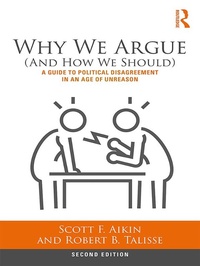
Why We Argue (And How We Should)
A Guide to Political Disagreement in an Age of Unreason
2nd Edition
Published on 3. September 2018
242 pages
978-1-351-61623-2 (ISBN)
Description

Why We Argue (And How We Should): A Guide to Political Disagreement in an Age of Unreason presents an accessible and engaging introduction to the theory of argument, with special emphasis on the way argument works in public political debate. The authors develop a view according to which proper argument is necessary for one's individual cognitive health; this insight is then expanded to the collective health of one's society. Proper argumentation, then, is seen to play a central role in a well-functioning democracy.
Written in a lively style and filled with examples drawn from the real world of contemporary politics, and questions following each chapter to encourage discussion, Why We Argue (And How We Should) reads like a guide for the participation in, and maintenance of, modern democracy. An excellent student resource for courses in critical thinking, political philosophy, and related fields, Why We Argue (And How We Should) is an important contribution to reasoned debate.
What's New in the Second Edition:
Updated examples throughout the book, including examples from the 2016 U.S. election and first years of the Trump presidency;
Expanded coverage of dialectical fallacies, including coverage of new types of fallacies and of sites where such fallacies thrive (e.g., cable news, social media);
Revised For Further Thought questions and definitions of Key Terms, included at the end of each chapter;
The addition of five new chapters:
Deep Disagreement
Argument by Analogy
Argument between the Ads
The Owl of Minerva (or weaponizing metalanguage)
Argumentative Responsibility and Repair.
Written in a lively style and filled with examples drawn from the real world of contemporary politics, and questions following each chapter to encourage discussion, Why We Argue (And How We Should) reads like a guide for the participation in, and maintenance of, modern democracy. An excellent student resource for courses in critical thinking, political philosophy, and related fields, Why We Argue (And How We Should) is an important contribution to reasoned debate.
What's New in the Second Edition:
Updated examples throughout the book, including examples from the 2016 U.S. election and first years of the Trump presidency;
Expanded coverage of dialectical fallacies, including coverage of new types of fallacies and of sites where such fallacies thrive (e.g., cable news, social media);
Revised For Further Thought questions and definitions of Key Terms, included at the end of each chapter;
The addition of five new chapters:
Deep Disagreement
Argument by Analogy
Argument between the Ads
The Owl of Minerva (or weaponizing metalanguage)
Argumentative Responsibility and Repair.
Reviews / Votes
"Why We Argue, Second Edition is a timely and important book. The inability to have productive discussions on matters on which we deeply disagree poses a threat to our democracy, and it can affect our mental health as citizens as well. In their wide-ranging discussion, Aikin and Talisse characterize the nature of the challenges involved, and they make useful suggestions as to how we might go about addressing them. I highly recommend their book."-Sanford Goldberg, Northwestern University
"Why We Argue (and How We Should), Second Edition continues to provide a superb introduction to reasoned argumentation and an explanation of why it is the lifeblood of healthy democratic practice. This well-timed edition equips readers with additional tools for analyzing when democratic discourse is derailed. Those who would contribute to the revitalization of democratic practice by taking responsibility for their own deliberative obligations will find genial guides in Aikin and Talisse."
-Lawrence Torcello, Rochester Institute of Technology, USA
More details
Edition
2nd edition
Language
English
Place of publication
London
United Kingdom
Publishing group
Taylor & Francis Ltd
Target group
College/higher education
File size
1,74 MB
ISBN-13
978-1-351-61623-2 (9781351616232)
Copyright in bibliographic data and cover images is held by Nielsen Book Services Limited or by the publishers or by their respective licensors: all rights reserved.
Schweitzer Classification
Other editions
Additional editions
Scott Aikin | Robert Talisse
Why We Argue (And How We Should)
A Guide to Political Disagreement in an Age of Unreason
Book
08/2018
2nd Edition
Routledge
€61.60
Shipment within 10-20 days
Scott Aikin | Robert Talisse
Why We Argue (And How We Should)
A Guide to Political Disagreement in an Age of Unreason
Book
08/2018
2nd Edition
Routledge
€207.70
Shipment within 10-20 days
Persons
Scott F. Aikin is Assistant Professor of Philosophy at Vanderbilt University. His previous books include Evidentialism and the Will to Believe (2014) and Epistemology and the Regress Problem (Routledge 2011).
Robert B. Talisse is W. Alton Jones Professor of Philosophy and Professor of Political Science at Vanderbilt University. He is the author of five books, including Engaging Political Philosophy (Routledge 2016), Pluralism and Liberal Politics (Routledge 2011), and Democracy and Moral Conflict (2009).
Robert B. Talisse is W. Alton Jones Professor of Philosophy and Professor of Political Science at Vanderbilt University. He is the author of five books, including Engaging Political Philosophy (Routledge 2016), Pluralism and Liberal Politics (Routledge 2011), and Democracy and Moral Conflict (2009).
Content
Introduction Part I: A Conception of Argument 1. Why Do We Argue? 2. Why Argument Matters 3. Public Argument in a Democratic Society 4. Deep Disagreements Part II: Case Studies in Public Argument 5. The Simple Truth Thesis 6. Pushovers 7. Tone of Voice 8. The Surprising Truth about Hypocrisy 9. Arguments by Analogy 10. Argumentation Between the Ads 11. Language, Spin, and Framing 12. Argument Online Part III: Repairing Public Argument 13. The Owl of Minerva Problem 14. Argumentative Responsibility and Argument Repair 15. Civility in Argument Index
