

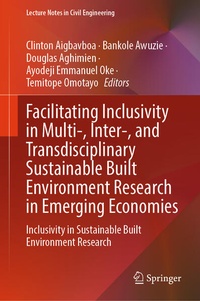
Facilitating Inclusivity in Multi-, Inter-, and Transdisciplinary Sustainable Built Environment Research in Emerging Economies
Description

This book gathers papers from the 1st Global Forum for Sustainable Built Environment Research Conference - SURE-Built 1. This year's event has theme "Facilitating Inclusivity in Multi-, Inter-, and Transdisciplinary Sustainable Built Environment Research in Emerging Economies" and was held virtually on the 4th-5th of September, 2025. The rationale behind the conference is rooted in inclusivity and aligned with a broader mission to promote sustainable development in line with global goals. This interdisciplinary focus encourages collaboration among architects, engineers, urban planners, environmental scientists, and policymakers, thus creating a comprehensive approach to tackling shared global challenges.
More details
Other editions
Additional editions
Persons
Prof. Clinton Aigbavboa is a Professor of Construction Industry Development and Sustainable Human Settlement with a PhD in Engineering Management. His expertise spans Construction 4.0, smart cities, sustainable human development, life cycle assessment, remanufacturing, low-income housing leadership, biomimicry, infrastructure development, engineering management, post-occupancy evaluation, green job creation, and AI applications in the built environment.
Prof. Bankole Awuzie is a Professor of Smart and Sustainable Built Environments at the University of Johannesburg, South Africa. He holds a PhD in Built Environment from the University of Salford, UK. His research focuses on sustainable, smart, and circular built environments, covering housing, construction project management, Construction 4.0/5.0, health and safety, productivity, procurement, circular economy, education for sustainable development, strategy implementation, and infrastructure delivery. He is a Y2-rated researcher by South Africa's NRF, co-editor-in-chief of the Applications of Circular Economy (ACE) journal, and associate editor for BEPAM and JCPMI . He also serves on editorial boards including Sustainable Development and Springer's Strategies for Sustainability series.
Dr. Douglas Aghimien holds a PhD in Engineering Management from the University of Johannesburg. He is a Fellow of the UK Higher Education Academy and a Member of the Chartered Institute of Building. A Y2-rated NRF researcher, his interests include construction management, digitalisation, and sustainability. He has authored four books and over 100 publications, contributing significantly to discussions on optimizing construction processes for a sustainable built environment.
Prof. Ayodeji Emmanuel Oke is an Associate Professor and Head of the Quantity Surveying Department at the Federal University of Technology Akure, Nigeria. He leads the Sustainable Infrastructure Management Plus (RG-SIM+) research group and is a DGNB International Consultant. His research covers sustainable development, value management, and digital construction. He received FUTA's Best Researcher award in 2023 and Best Lecturer in 2021. With over 500 publications, he ranks among the top 2% most-cited scientists globally in 2023 and 2024, according to Stanford University.
Dr. Temitope Omotayo is a Reader in Sustainable Construction and Digital Project Management and leads the Futures of Systems, People and Projects (FUSP) lab. He holds a PhD in Construction and Project Management from the University of Salford, UK. His research includes construction cost management, BIM, circular economy, smart campuses and cities, systems thinking, NLP, generative AI, and machine learning in built environment research. He has authored over 80 publications in these areas.
Content
Smart Wearable Devices for Construction Health and Safety: The Drivers and Barriers for its Adoption in a Developing Construction Industry.- Enhancing Human Thermal Comfort Prediction Models in Educational Buildings: An Artificial Intelligence (AI) Approach for Natural Ventilation Environments.- Assessing the Economic Viability of Integrating Green Building Technologies in Commercial Buildings in Nigeria.- Quantitative Assessment of the Barriers to Emerging AI Tools in the Rwandan Construction Industry.- Exploring the applicability of artificial intelligence for automated project planning and scheduling.- Achieving sustainable BIM process through artificial intelligence - driven multidisciplinary collaboration.- A Cheap-end BIM-GIS Integrated Approach to Proactive Fire Safety in Nigerian Public Buildings.- Institutional isomorphic determinants of smart contract adoption in public-private partnership projects .- Exploring the barriers and implementation strategies of Augmented Reality for construction labour productivity enhancement in Zimbabwe.- Sustainably Retrofitted Buildings: Drivers to Occupy.- Enhancing Energy Efficiency in Vertical Cities: Integrating Vertical Greening Systems in High-Rise Buildings in Kaduna, Nigeria.- Building Information Modelling for Construction Supply Chain Management in South Africa: Perceived Benefits.
