

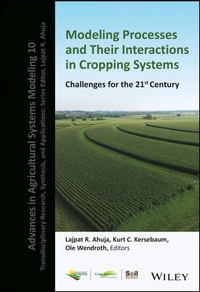
Modeling Processes and Their Interactions in Cropping Systems
Description

A complete discussion of soil-plant-climate-management processes
In Modeling Processes and Their Interactions in Cropping Systems: Challenges for the 21st Century, a team of distinguished researchers delivers a comprehensive and up-to-date scientific textbook devoted to teaching the modeling of soil-plant-climate-management processes at the upper undergraduate and graduate levels. The book emphasizes the new opportunities and paradigms available to modern lab and field researchers and aims to improve their understanding and quantification of individual processes and their interactions.
The book helps readers quantify field research results in terms of the fundamental theory and concepts broadly generalizable beyond specific sites, as well as predict experimental results from knowledge of the fundamental factors that determine the environment and plant growth in different climates. Readers will also discover:
* An introduction to water and chemical transport in the soil matrix and macropores
* Explorations of heat transport, water balance, snowpack, and soil freezing
* Discussions of merging machine learning with APSIM models to improve the evaluation of the impact of climate extremes on wheat yields in Australia
* Examinations of the quantification and modeling of management effects on soil properties, including discussions of tillage, reconsolidation, crop residues, and crop management
The book will be essential reading for anyone interested in the 2030 breakthroughs in agriculture identified by the National Academies of Sciences, Engineering, and Medicine.
More details
Other editions
Additional editions
Persons
Lajpat R. Ahuja, PhD, is the former Supervisory Research Soil Scientist and Research Leader at USDA-ARS, Agricultural Systems Research, Fort Collins, Colorado, USA.
Kurt C. Kersebaum, PhD, is Senior Scientist at Leibniz-Centre for Agricultural Landscape Research Müncheberg, Germany and honorary professor at Georg-August University, Göttingen, Germany.
Ole Wendroth, PhD, is Professor of Soil Physics at the University of Kentucky-College of Agricultural Food and Environment, Department of Plant and Soil Sciences, USA.
Content
Preface vii
1 Water and Chemical Transport in the Soil Matrix and Macropores 1
Lajpat R. Ahuja
2 Heat Transport, Water Balance, Snowpack and Soil Freezing 33
Gerald N. Flerchinger and Mark S. Seyfried
3 Evapotranspiration, Transpiration, and Evaporation Processes and Modeling in the Soil-Residue-Canopy System 53
Suat Irmak and Meetpal S. Kukal
4 Advances and Improvements in Modeling Water Fluxes in Vegetation Canopy and their Relation to Photosynthesis 115
Andree J. Tuzet, Dennis J. Timlin, and Alain Perrier
5 Soil Organic Matter and Carbon-Nitrogen Transformations 155
Marvin J. Shaffer and Lajpat R. Ahuja
6 Equilibrium Soil Chemistry Submodels 179
Donald L. Suarez and Todd H. Skaggs
7 Pesticide Dissipation and Fate in Agricultural Settings: A Review of Research, 2000-2020 203
R. Don Wauchope
8 Coupling Machine Learning with APSIM Model Improves the Evaluation of Climate Extremes Impact on Wheat Yield in Australia 251
Puyu Feng, Bin Wang, De Li Liu, Qiang Yu, and Kelin Hu
9 Simulating Maize Crop Processes in DSSAT: CSM-CERES-Maize vs. CSM-IXIM-Maize 277
Jon I. Lizaso, Vakhtang Shelia, and Gerrit Hoogenboom
10 Simulation of Climate Change Effects on Evapotranspiration, Photosynthesis, Crop Growth, and Yield Processes in Crop Models 291
Kurt C. Kersebaum and Claudio O. Stöckle
11 Quantifying and Modeling Management Effects on Soil Properties: Tillage, Reconsolidation, Crop Residues, and Crop Management 333
Lajpat R. Ahuja and Timothy R. Green
12 Integrating Models with Field Experiments to Enhance Research: Cover Crop, Manure, Tillage, and Climate Change Impacts on Crops in a Humid Region 359
Gary Feng and Saseendran S. Anapalli
Index 393
